

166 8 Magnetic Nanomaterials, Superparamagnetism
A Mößbauer spectrum shows either a doublet or a sextet of emission lines. (The
following explanation is a narrative image of a quite elaborate quantummechanical
theory; even when it is, in the sense of quantum mechanics incorrect, it gives
some insights to the processes.) The doublet is observed where there is no external
magnetic field acting on the iron nucleus. The doublet structure is caused by the
splitting of the energy levels into two levels in the gradient of the electrical field
(a quadrupole field) of the nucleus. An external magnetic field leads to a further
splitting of the energy levels of the ground and the excited state. In the case of an
additional external magnetic field, a sextet of emission lines is observed. The
number of emission lines is limited by the selection rules of quantum mechanics.
This explanation makes it clear that a magnetic material should be characterized
by a sextet in the Mößbauer spectrum.
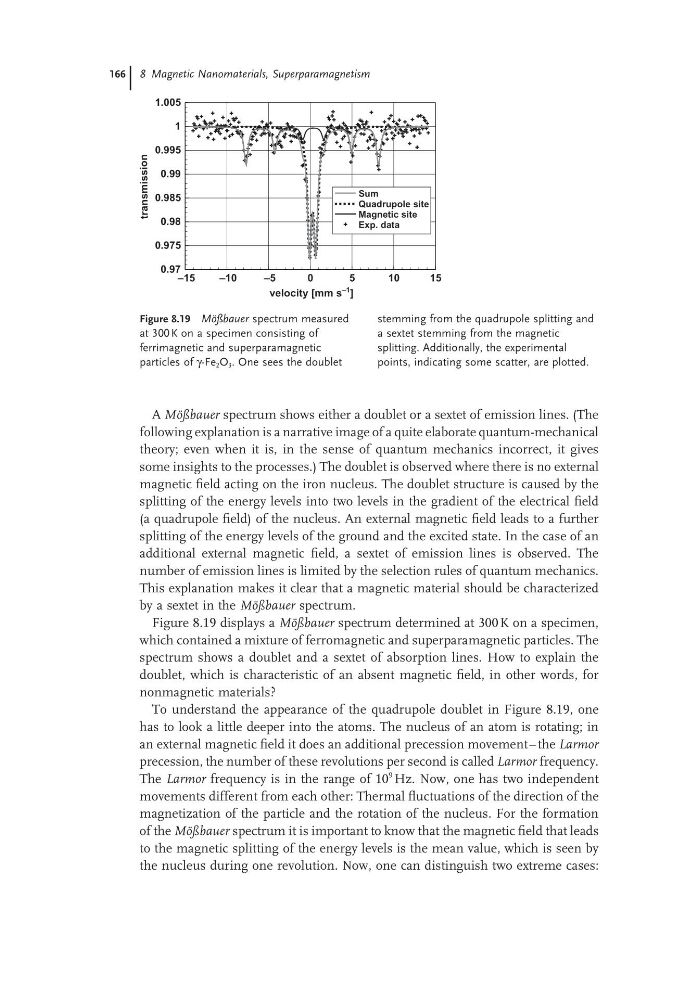
Figure 8.19 displays a Mößbauer spectrum determined at 300 K on a specimen,
which contained a mixture of ferromagnetic and superparamagnetic particles. The
spectrum shows a doublet and a sextet of absorption lines. How to explain the
doublet, which is characteristic of an absent magnetic field, in other words, for
nonmagnetic materials?
To understand the appearance of the quadrupole doublet in Figure 8.19, one
has to look a little deeper into the atoms. The nucleus of an atom is rotating; in
an external magnetic field it does an additional precession movement – the Larmor
precession, the number of these revolutions per second is called Larmor frequency.
The Larmor frequency is in the range of 10
9 Hz. Now, one has two independent
movements different from each other: Thermal fluctuations of the direction of the
magnetization of the particle and the rotation of the nucleus. For the formation
of the Mößbauer spectrum it is important to know that the magnetic field that leads
to the magnetic splitting of the energy levels is the mean value, which is seen by
the nucleus during one revolution. Now, one can distinguish two extreme cases:
Figure 8.19 Mößbauer spectrum measured
at 300 K on a specimen consisting of
ferrimagnetic and superparamagnetic
particles of γ-Fe 2 O 3 . One sees the doublet
stemming from the quadrupole splitting and
a sextet stemming from the magnetic
splitting. Additionally, the experimental
points, indicating some scatter, are plotted.
–15
–10
–5
0
5
10
15
velocity [mm s
–1
]
0.97
0.975
0.98
0.985
0.99
0.995
1
1.005
transmission
Sum
Quadrupole site
Magnetic site
Exp. data
A Mößbauer spectrum shows either a doublet or a sextet of emission lines. (The
following explanation is a narrative image of a quite elaborate quantummechanical
theory; even when it is, in the sense of quantum mechanics incorrect, it gives
some insights to the processes.) The doublet is observed where there is no external
magnetic field acting on the iron nucleus. The doublet structure is caused by the
splitting of the energy levels into two levels in the gradient of the electrical field
(a quadrupole field) of the nucleus. An external magnetic field leads to a further
splitting of the energy levels of the ground and the excited state. In the case of an
additional external magnetic field, a sextet of emission lines is observed. The
number of emission lines is limited by the selection rules of quantum mechanics.
This explanation makes it clear that a magnetic material should be characterized
by a sextet in the Mößbauer spectrum.
Figure 8.19 displays a Mößbauer spectrum determined at 300 K on a specimen,
which contained a mixture of ferromagnetic and superparamagnetic particles. The
spectrum shows a doublet and a sextet of absorption lines. How to explain the
doublet, which is characteristic of an absent magnetic field, in other words, for
nonmagnetic materials?
To understand the appearance of the quadrupole doublet in Figure 8.19, one
has to look a little deeper into the atoms. The nucleus of an atom is rotating; in
an external magnetic field it does an additional precession movement – the Larmor
precession, the number of these revolutions per second is called Larmor frequency.
The Larmor frequency is in the range of 10
9 Hz. Now, one has two independent
movements different from each other: Thermal fluctuations of the direction of the
magnetization of the particle and the rotation of the nucleus. For the formation
of the Mößbauer spectrum it is important to know that the magnetic field that leads
to the magnetic splitting of the energy levels is the mean value, which is seen by
the nucleus during one revolution. Now, one can distinguish two extreme cases:
Figure 8.19 Mößbauer spectrum measured
at 300 K on a specimen consisting of
ferrimagnetic and superparamagnetic
particles of γ-Fe 2 O 3 . One sees the doublet
stemming from the quadrupole splitting and
a sextet stemming from the magnetic
splitting. Additionally, the experimental
points, indicating some scatter, are plotted.
–15
–10
–5
0
5
10
15
velocity [mm s
–1
]
0.97
0.975
0.98
0.985
0.99
0.995
1
1.005
transmission
Sum
Quadrupole site
Magnetic site
Exp. data