

150 8 Magnetic Nanomaterials, Superparamagnetism
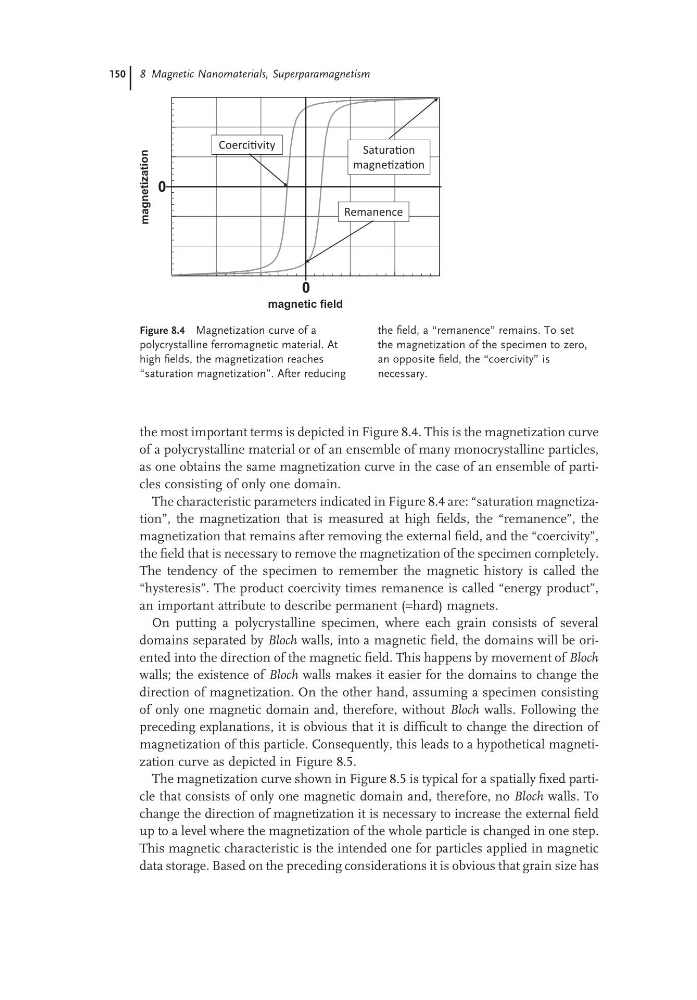
the most important terms is depicted in Figure 8.4. This is the magnetization curve
of a polycrystalline material or of an ensemble of many monocrystalline particles,
as one obtains the same magnetization curve in the case of an ensemble of particles consisting of only one domain.
The characteristic parameters indicated in Figure 8.4 are: “saturation magnetization”, the magnetization that is measured at high fields, the “remanence”, the
magnetization that remains after removing the external field, and the “coercivity”,
the field that is necessary to remove the magnetization of the specimen completely.
The tendency of the specimen to remember the magnetic history is called the
“hysteresis”. The product coercivity times remanence is called “energy product”,
an important attribute to describe permanent (=hard) magnets.
On putting a polycrystalline specimen, where each grain consists of several
domains separated by Bloch walls, into a magnetic field, the domains will be oriented into the direction of the magnetic field. This happens by movement of Bloch
walls; the existence of Bloch walls makes it easier for the domains to change the
direction of magnetization. On the other hand, assuming a specimen consisting
of only one magnetic domain and, therefore, without Bloch walls. Following the
preceding explanations, it is obvious that it is difficult to change the direction of
magnetization of this particle. Consequently, this leads to a hypothetical magnetization curve as depicted in Figure 8.5.
The magnetization curve shown in Figure 8.5 is typical for a spatially fixed particle that consists of only one magnetic domain and, therefore, no Bloch walls. To
change the direction of magnetization it is necessary to increase the external field
up to a level where the magnetization of the whole particle is changed in one step.
This magnetic characteristic is the intended one for particles applied in magnetic
data storage. Based on the preceding considerations it is obvious that grain size has
Figure 8.4 Magnetization curve of a
polycrystalline ferromagnetic material. At
high fields, the magnetization reaches
“saturation magnetization”. After reducing
the field, a “remanence” remains. To set
the magnetization of the specimen to zero,
an opposite field, the “coercivity” is
necessary.
-60
-40
-20
0
20
40
60
magnetic field
-3
-2
-1
0
1
2
3
magnetization
0
0
CoerciƟvity
Remanence
SaturaƟon
magneƟzaƟon
the most important terms is depicted in Figure 8.4. This is the magnetization curve
of a polycrystalline material or of an ensemble of many monocrystalline particles,
as one obtains the same magnetization curve in the case of an ensemble of particles consisting of only one domain.
The characteristic parameters indicated in Figure 8.4 are: “saturation magnetization”, the magnetization that is measured at high fields, the “remanence”, the
magnetization that remains after removing the external field, and the “coercivity”,
the field that is necessary to remove the magnetization of the specimen completely.
The tendency of the specimen to remember the magnetic history is called the
“hysteresis”. The product coercivity times remanence is called “energy product”,
an important attribute to describe permanent (=hard) magnets.
On putting a polycrystalline specimen, where each grain consists of several
domains separated by Bloch walls, into a magnetic field, the domains will be oriented into the direction of the magnetic field. This happens by movement of Bloch
walls; the existence of Bloch walls makes it easier for the domains to change the
direction of magnetization. On the other hand, assuming a specimen consisting
of only one magnetic domain and, therefore, without Bloch walls. Following the
preceding explanations, it is obvious that it is difficult to change the direction of
magnetization of this particle. Consequently, this leads to a hypothetical magnetization curve as depicted in Figure 8.5.
The magnetization curve shown in Figure 8.5 is typical for a spatially fixed particle that consists of only one magnetic domain and, therefore, no Bloch walls. To
change the direction of magnetization it is necessary to increase the external field
up to a level where the magnetization of the whole particle is changed in one step.
This magnetic characteristic is the intended one for particles applied in magnetic
data storage. Based on the preceding considerations it is obvious that grain size has
Figure 8.4 Magnetization curve of a
polycrystalline ferromagnetic material. At
high fields, the magnetization reaches
“saturation magnetization”. After reducing
the field, a “remanence” remains. To set
the magnetization of the specimen to zero,
an opposite field, the “coercivity” is
necessary.
-60
-40
-20
0
20
40
60
magnetic field
-3
-2
-1
0
1
2
3
magnetization
0
0
CoerciƟvity
Remanence
SaturaƟon
magneƟzaƟon