

148 8 Magnetic Nanomaterials, Superparamagnetism
As mentioned above, magnetic ordering leads to parallel or antiparallel ordering
of the elementary dipoles. Antiparallel ordering is observed in metals, for example,
chromium and manganese, and many oxides. The overall magnetic moment of
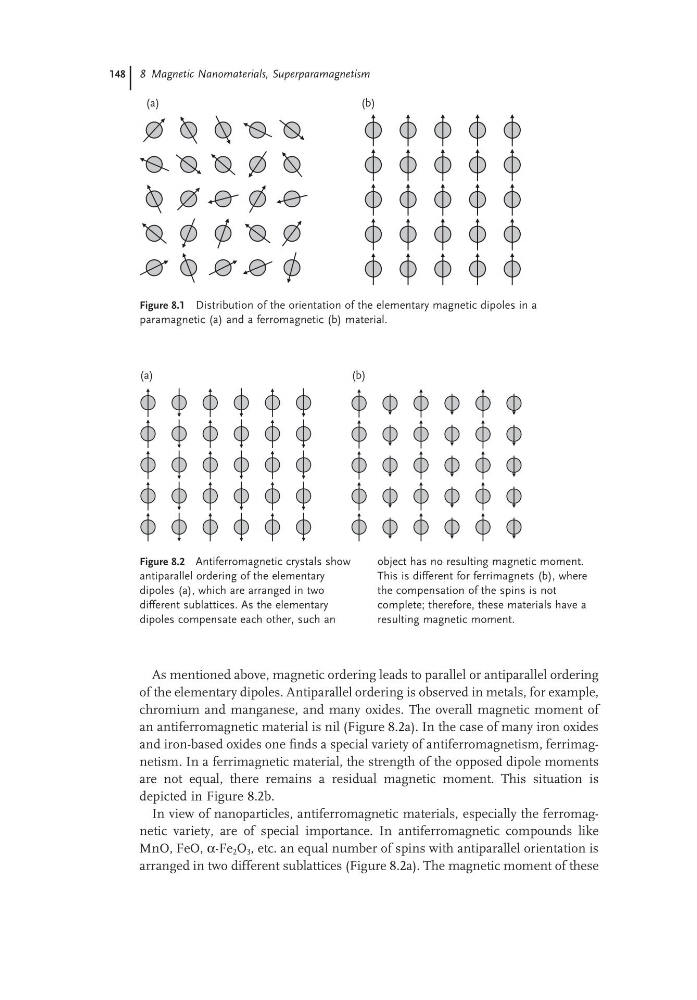
an antiferromagnetic material is nil (Figure 8.2a). In the case of many iron oxides
and ironbased oxides one finds a special variety of antiferromagnetism, ferrimagnetism. In a ferrimagnetic material, the strength of the opposed dipole moments
are not equal, there remains a residual magnetic moment. This situation is
depicted in Figure 8.2b.
In view of nanoparticles, antiferromagnetic materials, especially the ferromagnetic variety, are of special importance. In antiferromagnetic compounds like
MnO, FeO, αFe 2 O 3 , etc. an equal number of spins with antiparallel orientation is
arranged in two different sublattices (Figure 8.2a). The magnetic moment of these
Figure 8.1 Distribution of the orientation of the elementary magnetic dipoles in a
paramagnetic (a) and a ferromagnetic (b) material.
(a)
(b)
Figure 8.2 Antiferromagnetic crystals show
antiparallel ordering of the elementary
dipoles (a), which are arranged in two
different sublattices. As the elementary
dipoles compensate each other, such an
object has no resulting magnetic moment.
This is different for ferrimagnets (b), where
the compensation of the spins is not
complete; therefore, these materials have a
resulting magnetic moment.
(a)
(b)
As mentioned above, magnetic ordering leads to parallel or antiparallel ordering
of the elementary dipoles. Antiparallel ordering is observed in metals, for example,
chromium and manganese, and many oxides. The overall magnetic moment of
an antiferromagnetic material is nil (Figure 8.2a). In the case of many iron oxides
and ironbased oxides one finds a special variety of antiferromagnetism, ferrimagnetism. In a ferrimagnetic material, the strength of the opposed dipole moments
are not equal, there remains a residual magnetic moment. This situation is
depicted in Figure 8.2b.
In view of nanoparticles, antiferromagnetic materials, especially the ferromagnetic variety, are of special importance. In antiferromagnetic compounds like
MnO, FeO, αFe 2 O 3 , etc. an equal number of spins with antiparallel orientation is
arranged in two different sublattices (Figure 8.2a). The magnetic moment of these
Figure 8.1 Distribution of the orientation of the elementary magnetic dipoles in a
paramagnetic (a) and a ferromagnetic (b) material.
(a)
(b)
Figure 8.2 Antiferromagnetic crystals show
antiparallel ordering of the elementary
dipoles (a), which are arranged in two
different sublattices. As the elementary
dipoles compensate each other, such an
object has no resulting magnetic moment.
This is different for ferrimagnets (b), where
the compensation of the spins is not
complete; therefore, these materials have a
resulting magnetic moment.
(a)
(b)