

112 6 Nanofluids
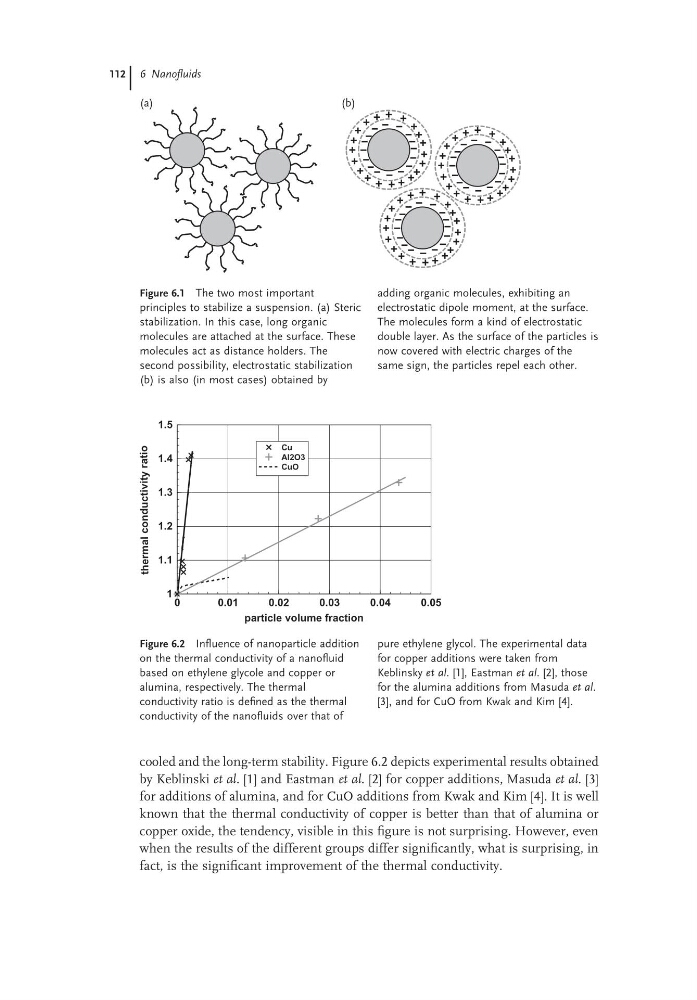
cooled and the long-term stability. Figure 6.2 depicts experimental results obtained
by Keblinski et al. [1] and Eastman et al. [2] for copper additions, Masuda et al. [3]
for additions of alumina, and for CuO additions from Kwak and Kim [4]. It is well
known that the thermal conductivity of copper is better than that of alumina or
copper oxide, the tendency, visible in this figure is not surprising. However, even
when the results of the different groups differ significantly, what is surprising, in
fact, is the significant improvement of the thermal conductivity.
Figure 6.1 The two most important
principles to stabilize a suspension. (a) Steric
stabilization. In this case, long organic
molecules are attached at the surface. These
molecules act as distance holders. The
second possibility, electrostatic stabilization
(b) is also (in most cases) obtained by
adding organic molecules, exhibiting an
electrostatic dipole moment, at the surface.
The molecules form a kind of electrostatic
double layer. As the surface of the particles is
now covered with electric charges of the
same sign, the particles repel each other.
(a)
(b)
Figure 6.2 Influence of nanoparticle addition
on the thermal conductivity of a nanofluid
based on ethylene glycole and copper or
alumina, respectively. The thermal
conductivity ratio is defined as the thermal
conductivity of the nanofluids over that of
pure ethylene glycol. The experimental data
for copper additions were taken from
Keblinsky et al. [1], Eastman et al. [2], those
for the alumina additions from Masuda et al.
[3], and for CuO from Kwak and Kim [4].
0
0.01
0.02
0.03
0.04
0.05
particle volume fraction
1
1.1
1.2
1.3
1.4
1.5
thermal
conductivity
ratio
Cu
Al2O3
CuO
cooled and the long-term stability. Figure 6.2 depicts experimental results obtained
by Keblinski et al. [1] and Eastman et al. [2] for copper additions, Masuda et al. [3]
for additions of alumina, and for CuO additions from Kwak and Kim [4]. It is well
known that the thermal conductivity of copper is better than that of alumina or
copper oxide, the tendency, visible in this figure is not surprising. However, even
when the results of the different groups differ significantly, what is surprising, in
fact, is the significant improvement of the thermal conductivity.
Figure 6.1 The two most important
principles to stabilize a suspension. (a) Steric
stabilization. In this case, long organic
molecules are attached at the surface. These
molecules act as distance holders. The
second possibility, electrostatic stabilization
(b) is also (in most cases) obtained by
adding organic molecules, exhibiting an
electrostatic dipole moment, at the surface.
The molecules form a kind of electrostatic
double layer. As the surface of the particles is
now covered with electric charges of the
same sign, the particles repel each other.
(a)
(b)
Figure 6.2 Influence of nanoparticle addition
on the thermal conductivity of a nanofluid
based on ethylene glycole and copper or
alumina, respectively. The thermal
conductivity ratio is defined as the thermal
conductivity of the nanofluids over that of
pure ethylene glycol. The experimental data
for copper additions were taken from
Keblinsky et al. [1], Eastman et al. [2], those
for the alumina additions from Masuda et al.
[3], and for CuO from Kwak and Kim [4].
0
0.01
0.02
0.03
0.04
0.05
particle volume fraction
1
1.1
1.2
1.3
1.4
1.5
thermal
conductivity
ratio
Cu
Al2O3
CuO