

92 5 One- and Two-Dimensional Nanoparticles
Box 5.6 Fullerenes
Polyhedra forming fullerenes are a subgroup of Archimedean polyhedra, which
consist of regular polygons, with identical vertices and identical arrangements
of polygons around each polygon with a constant number of edges at each
vertice. According to Euler, the number of vertices N, (in this case, identical
with the number of carbon atoms) of these polyhedrons consisting of hexagons
and pentagons follow the formula: N = 2i with i ≥ 12 and i ∈» Therefore, the
smallest fullerene should consist of 24 carbon atoms. All experimentally verified fullerenes consist of twelve pentagons and different numbers of hexagons.
The stability of a fullerene particle is maximal, in the case that the pentagons
are surrounded by hexagons only. Stable fullerenes consisting of less that 60
carbon atoms were never found. The fullerene C 60 is thus of special interest,
as it is the most symmetric molecule known. One can perform 120 symmetry
operations, (rotations around an axis, reflections in a plane) mapping the molecule onto itself.
The smallest, however, unstable fullerene, experimentally found, is C 20 . It is
set up of pentagons only and, therefore, it is not a polyhedron following the
Euler formula.
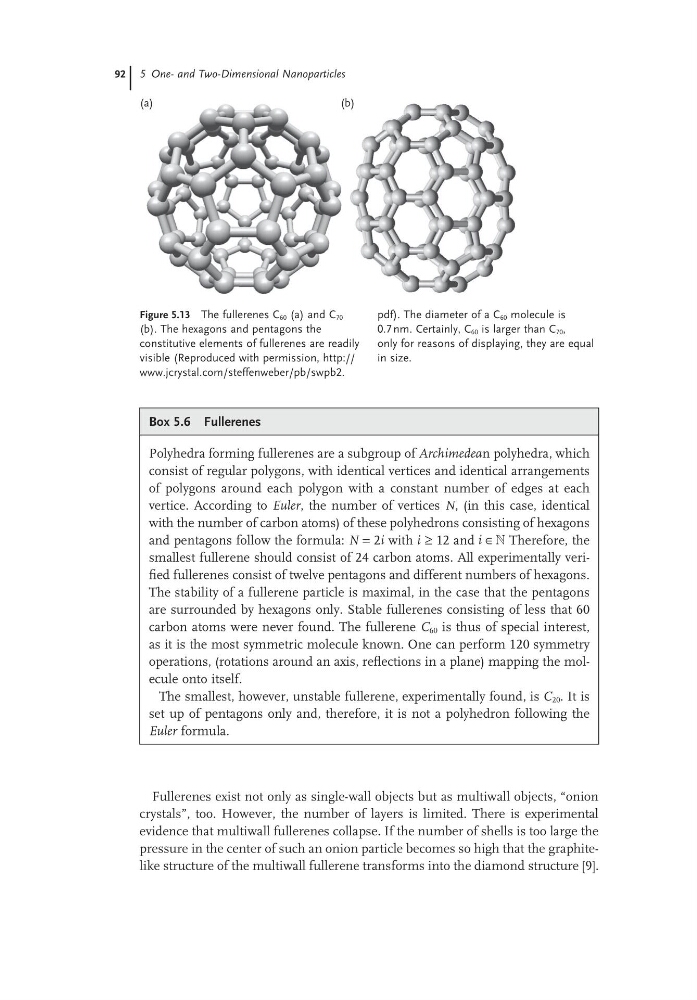
Figure 5.13 The fullerenes C 60 (a) and C 70
(b). The hexagons and pentagons the
constitutive elements of fullerenes are readily
visible (Reproduced with permission, http://
www.jcrystal.com/steffenweber/pb/swpb2.
pdf). The diameter of a C 60 molecule is
0.7 nm. Certainly, C 60 is larger than C 70 ,
only for reasons of displaying, they are equal
in size.
(a)
(b)
Fullerenes exist not only as single-wall objects but as multiwall objects, “onion
crystals”, too. However, the number of layers is limited. There is experimental
evidence that multiwall fullerenes collapse. If the number of shells is too large the
pressure in the center of such an onion particle becomes so high that the graphitelike structure of the multiwall fullerene transforms into the diamond structure [9].
Box 5.6 Fullerenes
Polyhedra forming fullerenes are a subgroup of Archimedean polyhedra, which
consist of regular polygons, with identical vertices and identical arrangements
of polygons around each polygon with a constant number of edges at each
vertice. According to Euler, the number of vertices N, (in this case, identical
with the number of carbon atoms) of these polyhedrons consisting of hexagons
and pentagons follow the formula: N = 2i with i ≥ 12 and i ∈» Therefore, the
smallest fullerene should consist of 24 carbon atoms. All experimentally verified fullerenes consist of twelve pentagons and different numbers of hexagons.
The stability of a fullerene particle is maximal, in the case that the pentagons
are surrounded by hexagons only. Stable fullerenes consisting of less that 60
carbon atoms were never found. The fullerene C 60 is thus of special interest,
as it is the most symmetric molecule known. One can perform 120 symmetry
operations, (rotations around an axis, reflections in a plane) mapping the molecule onto itself.
The smallest, however, unstable fullerene, experimentally found, is C 20 . It is
set up of pentagons only and, therefore, it is not a polyhedron following the
Euler formula.
Figure 5.13 The fullerenes C 60 (a) and C 70
(b). The hexagons and pentagons the
constitutive elements of fullerenes are readily
visible (Reproduced with permission, http://
www.jcrystal.com/steffenweber/pb/swpb2.
pdf). The diameter of a C 60 molecule is
0.7 nm. Certainly, C 60 is larger than C 70 ,
only for reasons of displaying, they are equal
in size.
(a)
(b)
Fullerenes exist not only as single-wall objects but as multiwall objects, “onion
crystals”, too. However, the number of layers is limited. There is experimental
evidence that multiwall fullerenes collapse. If the number of shells is too large the
pressure in the center of such an onion particle becomes so high that the graphitelike structure of the multiwall fullerene transforms into the diamond structure [9].