

classification is shown in Fig. 1. Selective laser sintering (SLS) uses a
laser to selectively sinter powdered material on a heated bed rendering the processing of metals, ceramics, and polymers. Stereolithography (SLA) works by selectively photopolymerizing layers of
a photosensitive polymer by means of an ultraviolet (UV) light or
laser; both metals and polymers are used. Three-dimensional printing (3DP) is based on the controlled deposition of a binder material
laid on a powder layer using an inkjet head, and it is used with
polymers. In extrusion-based techniques, the material is made to
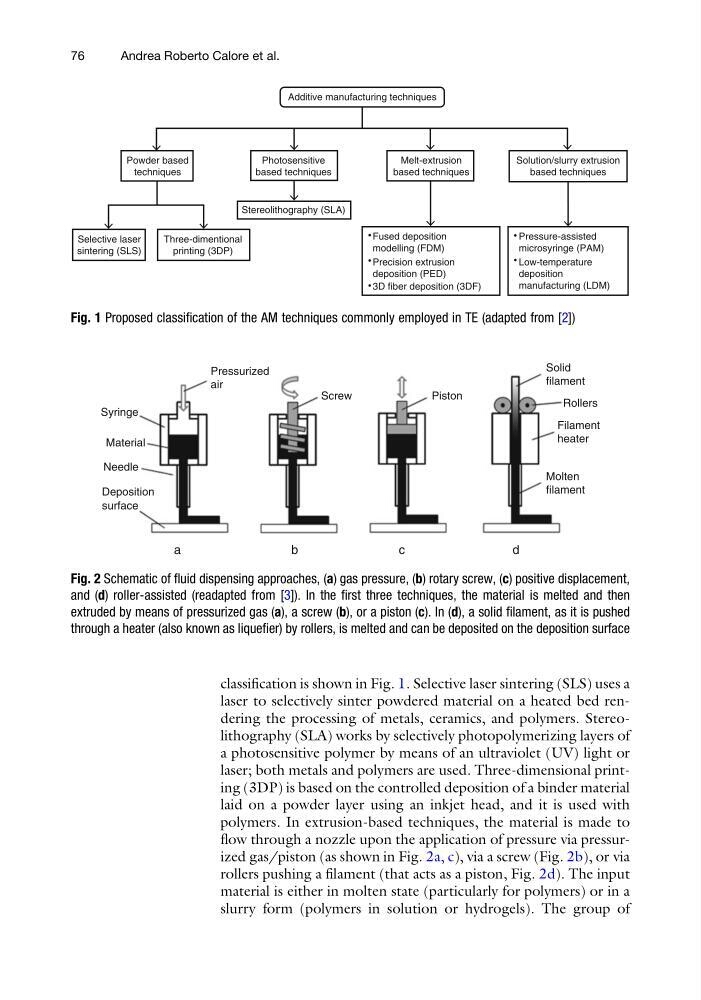
flow through a nozzle upon the application of pressure via pressurized gas/piston (as shown in Fig. 2a, c), via a screw (Fig. 2b), or via
rollers pushing a filament (that acts as a piston, Fig. 2d). The input
material is either in molten state (particularly for polymers) or in a
slurry form (polymers in solution or hydrogels). The group of
Additive manufacturing techniques
Powder based
techniques
Selective laser
sintering (SLS)
Three-dimentional
printing (3DP)
Stereolithography (SLA)
Fused deposition
modelling (FDM)
•
•
•
•
•
Pressure-assisted
microsyringe (PAM)
Low-temperature
deposition
manufacturing (LDM)
Precision extrusion
deposition (PED)
3D fiber deposition (3DF)
Photosensitive
based techniques
Melt-extrusion
based techniques
Solution/slurry extrusion
based techniques
Fig. 1 Proposed classification of the AM techniques commonly employed in TE (adapted from [2])
Pressurized
air
Screw
a
b
c
d
Syringe
Piston
Solid
filament
Rollers
Filament
heater
Molten
filament
Material
Needle
Deposition
surface
Fig. 2 Schematic of fluid dispensing approaches, (a) gas pressure, (b) rotary screw, (c) positive displacement,
and (d) roller-assisted (readapted from [3]). In the first three techniques, the material is melted and then
extruded by means of pressurized gas (a), a screw (b), or a piston (c). In (d), a solid filament, as it is pushed
through a heater (also known as liquefier) by rollers, is melted and can be deposited on the deposition surface
76
Andrea Roberto Calore et al.
laser to selectively sinter powdered material on a heated bed rendering the processing of metals, ceramics, and polymers. Stereolithography (SLA) works by selectively photopolymerizing layers of
a photosensitive polymer by means of an ultraviolet (UV) light or
laser; both metals and polymers are used. Three-dimensional printing (3DP) is based on the controlled deposition of a binder material
laid on a powder layer using an inkjet head, and it is used with
polymers. In extrusion-based techniques, the material is made to
flow through a nozzle upon the application of pressure via pressurized gas/piston (as shown in Fig. 2a, c), via a screw (Fig. 2b), or via
rollers pushing a filament (that acts as a piston, Fig. 2d). The input
material is either in molten state (particularly for polymers) or in a
slurry form (polymers in solution or hydrogels). The group of
Additive manufacturing techniques
Powder based
techniques
Selective laser
sintering (SLS)
Three-dimentional
printing (3DP)
Stereolithography (SLA)
Fused deposition
modelling (FDM)
•
•
•
•
•
Pressure-assisted
microsyringe (PAM)
Low-temperature
deposition
manufacturing (LDM)
Precision extrusion
deposition (PED)
3D fiber deposition (3DF)
Photosensitive
based techniques
Melt-extrusion
based techniques
Solution/slurry extrusion
based techniques
Fig. 1 Proposed classification of the AM techniques commonly employed in TE (adapted from [2])
Pressurized
air
Screw
a
b
c
d
Syringe
Piston
Solid
filament
Rollers
Filament
heater
Molten
filament
Material
Needle
Deposition
surface
Fig. 2 Schematic of fluid dispensing approaches, (a) gas pressure, (b) rotary screw, (c) positive displacement,
and (d) roller-assisted (readapted from [3]). In the first three techniques, the material is melted and then
extruded by means of pressurized gas (a), a screw (b), or a piston (c). In (d), a solid filament, as it is pushed
through a heater (also known as liquefier) by rollers, is melted and can be deposited on the deposition surface
76
Andrea Roberto Calore et al.