

rectangular functionally graded specimen is reported in the
Appendix.
2. The performance of functionally graded sample can be tested
under buckling. If a thin strip or film with variable stiffness is
subjected to buckling, the buckled shape is asymmetric. Place
the specimen between two flat plates of a tensile test machine
(Fig. 4a), and bring the specimen to a compression level of the
critical buckling load.
3. Acquire a picture of the buckled profile, and extract the
deformed shape using a software tool such as WebPlotDigitizer
[22] (Fig. 4a).
(a) The experimentally observed buckled shape can now be
validated using the following analysis developed for thin
films with graded properties. The buckled shape is theoretically obtained by solving the differential equation for
the buckling of a Euler column with variable cross section:
d
2
dx 2 EI x
ð Þ
d
2 w
dx 2
!
þ P
d
2 w
dx 2 ¼ 0:
ð3Þ
Exact solution for this differential equation can be
found in [22]. For the thin films analyzed
here, EI x
ð Þ ¼ E
π
4 r x
ð Þ
4 is the variable bending stiffness.
If we assume that the radius of the filaments varies linearly
as r(x) ¼ Ax + B, the buckled shape is given by
w x
ð Þ ¼
ffiffiffi
2
p
bL bx À 1
ð
Þsec
π
bL
À Á
sin
bLÀ1
ð
Þ πx
L bxÀ1
ð
Þ
π
ffiffiffiffiffiffiffiffiffiffiffiffiffiffiffiffiffiffiffiffiffiffiffiffiffiffiffi
L b
j j À bL
2 b
j j
q
,
ð4Þ
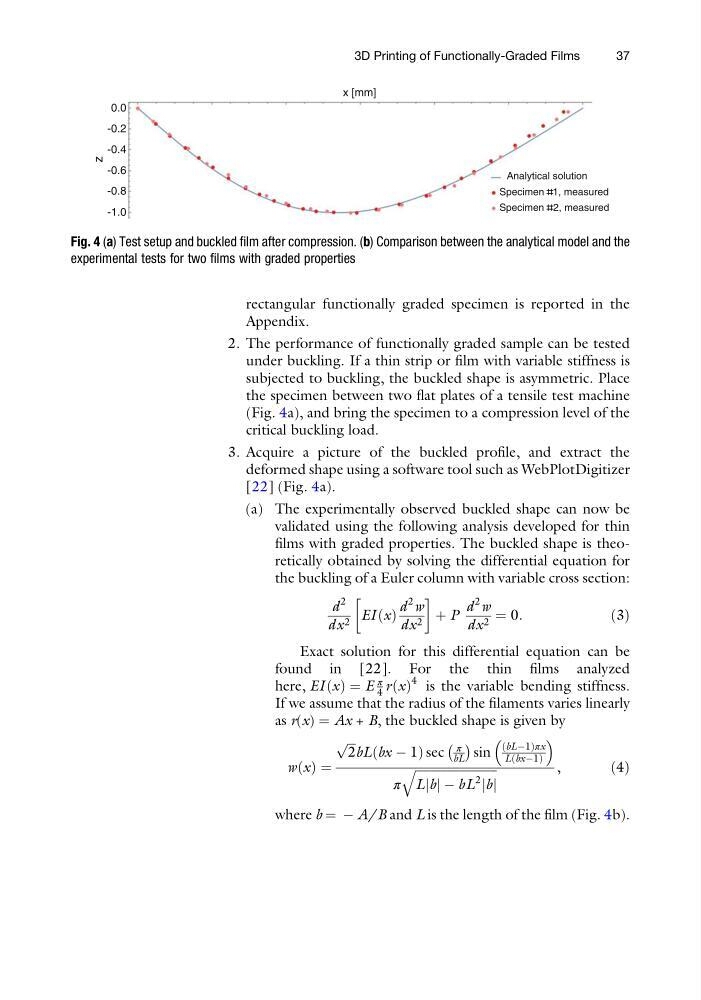
where b ¼ À A/B and L is the length of the film (Fig. 4b).
0.0
-0.2
x [mm]
Analytical solution
-0.4
z
-0.6
-0.8
-1.0
Specimen 1, measured
Specimen 2, measured
Fig. 4 (a) Test setup and buckled film after compression. (b) Comparison between the analytical model and the
experimental tests for two films with graded properties
3D Printing of Functionally-Graded Films
37
Appendix.
2. The performance of functionally graded sample can be tested
under buckling. If a thin strip or film with variable stiffness is
subjected to buckling, the buckled shape is asymmetric. Place
the specimen between two flat plates of a tensile test machine
(Fig. 4a), and bring the specimen to a compression level of the
critical buckling load.
3. Acquire a picture of the buckled profile, and extract the
deformed shape using a software tool such as WebPlotDigitizer
[22] (Fig. 4a).
(a) The experimentally observed buckled shape can now be
validated using the following analysis developed for thin
films with graded properties. The buckled shape is theoretically obtained by solving the differential equation for
the buckling of a Euler column with variable cross section:
d
2
dx 2 EI x
ð Þ
d
2 w
dx 2
!
þ P
d
2 w
dx 2 ¼ 0:
ð3Þ
Exact solution for this differential equation can be
found in [22]. For the thin films analyzed
here, EI x
ð Þ ¼ E
π
4 r x
ð Þ
4 is the variable bending stiffness.
If we assume that the radius of the filaments varies linearly
as r(x) ¼ Ax + B, the buckled shape is given by
w x
ð Þ ¼
ffiffiffi
2
p
bL bx À 1
ð
Þsec
π
bL
À Á
sin
bLÀ1
ð
Þ πx
L bxÀ1
ð
Þ
π
ffiffiffiffiffiffiffiffiffiffiffiffiffiffiffiffiffiffiffiffiffiffiffiffiffiffiffi
L b
j j À bL
2 b
j j
q
,
ð4Þ
where b ¼ À A/B and L is the length of the film (Fig. 4b).
0.0
-0.2
x [mm]
Analytical solution
-0.4
z
-0.6
-0.8
-1.0
Specimen 1, measured
Specimen 2, measured
Fig. 4 (a) Test setup and buckled film after compression. (b) Comparison between the analytical model and the
experimental tests for two films with graded properties
3D Printing of Functionally-Graded Films
37