

7. Gently place in the culture medium. The plug can be removed
gently after 24 h.
8. To maintain the co-culture device, change the culture medium
every 2–3 days or as needed.
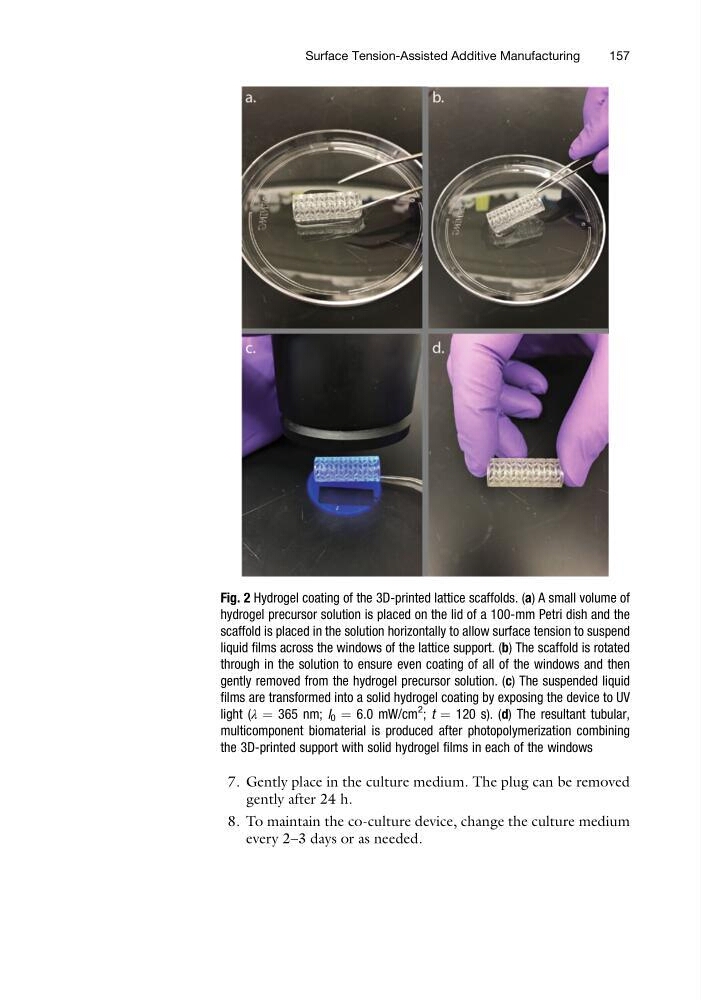
Fig. 2 Hydrogel coating of the 3D-printed lattice scaffolds. (a) A small volume of
hydrogel precursor solution is placed on the lid of a 100-mm Petri dish and the
scaffold is placed in the solution horizontally to allow surface tension to suspend
liquid films across the windows of the lattice support. (b) The scaffold is rotated
through in the solution to ensure even coating of all of the windows and then
gently removed from the hydrogel precursor solution. (c) The suspended liquid
films are transformed into a solid hydrogel coating by exposing the device to UV
light (λ ¼ 365 nm; I 0 ¼ 6.0 mW/cm
2 ; t ¼ 120 s). (d) The resultant tubular,
multicomponent biomaterial is produced after photopolymerization combining
the 3D-printed support with solid hydrogel films in each of the windows
Surface Tension-Assisted Additive Manufacturing
157
gently after 24 h.
8. To maintain the co-culture device, change the culture medium
every 2–3 days or as needed.
Fig. 2 Hydrogel coating of the 3D-printed lattice scaffolds. (a) A small volume of
hydrogel precursor solution is placed on the lid of a 100-mm Petri dish and the
scaffold is placed in the solution horizontally to allow surface tension to suspend
liquid films across the windows of the lattice support. (b) The scaffold is rotated
through in the solution to ensure even coating of all of the windows and then
gently removed from the hydrogel precursor solution. (c) The suspended liquid
films are transformed into a solid hydrogel coating by exposing the device to UV
light (λ ¼ 365 nm; I 0 ¼ 6.0 mW/cm
2 ; t ¼ 120 s). (d) The resultant tubular,
multicomponent biomaterial is produced after photopolymerization combining
the 3D-printed support with solid hydrogel films in each of the windows
Surface Tension-Assisted Additive Manufacturing
157