

2.1 Topological
Optimization
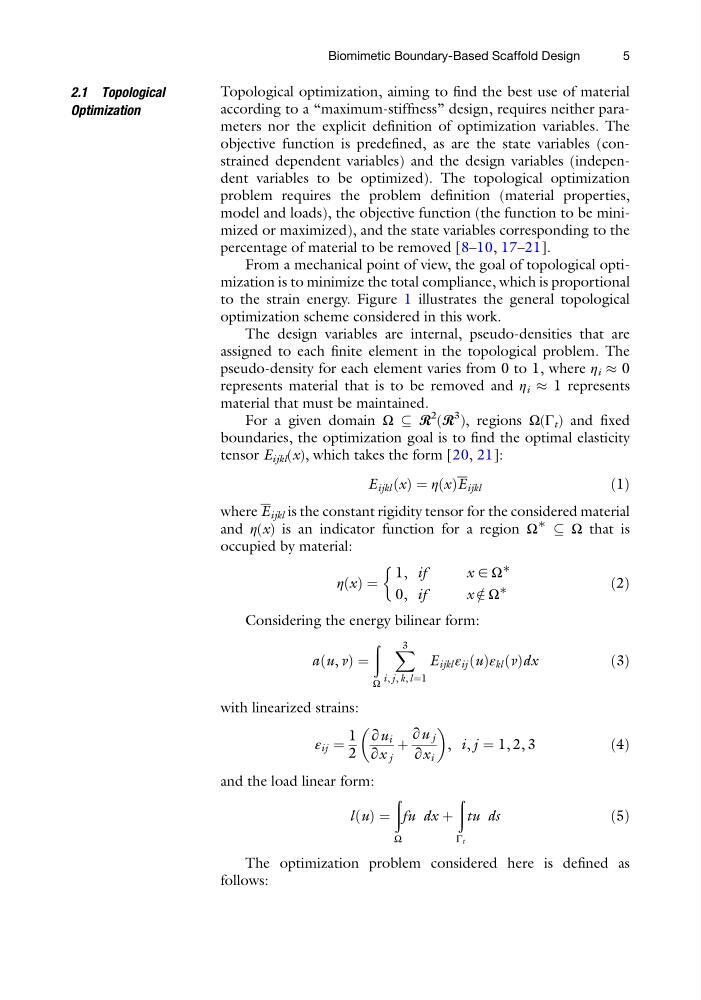
Topological optimization, aiming to find the best use of material
according to a “maximum-stiffness” design, requires neither parameters nor the explicit definition of optimization variables. The
objective function is predefined, as are the state variables (constrained dependent variables) and the design variables (independent variables to be optimized). The topological optimization
problem requires the problem definition (material properties,
model and loads), the objective function (the function to be minimized or maximized), and the state variables corresponding to the
percentage of material to be removed [8–10, 17–21].
From a mechanical point of view, the goal of topological optimization is to minimize the total compliance, which is proportional
to the strain energy. Figure 1 illustrates the general topological
optimization scheme considered in this work.
The design variables are internal, pseudo-densities that are
assigned to each finite element in the topological problem. The
pseudo-density for each element varies from 0 to 1, where η i % 0
represents material that is to be removed and η i % 1 represents
material that must be maintained.
For a given domain Ω R
2 (R
3 ), regions Ω(Γ t ) and fixed
boundaries, the optimization goal is to find the optimal elasticity
tensor E ijkl (x), which takes the form [20, 21]:
E ijkl x
ð Þ ¼ η x
ð ÞE ijkl
ð1Þ
where E ijkl is the constant rigidity tensor for the considered material
and η(x) is an indicator function for a region Ω
∗
Ω that is
occupied by material:
η x
ð Þ ¼
1, if
x ∈ Ω
∗
0, if
x =
2 Ω
∗
&
ð2Þ
Considering the energy bilinear form:
a u, v
ð
Þ ¼
ð
Ω
X 3
i, j , k, l¼1
E ijkl ε ij u
ð Þε kl v
ð Þdx
ð3Þ
with linearized strains:
ε ij ¼
1
2
∂u i
∂x j
þ
∂u j
∂x i
, i, j ¼ 1, 2, 3
ð4Þ
and the load linear form:
l u
ð Þ ¼
ð
Ω
fu dx þ
ð
Γ t
tu ds
ð5Þ
The optimization problem considered here is defined as
follows:
Biomimetic Boundary-Based Scaffold Design
5
Optimization
Topological optimization, aiming to find the best use of material
according to a “maximum-stiffness” design, requires neither parameters nor the explicit definition of optimization variables. The
objective function is predefined, as are the state variables (constrained dependent variables) and the design variables (independent variables to be optimized). The topological optimization
problem requires the problem definition (material properties,
model and loads), the objective function (the function to be minimized or maximized), and the state variables corresponding to the
percentage of material to be removed [8–10, 17–21].
From a mechanical point of view, the goal of topological optimization is to minimize the total compliance, which is proportional
to the strain energy. Figure 1 illustrates the general topological
optimization scheme considered in this work.
The design variables are internal, pseudo-densities that are
assigned to each finite element in the topological problem. The
pseudo-density for each element varies from 0 to 1, where η i % 0
represents material that is to be removed and η i % 1 represents
material that must be maintained.
For a given domain Ω R
2 (R
3 ), regions Ω(Γ t ) and fixed
boundaries, the optimization goal is to find the optimal elasticity
tensor E ijkl (x), which takes the form [20, 21]:
E ijkl x
ð Þ ¼ η x
ð ÞE ijkl
ð1Þ
where E ijkl is the constant rigidity tensor for the considered material
and η(x) is an indicator function for a region Ω
∗
Ω that is
occupied by material:
η x
ð Þ ¼
1, if
x ∈ Ω
∗
0, if
x =
2 Ω
∗
&
ð2Þ
Considering the energy bilinear form:
a u, v
ð
Þ ¼
ð
Ω
X 3
i, j , k, l¼1
E ijkl ε ij u
ð Þε kl v
ð Þdx
ð3Þ
with linearized strains:
ε ij ¼
1
2
∂u i
∂x j
þ
∂u j
∂x i
, i, j ¼ 1, 2, 3
ð4Þ
and the load linear form:
l u
ð Þ ¼
ð
Ω
fu dx þ
ð
Γ t
tu ds
ð5Þ
The optimization problem considered here is defined as
follows:
Biomimetic Boundary-Based Scaffold Design
5