

760
L. Rozhdestvenska et al.
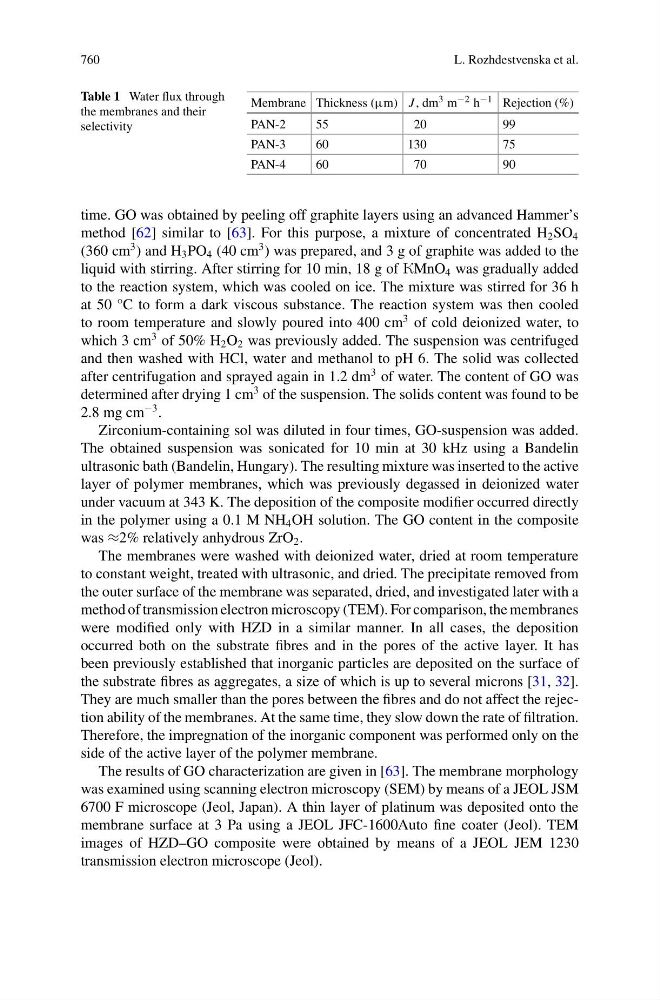
Table 1 Water flux through
the membranes and their
selectivity
Membrane Thickness (µm) J , dm 3 m −2 h −1 Rejection (%)
PAN-2
55
20
99
PAN-3
60
130
75
PAN-4
60
70
90
time. GO was obtained by peeling off graphite layers using an advanced Hammer’s
method [62] similar to [63]. For this purpose, a mixture of concentrated H 2 SO 4
(360 cm
3 ) and H 3 PO 4 (40 cm
3 ) was prepared, and 3 g of graphite was added to the
liquid with stirring. After stirring for 10 min, 18 g of KMnO 4 was gradually added
to the reaction system, which was cooled on ice. The mixture was stirred for 36 h
at 50 °C to form a dark viscous substance. The reaction system was then cooled
to room temperature and slowly poured into 400 cm
3 of cold deionized water, to
which 3 cm
3 of 50% H 2 O 2 was previously added. The suspension was centrifuged
and then washed with HCl, water and methanol to pH 6. The solid was collected
after centrifugation and sprayed again in 1.2 dm
3 of water. The content of GO was
determined after drying 1 cm
3 of the suspension. The solids content was found to be
2.8 mg cm
−3 .
Zirconium-containing sol was diluted in four times, GO-suspension was added.
The obtained suspension was sonicated for 10 min at 30 kHz using a Bandelin
ultrasonic bath (Bandelin, Hungary). The resulting mixture was inserted to the active
layer of polymer membranes, which was previously degassed in deionized water
under vacuum at 343 K. The deposition of the composite modifier occurred directly
in the polymer using a 0.1 M NH 4 OH solution. The GO content in the composite
was ≈2% relatively anhydrous ZrO 2 .
The membranes were washed with deionized water, dried at room temperature
to constant weight, treated with ultrasonic, and dried. The precipitate removed from
the outer surface of the membrane was separated, dried, and investigated later with a
method of transmission electron microscopy (TEM). For comparison, the membranes
were modified only with HZD in a similar manner. In all cases, the deposition
occurred both on the substrate fibres and in the pores of the active layer. It has
been previously established that inorganic particles are deposited on the surface of
the substrate fibres as aggregates, a size of which is up to several microns [31, 32].
They are much smaller than the pores between the fibres and do not affect the rejection ability of the membranes. At the same time, they slow down the rate of filtration.
Therefore, the impregnation of the inorganic component was performed only on the
side of the active layer of the polymer membrane.
The results of GO characterization are given in [63]. The membrane morphology
was examined using scanning electron microscopy (SEM) by means of a JEOL JSM
6700 F microscope (Jeol, Japan). A thin layer of platinum was deposited onto the
membrane surface at 3 Pa using a JEOL JFC-1600Auto fine coater (Jeol). TEM
images of HZD–GO composite were obtained by means of a JEOL JEM 1230
transmission electron microscope (Jeol).