

TiO 2 –ZnO Nanocomposites for Photodegradation of Dyes …
725
method. The photocatalytic activity of the obtained catalysts was tested for the degradation reactions of Rhodamine B in UV and near-visible light irradiation (254 nm,
313 nm, 350 nm, and 420 nm, respectively). It has been shown that under UV irradiation, the decomposition of the dye occurs by 100% and gradually the degradation
degree of the contaminant is reduced to 4% in the visible region of the irradiation. Studies have confirmed the presence of a synergistic effect in the reaction of
Rodamin B photodestruction. The percentage of the dye solution degradation on TiO 2
nanotubes was 65%, whereas in the presence of ZnO nanoparticles, this percentage
reached up to 72, 83, 91, and 94% according to the number of electrochemical
deposition cycles—2, 4, 6, 8. The photocatalytic activity of the samples increased
depending on the ZnO content, but had a certain limit, due to the fact that the deposition of more than eight cycles of zinc oxide was subjected to total agglomeration
on the titanium (IV) oxide surface and screened the surface-active centers. That is,
further deposition of zinc oxide leads to the formation of the dominant layer of ZnO
nanoparticles on the surface of TiO 2 nanotubes and loss of synergistic effect between
nanotubes and nanoparticles.
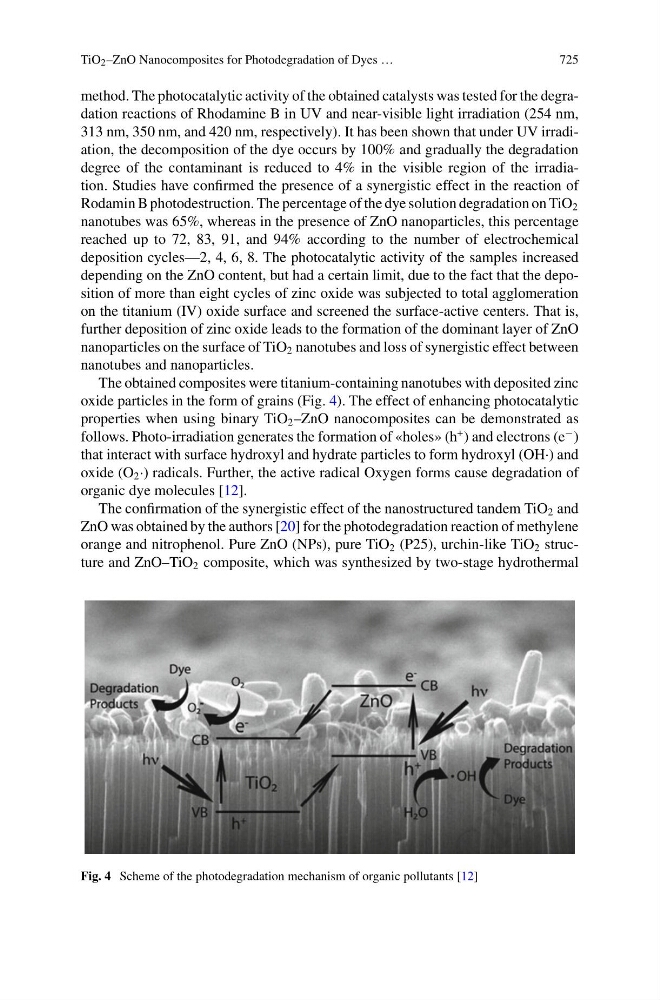
The obtained composites were titanium-containing nanotubes with deposited zinc
oxide particles in the form of grains (Fig. 4). The effect of enhancing photocatalytic
properties when using binary TiO 2 –ZnO nanocomposites can be demonstrated as
follows. Photo-irradiation generates the formation of «holes» (h
+ ) and electrons (e
− )
that interact with surface hydroxyl and hydrate particles to form hydroxyl (OH·) and
oxide (O 2 ·) radicals. Further, the active radical Oxygen forms cause degradation of
organic dye molecules [12].
The confirmation of the synergistic effect of the nanostructured tandem TiO 2 and
ZnO was obtained by the authors [20] for the photodegradation reaction of methylene
orange and nitrophenol. Pure ZnO (NPs), pure TiO 2 (P25), urchin-like TiO 2 structure and ZnO–TiO 2 composite, which was synthesized by two-stage hydrothermal
Fig. 4 Scheme of the photodegradation mechanism of organic pollutants [12]