

TiO 2 –ZnO Nanocomposites for Photodegradation of Dyes …
723
the broad bandgap in both semiconductors (absorbing only a small (~5%) fraction
of solar radiation), ZnO exhibits mobility of photo-excited electrons at least 2 orders
of magnitude higher than that of TiO 2 and it is characterized by stable photocatalytic
properties in the degradation process of dye molecules in both acidic and alkaline
environments [12].
The manifestation of similar properties of TiO 2 and ZnO under different conditions makes the use of these oxides to create photocatalysts composites logical and
promising. Therefore, interest in the photocatalytic properties of mixed oxide nanomaterials, which can potentially combine the properties of individual oxides, leads
to the search for new synthesis methods of composites. Increased photostability,
accompanied by improved photoactivity, is one of the factors that justify the creation
of mixed oxide nanocrystals, which are considered as promising photocatalysts for
environmental applications, in particular for the decomposition of dyes. The interaction of TiO 2 and ZnO in nanostructures enhances the physical and chemical properties
(such as electrical conductivity and charge carrier concentration) of devices used in
lithium batteries, supercapacitors, and fuel cells.
Thus, the authors of [13] consider semiconductor oxides to be unique in nature
due to the presence of partially filled d-orbitals. This feature of the transition metal
structure allows changing the electronic properties of semiconductors, including by
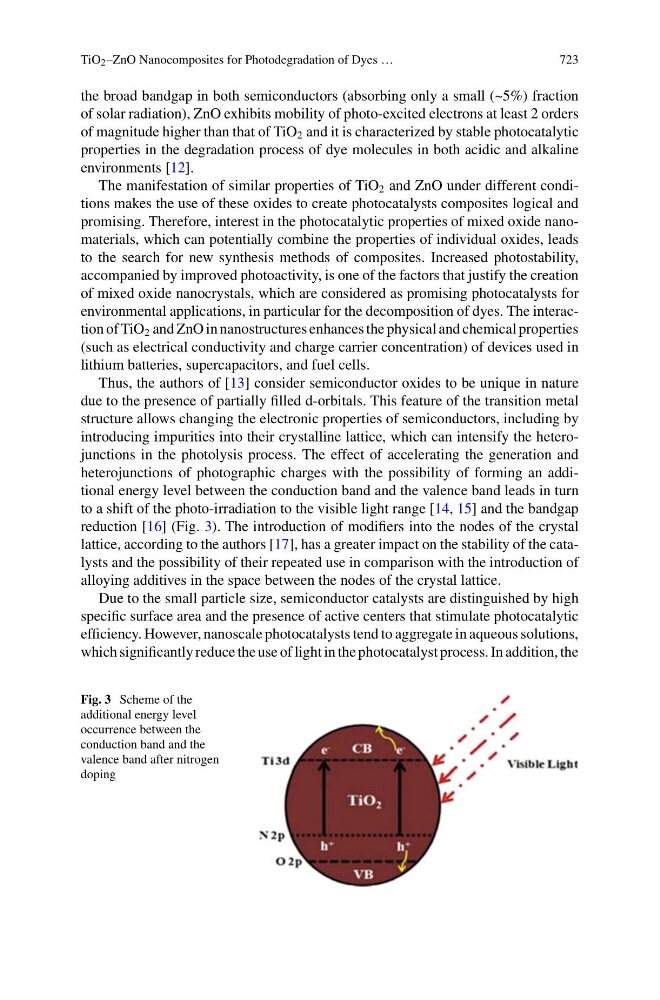
introducing impurities into their crystalline lattice, which can intensify the heterojunctions in the photolysis process. The effect of accelerating the generation and
heterojunctions of photographic charges with the possibility of forming an additional energy level between the conduction band and the valence band leads in turn
to a shift of the photo-irradiation to the visible light range [14, 15] and the bandgap
reduction [16] (Fig. 3). The introduction of modifiers into the nodes of the crystal
lattice, according to the authors [17], has a greater impact on the stability of the catalysts and the possibility of their repeated use in comparison with the introduction of
alloying additives in the space between the nodes of the crystal lattice.
Due to the small particle size, semiconductor catalysts are distinguished by high
specific surface area and the presence of active centers that stimulate photocatalytic
efficiency. However, nanoscale photocatalysts tend to aggregate in aqueous solutions,
which significantly reduce the use of light in the photocatalyst process. In addition, the
Fig. 3 Scheme of the
additional energy level
occurrence between the
conduction band and the
valence band after nitrogen
doping