

Influence of the Carbon Allotropes on Dilatometric Properties …
675
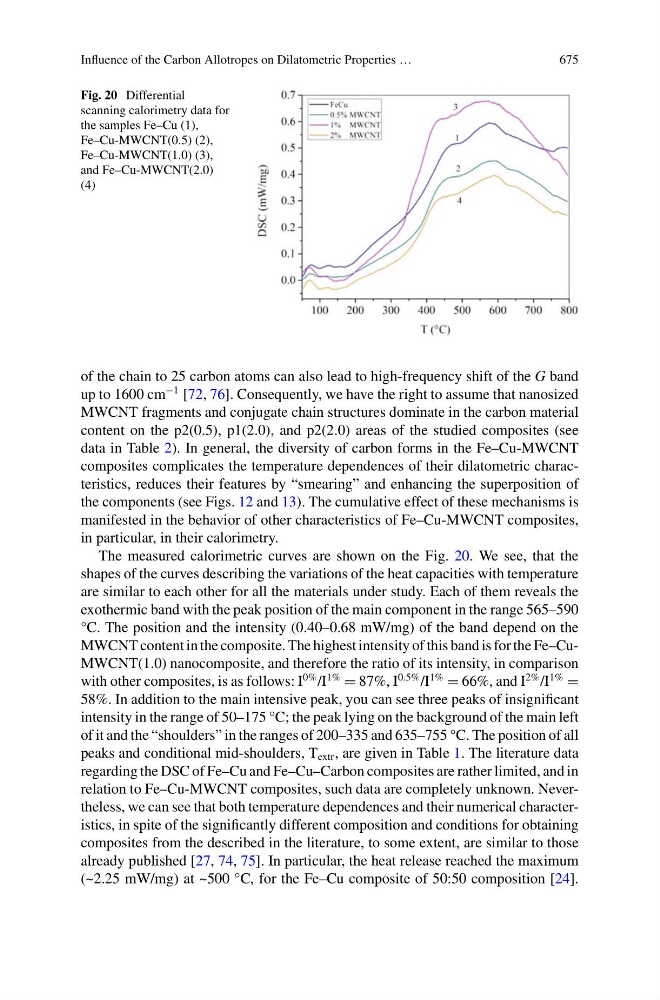
Fig. 20 Differential
scanning calorimetry data for
the samples Fe–Cu (1),
Fe–Cu-MWCNT(0.5) (2),
Fe–Cu-MWCNT(1.0) (3),
and Fe–Cu-MWCNT(2.0)
(4)
of the chain to 25 carbon atoms can also lead to high-frequency shift of the G band
up to 1600 cm
−1 [72, 76]. Consequently, we have the right to assume that nanosized
MWCNT fragments and conjugate chain structures dominate in the carbon material
content on the p2(0.5), p1(2.0), and p2(2.0) areas of the studied composites (see
data in Table 2). In general, the diversity of carbon forms in the Fe–Cu-MWCNT
composites complicates the temperature dependences of their dilatometric characteristics, reduces their features by “smearing” and enhancing the superposition of
the components (see Figs. 12 and 13). The cumulative effect of these mechanisms is
manifested in the behavior of other characteristics of Fe–Cu-MWCNT composites,
in particular, in their calorimetry.
The measured calorimetric curves are shown on the Fig. 20. We see, that the
shapes of the curves describing the variations of the heat capacities with temperature
are similar to each other for all the materials under study. Each of them reveals the
exothermic band with the peak position of the main component in the range 565–590
°C. The position and the intensity (0.40–0.68 mW/mg) of the band depend on the
MWCNT content in the composite. The highest intensity of this band is for the Fe–CuMWCNT(1.0) nanocomposite, and therefore the ratio of its intensity, in comparison
with other composites, is as follows: I
0% /I
1%
= 87%, I
0.5% /I
1%
= 66%, and I
2% /I
1%
=
58%. In addition to the main intensive peak, you can see three peaks of insignificant
intensity in the range of 50–175 °C; the peak lying on the background of the main left
of it and the “shoulders” in the ranges of 200–335 and 635–755 °C. The position of all
peaks and conditional mid-shoulders, T extr , are given in Table 1. The literature data
regarding the DSC of Fe–Cu and Fe–Cu–Carbon composites are rather limited, and in
relation to Fe–Cu-MWCNT composites, such data are completely unknown. Nevertheless, we can see that both temperature dependences and their numerical characteristics, in spite of the significantly different composition and conditions for obtaining
composites from the described in the literature, to some extent, are similar to those
already published [27, 74, 75]. In particular, the heat release reached the maximum
(~2.25 mW/mg) at ~500 °C, for the Fe–Cu composite of 50:50 composition [24].