

668
M. C. Bouleklab et al.
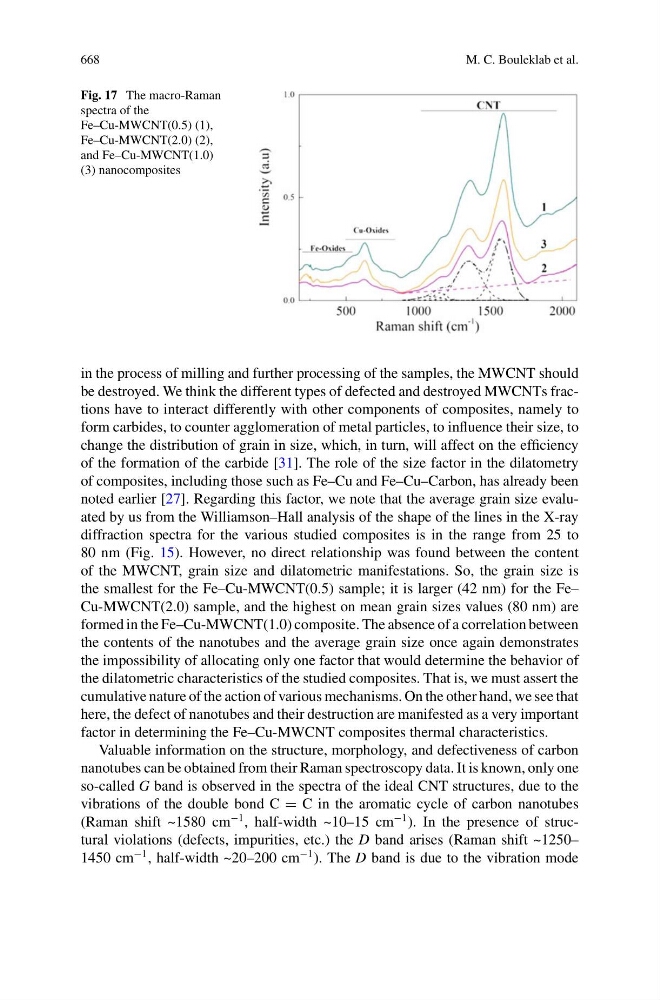
Fig. 17 The macro-Raman
spectra of the
Fe–Cu-MWCNT(0.5) (1),
Fe–Cu-MWCNT(2.0) (2),
and Fe–Cu-MWCNT(1.0)
(3) nanocomposites
in the process of milling and further processing of the samples, the MWCNT should
be destroyed. We think the different types of defected and destroyed MWCNTs fractions have to interact differently with other components of composites, namely to
form carbides, to counter agglomeration of metal particles, to influence their size, to
change the distribution of grain in size, which, in turn, will affect on the efficiency
of the formation of the carbide [31]. The role of the size factor in the dilatometry
of composites, including those such as Fe–Cu and Fe–Cu–Carbon, has already been
noted earlier [27]. Regarding this factor, we note that the average grain size evaluated by us from the Williamson–Hall analysis of the shape of the lines in the X-ray
diffraction spectra for the various studied composites is in the range from 25 to
80 nm (Fig. 15). However, no direct relationship was found between the content
of the MWCNT, grain size and dilatometric manifestations. So, the grain size is
the smallest for the Fe–Cu-MWCNT(0.5) sample; it is larger (42 nm) for the Fe–
Cu-MWCNT(2.0) sample, and the highest on mean grain sizes values (80 nm) are
formed in the Fe–Cu-MWCNT(1.0) composite. The absence of a correlation between
the contents of the nanotubes and the average grain size once again demonstrates
the impossibility of allocating only one factor that would determine the behavior of
the dilatometric characteristics of the studied composites. That is, we must assert the
cumulative nature of the action of various mechanisms. On the other hand, we see that
here, the defect of nanotubes and their destruction are manifested as a very important
factor in determining the Fe–Cu-MWCNT composites thermal characteristics.
Valuable information on the structure, morphology, and defectiveness of carbon
nanotubes can be obtained from their Raman spectroscopy data. It is known, only one
so-called G band is observed in the spectra of the ideal CNT structures, due to the
vibrations of the double bond C = C in the aromatic cycle of carbon nanotubes
(Raman shift ~1580 cm
−1 , half-width ~10–15 cm
−1 ). In the presence of structural violations (defects, impurities, etc.) the D band arises (Raman shift ~1250–
1450 cm
−1 , half-width ~20–200 cm
−1 ). The D band is due to the vibration mode