

636
A. P. Pospelov et al.
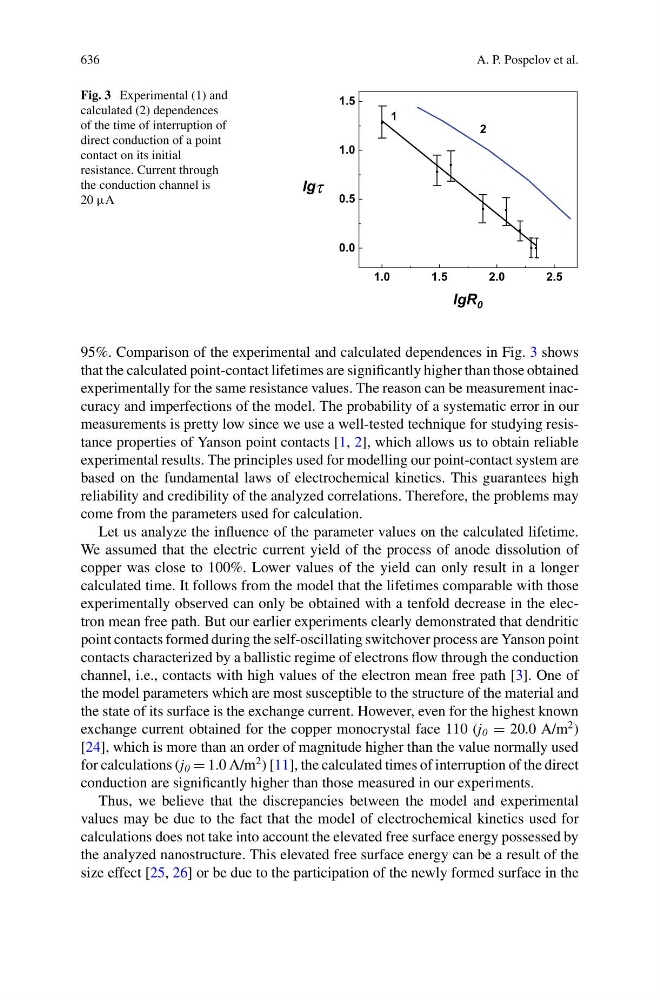
Fig. 3 Experimental (1) and
calculated (2) dependences
of the time of interruption of
direct conduction of a point
contact on its initial
resistance. Current through
the conduction channel is
20 μA
1.0
1.5
2.0
2.5
0.0
0.5
1.0
1.5
lg
lgR 0
1
2
τ
95%. Comparison of the experimental and calculated dependences in Fig. 3 shows
that the calculated point-contact lifetimes are significantly higher than those obtained
experimentally for the same resistance values. The reason can be measurement inaccuracy and imperfections of the model. The probability of a systematic error in our
measurements is pretty low since we use a well-tested technique for studying resistance properties of Yanson point contacts [1, 2], which allows us to obtain reliable
experimental results. The principles used for modelling our point-contact system are
based on the fundamental laws of electrochemical kinetics. This guarantees high
reliability and credibility of the analyzed correlations. Therefore, the problems may
come from the parameters used for calculation.
Let us analyze the influence of the parameter values on the calculated lifetime.
We assumed that the electric current yield of the process of anode dissolution of
copper was close to 100%. Lower values of the yield can only result in a longer
calculated time. It follows from the model that the lifetimes comparable with those
experimentally observed can only be obtained with a tenfold decrease in the electron mean free path. But our earlier experiments clearly demonstrated that dendritic
point contacts formed during the self-oscillating switchover process are Yanson point
contacts characterized by a ballistic regime of electrons flow through the conduction
channel, i.e., contacts with high values of the electron mean free path [3]. One of
the model parameters which are most susceptible to the structure of the material and
the state of its surface is the exchange current. However, even for the highest known
exchange current obtained for the copper monocrystal face 110 (j 0 = 20.0 A/m
2 )
[24], which is more than an order of magnitude higher than the value normally used
for calculations (j 0 = 1.0 A/m
2 ) [11], the calculated times of interruption of the direct
conduction are significantly higher than those measured in our experiments.
Thus, we believe that the discrepancies between the model and experimental
values may be due to the fact that the model of electrochemical kinetics used for
calculations does not take into account the elevated free surface energy possessed by
the analyzed nanostructure. This elevated free surface energy can be a result of the
size effect [25, 26] or be due to the participation of the newly formed surface in the