

Activation Mechanism of the Cyclic Switchover Effect …
629
to a spring-damper in order to lower the probability of mechanically breaking the
structure. The gap between the electrodes was filled with an electrolyte to enable
the formation of a gapless electrode system which initiates the cyclic switchover
effect in an electric field [3]. The electrolyte was a 0.05 mol/dm
3 aqueous solution
of CuSO 4 ·5H 2 O prepared with bidistilled water and a very high-purity salt. The
electrode system was created in an airtight chamber blown through with argon for
30 min. The dendritic point contact was formed in an electric field generated by a
stabilized DC source. The negative and positive poles of the source were connected
to the needle and to the “anvil,” respectively. A special multichannel device—pointcontact spectrometer [9]—was used to perform the measurements, which allowed
controlling parameters of the studied processes, recording electric characteristics of
the point contacts, simultaneously measuring the current–voltage characteristics of
the point contact along with its first and second derivatives, etc. The measurements
were made using the four-probe scheme to exclude the influence of any currentcarrying conductors.
3 Results and Discussion
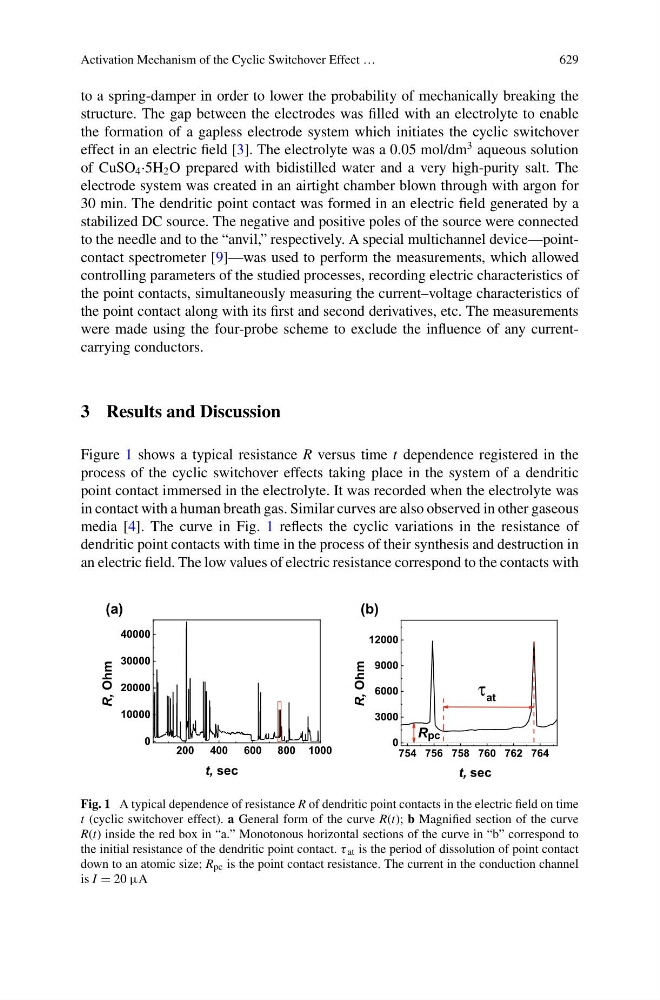
Figure 1 shows a typical resistance R versus time t dependence registered in the
process of the cyclic switchover effects taking place in the system of a dendritic
point contact immersed in the electrolyte. It was recorded when the electrolyte was
in contact with a human breath gas. Similar curves are also observed in other gaseous
media [4]. The curve in Fig. 1 reflects the cyclic variations in the resistance of
dendritic point contacts with time in the process of their synthesis and destruction in
an electric field. The low values of electric resistance correspond to the contacts with
200 400 600 800 1000
0
10000
20000
30000
40000
R,
Ohm
t, sec
(a)
(b)
754 756 758 760 762 764
0
3000
6000
9000
12000
R pc
τ at
R,
Ohm
t, sec
Fig. 1 A typical dependence of resistance R of dendritic point contacts in the electric field on time
t (cyclic switchover effect). a General form of the curve R(t); b Magnified section of the curve
R(t) inside the red box in “a.” Monotonous horizontal sections of the curve in “b” correspond to
the initial resistance of the dendritic point contact. τ at is the period of dissolution of point contact
down to an atomic size; R pc is the point contact resistance. The current in the conduction channel
is I = 20 μA