

624
S. I. Pokutnyi
6 Conclusion
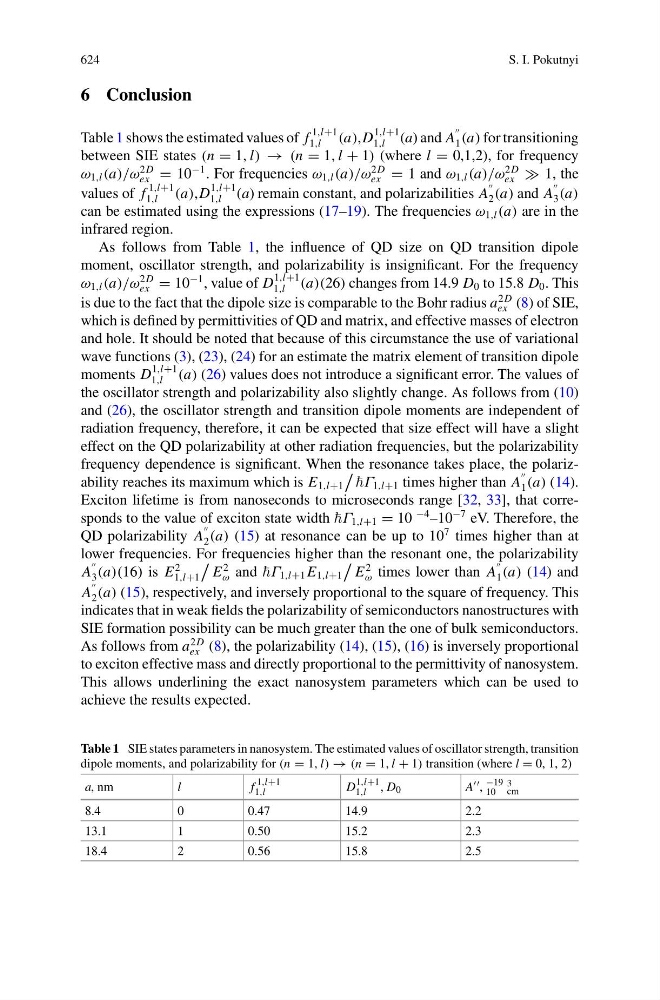
Table 1 shows the estimated values of f
1,l+1
1,l
(a),D
1,l+1
1,l (a) and A
1 (a) for transitioning
between SIE states (n = 1, l) → (n = 1, l + 1) (where l = 0,1,2), for frequency
ω 1,l (a)/ω
2D
ex = 10
−1 . For frequencies ω 1,l (a)/ω
2D
ex = 1 and ω 1,l (a)/ω
2D
ex 1, the
values of f
1,l+1
1,l
(a),D
1,l+1
1,l (a) remain constant, and polarizabilities A
2 (a) and A
3 (a)
can be estimated using the expressions (17–19). The frequencies ω 1,l (a) are in the
infrared region.
As follows from Table 1, the influence of QD size on QD transition dipole
moment, oscillator strength, and polarizability is insignificant. For the frequency
ω 1,l (a)/ω
2D
ex = 10
−1 , value of D
1,l+1
1,l (a)(26) changes from 14.9 D 0 to 15.8 D 0 . This
is due to the fact that the dipole size is comparable to the Bohr radius a
2D
ex (8) of SIE,
which is defined by permittivities of QD and matrix, and effective masses of electron
and hole. It should be noted that because of this circumstance the use of variational
wave functions (3), (23), (24) for an estimate the matrix element of transition dipole
moments D
1,l+1
1,l (a) (26) values does not introduce a significant error. The values of
the oscillator strength and polarizability also slightly change. As follows from (10)
and (26), the oscillator strength and transition dipole moments are independent of
radiation frequency, therefore, it can be expected that size effect will have a slight
effect on the QD polarizability at other radiation frequencies, but the polarizability
frequency dependence is significant. When the resonance takes place, the polarizability reaches its maximum which is E 1,l+1
Γ 1,l+1 times higher than A
1 (a) (14).
Exciton lifetime is from nanoseconds to microseconds range [32, 33], that corresponds to the value of exciton state width Γ 1,l+1 = 10
−4 –10
−7 eV. Therefore, the
QD polarizability A
2 (a) (15) at resonance can be up to 10
7 times higher than at
lower frequencies. For frequencies higher than the resonant one, the polarizability
A
3 (a)(16) is E
2
1,l+1
E
2
ω and Γ 1,l+1 E 1,l+1
E
2
ω times lower than A
1 (a) (14) and
A
2 (a) (15), respectively, and inversely proportional to the square of frequency. This
indicates that in weak fields the polarizability of semiconductors nanostructures with
SIE formation possibility can be much greater than the one of bulk semiconductors.
As follows from a
2D
ex (8), the polarizability (14), (15), (16) is inversely proportional
to exciton effective mass and directly proportional to the permittivity of nanosystem.
This allows underlining the exact nanosystem parameters which can be used to
achieve the results expected.
Table 1 SIE states parameters in nanosystem. The estimated values of oscillator strength, transition
dipole moments, and polarizability for (n = 1, l) → (n = 1, l + 1) transition (where l = 0, 1, 2)
a, nm
l
f
1,l+1
1,l
D
1,l+1
1,l , D 0
A ,
−19
10
3
cm
8.4
0
0.47
14.9
2.2
13.1
1
0.50
15.2
2.3
18.4
2
0.56
15.8
2.5