

The Effects of Interactions of the Extremely Low-Level …
39
in CD is limited from above by energy of gap (equal 0.26 eV/molecule); as in CD
about 6 million molecules, it appears that the spectrum of the isolated water does not
have a limit practically [16].
Actually, as specified in [17], energy, reserved in CD, can achieve a value,
sufficient for realization of reaction of nuclear fusion!
The water structures, formed on the surfaces or on nanostructures, are necessary
to examine as extensive CD, which possesses the high degree of coherence. EZ water
has similar properties.
G. Pollak, studying properties of EZ water, marked that some forces of long-range
action are responsible for its formation, and that molecules in it are in excited state
[18].
Indeed, if to proceed from a position of traditional conceptions, the attraction
of water molecules to the hydrophilic surface is possible to explain from its dipole
properties, by virtue of which the water molecules must be attracted to surface,
which have the superficial charges. In that case, the number of layers attracted to
a surface should not exceed a few layers. Actually, near-surface water forms the
layers occupying the much greater volume—sometimes and up to several hundreds
of micron on thickness.
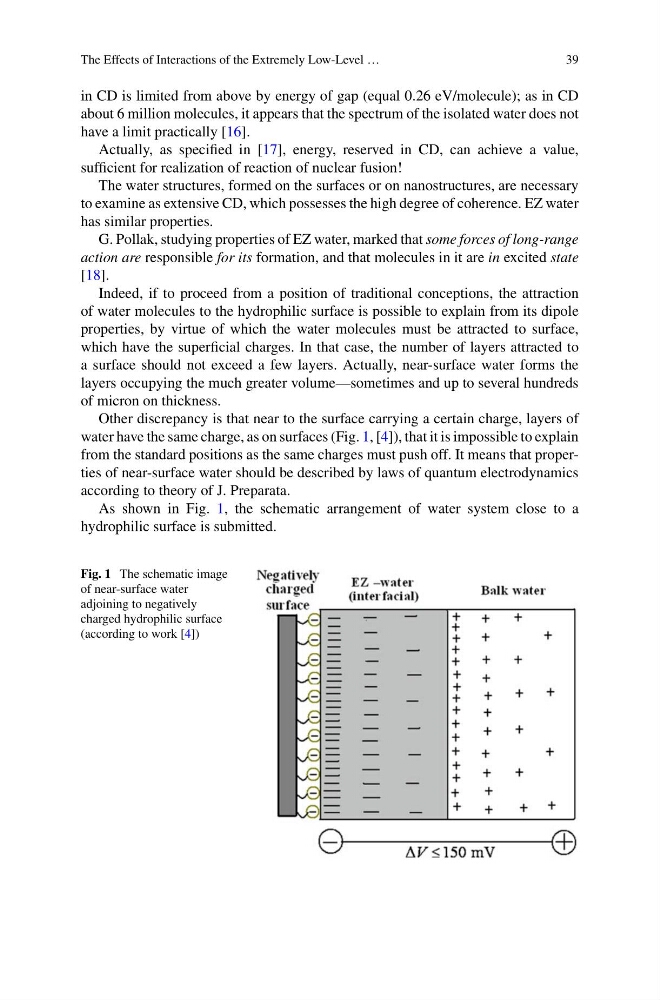
Other discrepancy is that near to the surface carrying a certain charge, layers of
water have the same charge, as on surfaces (Fig. 1, [4]), that it is impossible to explain
from the standard positions as the same charges must push off. It means that properties of near-surface water should be described by laws of quantum electrodynamics
according to theory of J. Preparata.
As shown in Fig. 1, the schematic arrangement of water system close to a
hydrophilic surface is submitted.
Fig. 1 The schematic image
of near-surface water
adjoining to negatively
charged hydrophilic surface
(according to work [4])
39
in CD is limited from above by energy of gap (equal 0.26 eV/molecule); as in CD
about 6 million molecules, it appears that the spectrum of the isolated water does not
have a limit practically [16].
Actually, as specified in [17], energy, reserved in CD, can achieve a value,
sufficient for realization of reaction of nuclear fusion!
The water structures, formed on the surfaces or on nanostructures, are necessary
to examine as extensive CD, which possesses the high degree of coherence. EZ water
has similar properties.
G. Pollak, studying properties of EZ water, marked that some forces of long-range
action are responsible for its formation, and that molecules in it are in excited state
[18].
Indeed, if to proceed from a position of traditional conceptions, the attraction
of water molecules to the hydrophilic surface is possible to explain from its dipole
properties, by virtue of which the water molecules must be attracted to surface,
which have the superficial charges. In that case, the number of layers attracted to
a surface should not exceed a few layers. Actually, near-surface water forms the
layers occupying the much greater volume—sometimes and up to several hundreds
of micron on thickness.
Other discrepancy is that near to the surface carrying a certain charge, layers of
water have the same charge, as on surfaces (Fig. 1, [4]), that it is impossible to explain
from the standard positions as the same charges must push off. It means that properties of near-surface water should be described by laws of quantum electrodynamics
according to theory of J. Preparata.
As shown in Fig. 1, the schematic arrangement of water system close to a
hydrophilic surface is submitted.
Fig. 1 The schematic image
of near-surface water
adjoining to negatively
charged hydrophilic surface
(according to work [4])