

622
S. I. Pokutnyi
π
∫
0
P l (cosθ)P l+1 (cosθ)sinθ cosθ dθ
a
∫
0
(r
3
−K a
3
)R 1,l (r )R 1,l+1 (r )dr
(25)
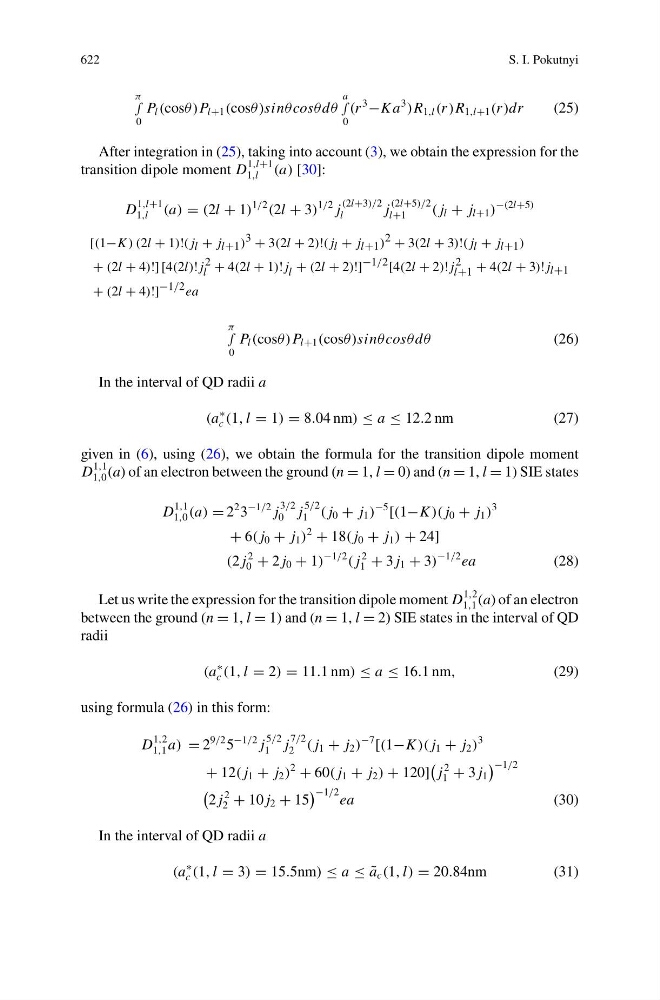
After integration in (25), taking into account (3), we obtain the expression for the
transition dipole moment D
1,l+1
1,l (a) [30]:
D
1,l+1
1,l (a) = (2l + 1)
1/2
(2l + 3)
1/2 j
(2l+3)/2
l
j
(2l+5)/2
l+1
( j l + j l+1 )
−(2l+5)
[(1−K ) (2l + 1)!( j l + j l+1 ) 3 + 3(2l + 2)!( j l + j l+1 ) 2 + 3(2l + 3)!( j l + j l+1 )
+ (2l + 4)!] [4(2l)! j 2
l + 4(2l + 1)! j l + (2l + 2)!] −1/2 [4(2l + 2)! j 2
l+1 + 4(2l + 3)! j l+1
+ (2l + 4)!] −1/2 ea
π
∫
0
P l (cosθ)P l+1 (cosθ)sinθ cosθ dθ
(26)
In the interval of QD radii a
(a
∗
c (1, l = 1) = 8.04 nm) ≤ a ≤ 12.2 nm
(27)
given in (6), using (26), we obtain the formula for the transition dipole moment
D
1,1
1,0 (a) of an electron between the ground (n = 1, l = 0) and (n = 1, l = 1) SIE states
D
1,1
1,0 (a) = 2
2 3
−1/2 j
3/2
0 j
5/2
1 ( j 0 + j 1 )
−5
[(1−K )( j 0 + j 1 )
3
+ 6( j 0 + j 1 )
2
+ 18( j 0 + j 1 ) + 24]
(2 j
2
0 + 2 j 0 + 1)
−1/2
( j
2
1 + 3 j 1 + 3)
−1/2 ea
(28)
Let us write the expression for the transition dipole moment D
1,2
1,1 (a) of an electron
between the ground (n = 1, l = 1) and (n = 1, l = 2) SIE states in the interval of QD
radii
(a
∗
c (1, l = 2) = 11.1 nm) ≤ a ≤ 16.1 nm,
(29)
using formula (26) in this form:
D
1,2
1,1 a) = 2
9/2 5
−1/2 j
5/2
1 j
7/2
2 ( j 1 + j 2 )
−7
[(1−K )( j 1 + j 2 )
3
+ 12( j 1 + j 2 )
2
+ 60( j 1 + j 2 ) + 120]
j
2
1 + 3 j 1
−1/2
2 j
2
2 + 10 j 2 + 15
−1/2 ea
(30)
In the interval of QD radii a
(a
∗
c (1, l = 3) = 15.5nm) ≤ a ≤ ˜
a c (1, l) = 20.84nm
(31)