

Polarization of Germanium Quantum Dots in Heterostructure Ge/Si …
619
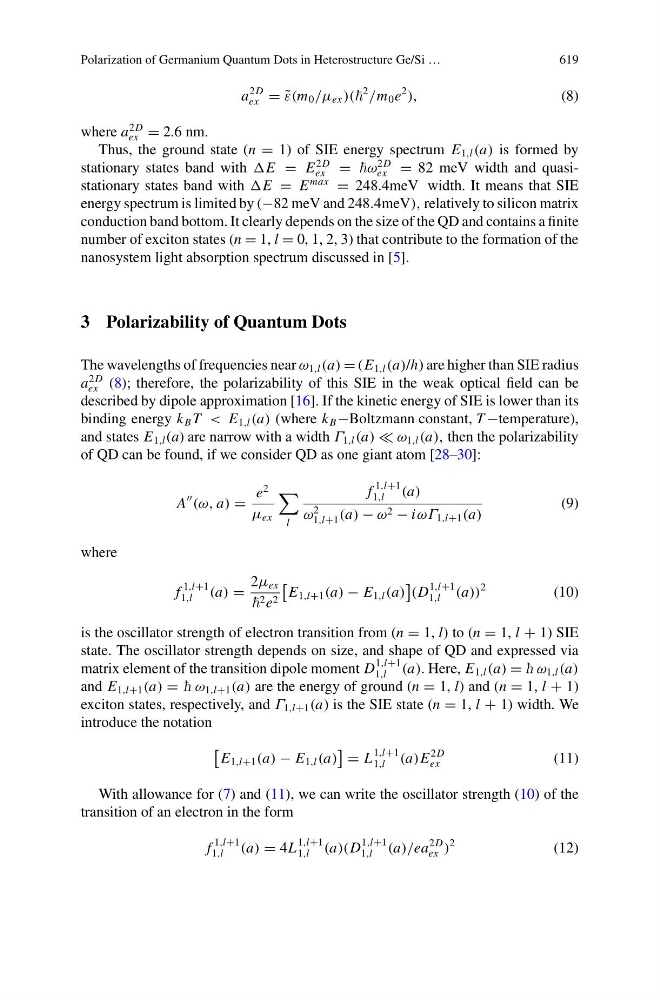
a
2D
ex = ˜
ε(m 0 /μ ex )(
2
/m 0 e
2
),
(8)
where a
2D
ex = 2.6 nm.
Thus, the ground state (n = 1) of SIE energy spectrum E 1,l (a) is formed by
stationary states band with E = E
2D
ex = ω
2D
ex = 82 meV width and quasistationary states band with E = E
max
= 248.4meV width. It means that SIE
energy spectrum is limited by (−82 meV and 248.4meV), relatively to silicon matrix
conduction band bottom. It clearly depends on the size of the QD and contains a finite
number of exciton states (n = 1, l = 0, 1, 2, 3) that contribute to the formation of the
nanosystem light absorption spectrum discussed in [5].
3 Polarizability of Quantum Dots
The wavelengths of frequencies near ω 1,l (a) = (E 1,l (a)/h) are higher than SIE radius
a
2D
ex (8); therefore, the polarizability of this SIE in the weak optical field can be
described by dipole approximation [16]. If the kinetic energy of SIE is lower than its
binding energy k B T < E 1,l (a) (where k B −Boltzmann constant, T −temperature),
and states E 1,l (a) are narrow with a width Γ 1,l (a) ω 1,l (a), then the polarizability
of QD can be found, if we consider QD as one giant atom [28–30]:
A
(ω, a) =
e
2
μ ex
l
f
1,l+1
1,l
(a)
ω
2
1,l+1 (a) − ω 2 − iωΓ 1,l+1 (a)
(9)
where
f
1,l+1
1,l
(a) =
2μ ex
2 e 2
E 1,l+1 (a) − E 1,l (a)
(D
1,l+1
1,l (a))
2
(10)
is the oscillator strength of electron transition from (n = 1, l) to (n = 1, l + 1) SIE
state. The oscillator strength depends on size, and shape of QD and expressed via
matrix element of the transition dipole moment D
1,l+1
1,l (a). Here, E 1,l (a) = è ω 1,l (a)
and E 1,l+1 (a) = è ω 1,l+1 (a) are the energy of ground (n = 1, l) and (n = 1, l + 1)
exciton states, respectively, and Γ 1,l+1 (a) is the SIE state (n = 1, l + 1) width. We
introduce the notation
E 1,l+1 (a) − E 1,l (a)
= L
1,l+1
1,l (a)E
2D
ex
(11)
With allowance for (7) and (11), we can write the oscillator strength (10) of the
transition of an electron in the form
f
1,l+1
1,l
(a) = 4L
1,l+1
1,l (a)(D
1,l+1
1,l (a)/ea
2D
ex )
2
(12)