

Polarization of Germanium Quantum Dots in Heterostructure Ge/Si …
617
At present, the optical absorption of Ge/Si nanosystems with germanium QDs was
not sufficiently clarified. Investigations in the theory of interaction of weak optical
fields with SIE in Ge/Si nanosystem with germanium QDs have not been performed
as of yet; to fill this gap, a theory of interaction of weak optical fields with SIE states
emerging in Ge/Si nanosystem with germanium QDs is developed in this study.
In this paper, we use the Ge/Si nanosystems with germanium QDs, from works
[1–3] to assess, within the framework of dipole approximation, the values of oscillator strength, transition dipole moments of the SIE ground state, QD polarizability,
and size effect impact. The results show significantly higher values than for electron transitions in bulk semiconductors. It makes possible the appearance of optical
nonlinearity even in weak optical fields when single transitions to exciton states are
taking place.
2 Energy Spectrum of Exciton States in the Nanosystem
Quantitative estimation of the QD size corresponding to various exciton states can
be carried out using the real nanosystem [1–3] containing the germanium QD with
a radius a and permittivity ε 2 = 16.3, in silicon matrix with ε 1 = 11.7. In this
nanosystem, a hole with effective mass (m h /m 0 ) = 0.39 moves in QD volume, and
electron with effective mass (m e /m 0 ) = 0.98 moves in silicon matrix (m 0 is free
electron mass), r e and r h —electron and hole distances from the QD center [4, 5].
In nanosystem, the main electronic level is located in a silicon matrix, and the main
hole level is in the QD. The energy of electron–hole Coulomb interaction and energy
polarization interaction causes localization of the electron in a potential well above
the surface of the QD [4, 5]. For simplicity, we assume that a hole h with effective
mass m h is located at the QD center (with r h = 0), and an electron e with effective
mass m e is localized over the spherical surface of the QD in the silicon matrix (r e =
r—distance of the electron e from the QD center).
In the model of quasi-zero-dimensional nanosystem in the framework of the
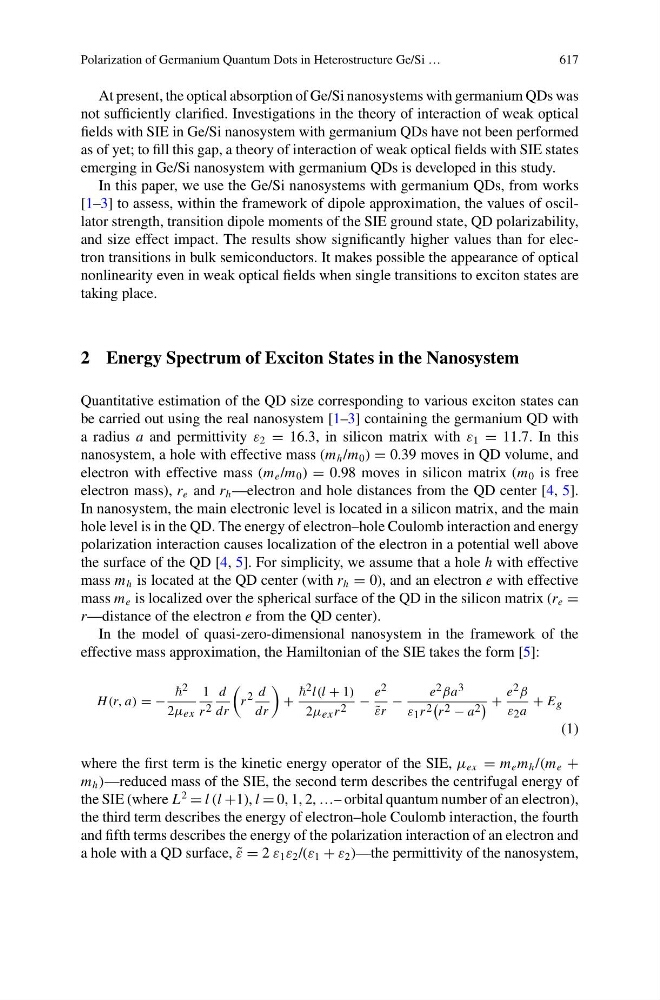
effective mass approximation, the Hamiltonian of the SIE takes the form [5]:
H (r, a) = −
2
2μ ex
1
r 2
d
dr
r 2 d
dr
+
2 l(l + 1)
2μ ex r 2 −
e 2
˜
εr
−
e 2 βa 3
ε 1 r 2
r 2 − a 2
+
e 2 β
ε 2 a
+ E g
(1)
where the first term is the kinetic energy operator of the SIE, μ ex = m e m h /(m e +
m h )—reduced mass of the SIE, the second term describes the centrifugal energy of
the SIE (where L
2
= l (l +1), l = 0, 1, 2, …– orbital quantum number of an electron),
the third term describes the energy of electron–hole Coulomb interaction, the fourth
and fifth terms describes the energy of the polarization interaction of an electron and
a hole with a QD surface, ˜
ε = 2 ε 1 ε 2 /(ε 1 + ε 2 )—the permittivity of the nanosystem,