

570
E. I. Get’man and S. V. Radio
with Er. However, no information on the substitution limits in the Lu 2–x Sc x SiO 5 and
Er x Sc 2–x SiO 5 systems is available.
It is important to determine experimentally solubility regions in the solid phase,
which requires special equipment, additional expensive reagents, and more time.
This forces researchers who study the properties of “mixed” REE oxyorthosilicates
to choose the composition of host matrix materials and activators either by analogy
with related systems or by trial and error.
It is often ignored that “mixed” REE oxyorthosilicates tend to decompose and
change their phase composition and properties upon cooling. This can lead to the
degradation of materials based on them if used in practical applications. Therefore,
before carrying synthesis and studying it, it is recommended to evaluate the stability
of solid solutions in the corresponding systems during their synthesis and intended
use.
In view of this, the aim of this research is to predict the phase stability and substitution limits in materials based on solid solutions of oxyorthosilicate of scandium
and REEs of Tb–Lu row, and Y.
Yttrium subgroup REEs and yttrium were chosen as second cations due to their
isostructurality with Sc 2 SiO 5 , as well as the proximity of crystalline ionic radii of
Sc
3+ (0.885 Å) and triple-charged cations of yttrium subgroup REEs and yttrium
(1.063–1.001 Å [14]), which suggests the wide presence of isomorphic substitution of scandium by these REEs. The radii of the cerium subgroup REE cations
(1.172–1.078 Å) significantly differ from the ionic radius of scandium, and their
oxyorthosilicates are not isostructural with Sc 2 SiO 5 [15], which, according to the
theory of isomorphic miscibility [16–18], should significantly limit the solubility of
components in systems with scandium and REEs of the La–Gd series.
2 Calculation Procedure and Initial Data
The main task in calculating the substitution limits of solid solutions using the
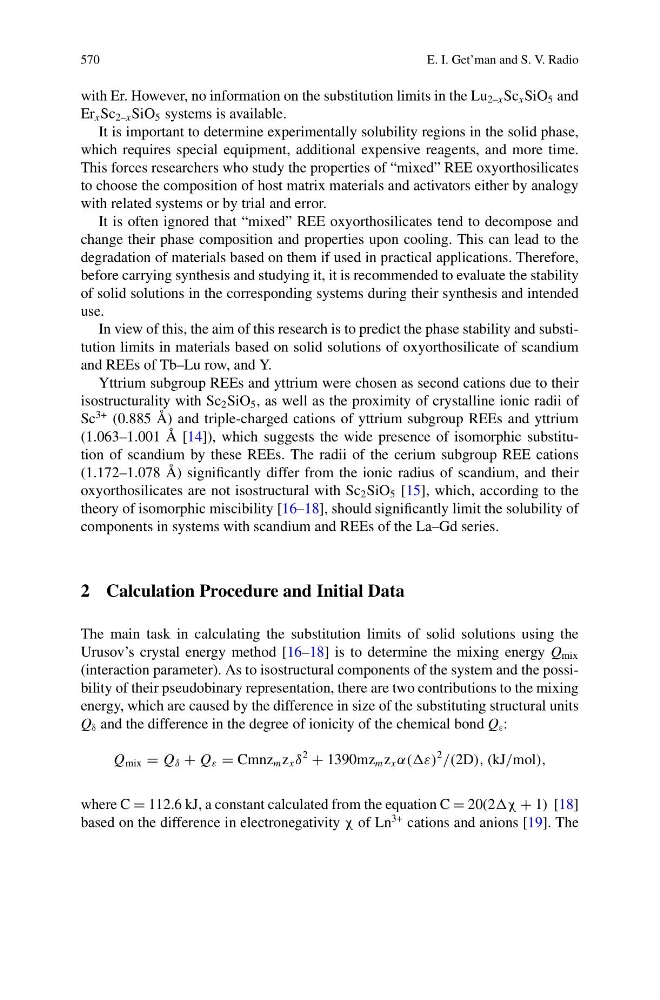
Urusov’s crystal energy method [16–18] is to determine the mixing energy Q mix
(interaction parameter). As to isostructural components of the system and the possibility of their pseudobinary representation, there are two contributions to the mixing
energy, which are caused by the difference in size of the substituting structural units
Q δ and the difference in the degree of ionicity of the chemical bond Q ε :
Q mix = Q δ + Q ε = Cmnz m z x δ
2
+ 1390mz m z x α(ε)
2
/(2D), (kJ/mol),
where C = 112.6 kJ, a constant calculated from the equation C = 20(2χ + 1) [18]
based on the difference in electronegativity χ of Ln
3+ cations and anions [19]. The
E. I. Get’man and S. V. Radio
with Er. However, no information on the substitution limits in the Lu 2–x Sc x SiO 5 and
Er x Sc 2–x SiO 5 systems is available.
It is important to determine experimentally solubility regions in the solid phase,
which requires special equipment, additional expensive reagents, and more time.
This forces researchers who study the properties of “mixed” REE oxyorthosilicates
to choose the composition of host matrix materials and activators either by analogy
with related systems or by trial and error.
It is often ignored that “mixed” REE oxyorthosilicates tend to decompose and
change their phase composition and properties upon cooling. This can lead to the
degradation of materials based on them if used in practical applications. Therefore,
before carrying synthesis and studying it, it is recommended to evaluate the stability
of solid solutions in the corresponding systems during their synthesis and intended
use.
In view of this, the aim of this research is to predict the phase stability and substitution limits in materials based on solid solutions of oxyorthosilicate of scandium
and REEs of Tb–Lu row, and Y.
Yttrium subgroup REEs and yttrium were chosen as second cations due to their
isostructurality with Sc 2 SiO 5 , as well as the proximity of crystalline ionic radii of
Sc
3+ (0.885 Å) and triple-charged cations of yttrium subgroup REEs and yttrium
(1.063–1.001 Å [14]), which suggests the wide presence of isomorphic substitution of scandium by these REEs. The radii of the cerium subgroup REE cations
(1.172–1.078 Å) significantly differ from the ionic radius of scandium, and their
oxyorthosilicates are not isostructural with Sc 2 SiO 5 [15], which, according to the
theory of isomorphic miscibility [16–18], should significantly limit the solubility of
components in systems with scandium and REEs of the La–Gd series.
2 Calculation Procedure and Initial Data
The main task in calculating the substitution limits of solid solutions using the
Urusov’s crystal energy method [16–18] is to determine the mixing energy Q mix
(interaction parameter). As to isostructural components of the system and the possibility of their pseudobinary representation, there are two contributions to the mixing
energy, which are caused by the difference in size of the substituting structural units
Q δ and the difference in the degree of ionicity of the chemical bond Q ε :
Q mix = Q δ + Q ε = Cmnz m z x δ
2
+ 1390mz m z x α(ε)
2
/(2D), (kJ/mol),
where C = 112.6 kJ, a constant calculated from the equation C = 20(2χ + 1) [18]
based on the difference in electronegativity χ of Ln
3+ cations and anions [19]. The