

Structure and Properties of Nanostructured Metallic Glass …
565
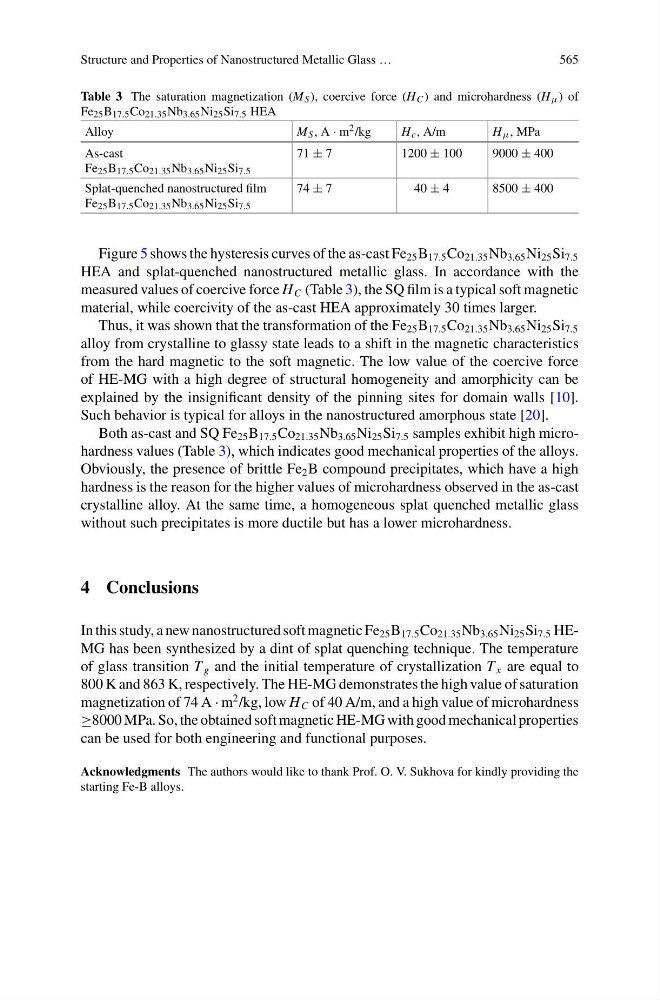
Table 3 The saturation magnetization (M S ), coercive force (H C ) and microhardness (H μ ) of
Fe 25 B 17.5 Co 21.35 Nb 3.65 Ni 25 Si 7.5 HEA
Alloy
M S , A · m 2 /kg
H c , A/m
H μ , MPa
As-cast
Fe 25 B 17.5 Co 21.35 Nb 3.65 Ni 25 Si 7.5
71 ± 7
1200 ± 100
9000 ± 400
Splat-quenched nanostructured film
Fe 25 B 17.5 Co 21.35 Nb 3.65 Ni 25 Si 7.5
74 ± 7
40 ± 4
8500 ± 400
Figure 5 shows the hysteresis curves of the as-cast Fe 25 B 17.5 Co 21.35 Nb 3.65 Ni 25 Si 7.5
HEA and splat-quenched nanostructured metallic glass. In accordance with the
measured values of coercive force H C (Table 3), the SQ film is a typical soft magnetic
material, while coercivity of the as-cast HEA approximately 30 times larger.
Thus, it was shown that the transformation of the Fe 25 B 17.5 Co 21.35 Nb 3.65 Ni 25 Si 7.5
alloy from crystalline to glassy state leads to a shift in the magnetic characteristics
from the hard magnetic to the soft magnetic. The low value of the coercive force
of HE-MG with a high degree of structural homogeneity and amorphicity can be
explained by the insignificant density of the pinning sites for domain walls [10].
Such behavior is typical for alloys in the nanostructured amorphous state [20].
Both as-cast and SQ Fe 25 B 17.5 Co 21.35 Nb 3.65 Ni 25 Si 7.5 samples exhibit high microhardness values (Table 3), which indicates good mechanical properties of the alloys.
Obviously, the presence of brittle Fe 2 B compound precipitates, which have a high
hardness is the reason for the higher values of microhardness observed in the as-cast
crystalline alloy. At the same time, a homogeneous splat quenched metallic glass
without such precipitates is more ductile but has a lower microhardness.
4 Conclusions
In this study, a new nanostructured soft magnetic Fe 25 B 17.5 Co 21.35 Nb 3.65 Ni 25 Si 7.5 HEMG has been synthesized by a dint of splat quenching technique. The temperature
of glass transition T g and the initial temperature of crystallization T x are equal to
800 K and 863 K, respectively. The HE-MG demonstrates the high value of saturation
magnetization of 74 A · m
2 /kg, low H C of 40 A/m, and a high value of microhardness
≥8000 MPa. So, the obtained soft magnetic HE-MG with good mechanical properties
can be used for both engineering and functional purposes.
Acknowledgments The authors would like to thank Prof. O. V. Sukhova for kindly providing the
starting Fe-B alloys.
565
Table 3 The saturation magnetization (M S ), coercive force (H C ) and microhardness (H μ ) of
Fe 25 B 17.5 Co 21.35 Nb 3.65 Ni 25 Si 7.5 HEA
Alloy
M S , A · m 2 /kg
H c , A/m
H μ , MPa
As-cast
Fe 25 B 17.5 Co 21.35 Nb 3.65 Ni 25 Si 7.5
71 ± 7
1200 ± 100
9000 ± 400
Splat-quenched nanostructured film
Fe 25 B 17.5 Co 21.35 Nb 3.65 Ni 25 Si 7.5
74 ± 7
40 ± 4
8500 ± 400
Figure 5 shows the hysteresis curves of the as-cast Fe 25 B 17.5 Co 21.35 Nb 3.65 Ni 25 Si 7.5
HEA and splat-quenched nanostructured metallic glass. In accordance with the
measured values of coercive force H C (Table 3), the SQ film is a typical soft magnetic
material, while coercivity of the as-cast HEA approximately 30 times larger.
Thus, it was shown that the transformation of the Fe 25 B 17.5 Co 21.35 Nb 3.65 Ni 25 Si 7.5
alloy from crystalline to glassy state leads to a shift in the magnetic characteristics
from the hard magnetic to the soft magnetic. The low value of the coercive force
of HE-MG with a high degree of structural homogeneity and amorphicity can be
explained by the insignificant density of the pinning sites for domain walls [10].
Such behavior is typical for alloys in the nanostructured amorphous state [20].
Both as-cast and SQ Fe 25 B 17.5 Co 21.35 Nb 3.65 Ni 25 Si 7.5 samples exhibit high microhardness values (Table 3), which indicates good mechanical properties of the alloys.
Obviously, the presence of brittle Fe 2 B compound precipitates, which have a high
hardness is the reason for the higher values of microhardness observed in the as-cast
crystalline alloy. At the same time, a homogeneous splat quenched metallic glass
without such precipitates is more ductile but has a lower microhardness.
4 Conclusions
In this study, a new nanostructured soft magnetic Fe 25 B 17.5 Co 21.35 Nb 3.65 Ni 25 Si 7.5 HEMG has been synthesized by a dint of splat quenching technique. The temperature
of glass transition T g and the initial temperature of crystallization T x are equal to
800 K and 863 K, respectively. The HE-MG demonstrates the high value of saturation
magnetization of 74 A · m
2 /kg, low H C of 40 A/m, and a high value of microhardness
≥8000 MPa. So, the obtained soft magnetic HE-MG with good mechanical properties
can be used for both engineering and functional purposes.
Acknowledgments The authors would like to thank Prof. O. V. Sukhova for kindly providing the
starting Fe-B alloys.