

Structure and Properties of Nanostructured Metallic Glass …
559
using a tester PMT-3 at a load of 100 g. The coercive force (H C ) was measured at
room temperature with a B–H curve tracer. The hysteresis loops of the samples were
measured at room temperature via a vibrating sample magnetometer (VSM) with the
field applied parallel to the plane of the film.
3 Results and Discussion
There are two main criteria by which the HEAs are usually characterized. This is
the entropy of mixing S mix and the enthalpy of mixing H mix . However, to predict
the phase composition of HEAs, some additional parameters were proposed [1, 3].
These parameters include in particular the valence electron concentration (VEC),
the thermodynamic parameter , which takes into account the melting temperature,
mixing entropy and the mixing enthalpy. The important parameter is an atomic-size
difference between alloy components which is denoted as δ.
Lately, it was found that the topological instability of atomic packing is also
affected by the atomic-size difference [15]. In accordance with the results of [15],
a decisive role in determining the stability of the atomic packaging in HEAs is
played by atoms with minimum and maximum radii. To characterize quantitatively
the effects of the atomic-size difference on the packing in HEAs it is necessary to
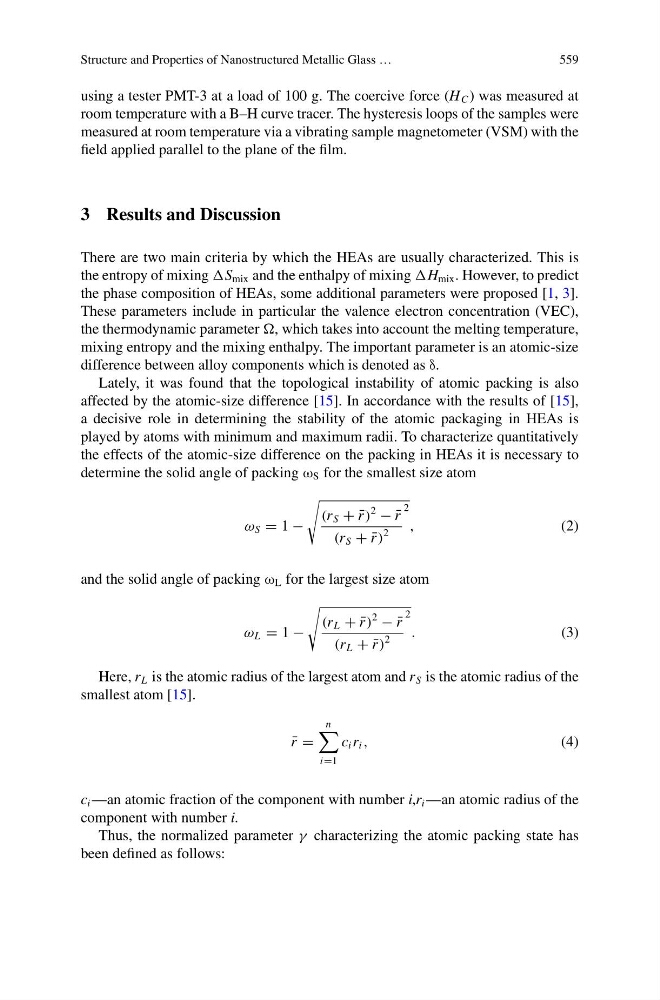
determine the solid angle of packing ω S for the smallest size atom
ω S = 1 −
(r S + ¯
r )
2
− ¯
r
(r S + ¯
r )
2
2
,
(2)
and the solid angle of packing ω L for the largest size atom
ω L = 1 −
(r L + ¯
r )
2
− ¯
r
(r L + ¯
r )
2
2
.
(3)
Here, r L is the atomic radius of the largest atom and r S is the atomic radius of the
smallest atom [15].
¯
r =
n
i=1
c i r i ,
(4)
c i —an atomic fraction of the component with number i,r i —an atomic radius of the
component with number i.
Thus, the normalized parameter γ characterizing the atomic packing state has
been defined as follows:
559
using a tester PMT-3 at a load of 100 g. The coercive force (H C ) was measured at
room temperature with a B–H curve tracer. The hysteresis loops of the samples were
measured at room temperature via a vibrating sample magnetometer (VSM) with the
field applied parallel to the plane of the film.
3 Results and Discussion
There are two main criteria by which the HEAs are usually characterized. This is
the entropy of mixing S mix and the enthalpy of mixing H mix . However, to predict
the phase composition of HEAs, some additional parameters were proposed [1, 3].
These parameters include in particular the valence electron concentration (VEC),
the thermodynamic parameter , which takes into account the melting temperature,
mixing entropy and the mixing enthalpy. The important parameter is an atomic-size
difference between alloy components which is denoted as δ.
Lately, it was found that the topological instability of atomic packing is also
affected by the atomic-size difference [15]. In accordance with the results of [15],
a decisive role in determining the stability of the atomic packaging in HEAs is
played by atoms with minimum and maximum radii. To characterize quantitatively
the effects of the atomic-size difference on the packing in HEAs it is necessary to
determine the solid angle of packing ω S for the smallest size atom
ω S = 1 −
(r S + ¯
r )
2
− ¯
r
(r S + ¯
r )
2
2
,
(2)
and the solid angle of packing ω L for the largest size atom
ω L = 1 −
(r L + ¯
r )
2
− ¯
r
(r L + ¯
r )
2
2
.
(3)
Here, r L is the atomic radius of the largest atom and r S is the atomic radius of the
smallest atom [15].
¯
r =
n
i=1
c i r i ,
(4)
c i —an atomic fraction of the component with number i,r i —an atomic radius of the
component with number i.
Thus, the normalized parameter γ characterizing the atomic packing state has
been defined as follows: