

Role of Active Complexes of Selected Thiopurine Derivatives …
527
400
200
0
-200 -400 -600 -800 -1000 -1200 -1400
E/ mV
0
20
40
60
80
100
120
140
160
C
d /µF .
cm
-2
AZA
6MP
6TG
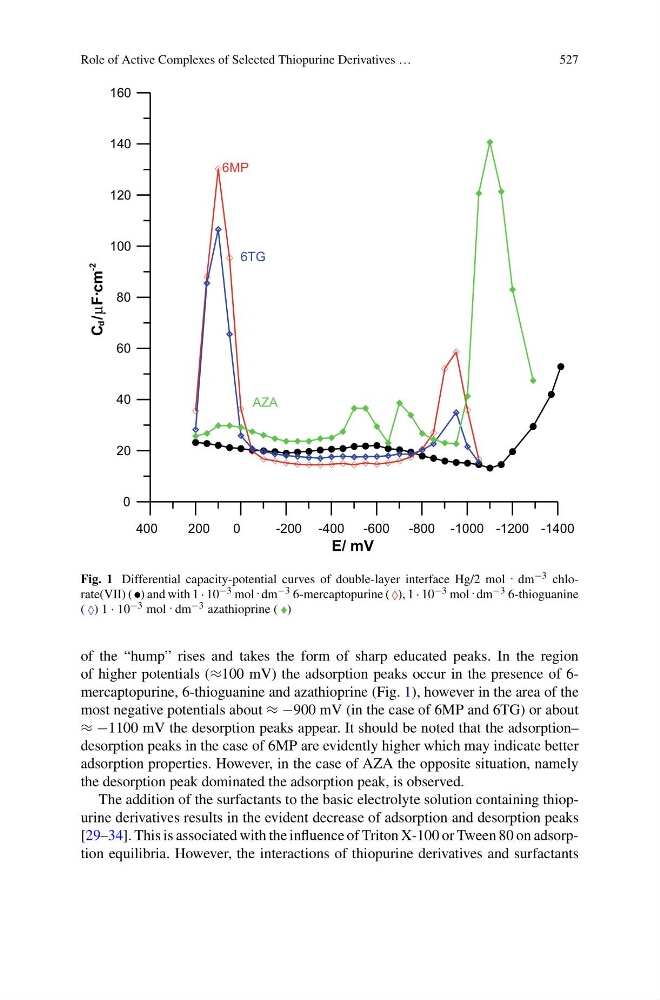
Fig. 1 Differential capacity-potential curves of double-layer interface Hg/2 mol : dm −3 chlorate(VII) ( ) and with 1 · 10 −3 mol : dm −3 6-mercaptopurine ( ), 1 · 10 −3 mol : dm −3 6-thioguanine
( ) 1 · 10 −3 mol : dm −3 azathioprine ( )
of the “hump” rises and takes the form of sharp educated peaks. In the region
of higher potentials (≈100 mV) the adsorption peaks occur in the presence of 6mercaptopurine, 6-thioguanine and azathioprine (Fig. 1), however in the area of the
most negative potentials about ≈ −900 mV (in the case of 6MP and 6TG) or about
≈ −1100 mV the desorption peaks appear. It should be noted that the adsorption–
desorption peaks in the case of 6MP are evidently higher which may indicate better
adsorption properties. However, in the case of AZA the opposite situation, namely
the desorption peak dominated the adsorption peak, is observed.
The addition of the surfactants to the basic electrolyte solution containing thiopurine derivatives results in the evident decrease of adsorption and desorption peaks
[29–34]. This is associated with the influence of Triton X-100 or Tween 80 on adsorption equilibria. However, the interactions of thiopurine derivatives and surfactants
527
400
200
0
-200 -400 -600 -800 -1000 -1200 -1400
E/ mV
0
20
40
60
80
100
120
140
160
C
d /µF .
cm
-2
AZA
6MP
6TG
Fig. 1 Differential capacity-potential curves of double-layer interface Hg/2 mol : dm −3 chlorate(VII) ( ) and with 1 · 10 −3 mol : dm −3 6-mercaptopurine ( ), 1 · 10 −3 mol : dm −3 6-thioguanine
( ) 1 · 10 −3 mol : dm −3 azathioprine ( )
of the “hump” rises and takes the form of sharp educated peaks. In the region
of higher potentials (≈100 mV) the adsorption peaks occur in the presence of 6mercaptopurine, 6-thioguanine and azathioprine (Fig. 1), however in the area of the
most negative potentials about ≈ −900 mV (in the case of 6MP and 6TG) or about
≈ −1100 mV the desorption peaks appear. It should be noted that the adsorption–
desorption peaks in the case of 6MP are evidently higher which may indicate better
adsorption properties. However, in the case of AZA the opposite situation, namely
the desorption peak dominated the adsorption peak, is observed.
The addition of the surfactants to the basic electrolyte solution containing thiopurine derivatives results in the evident decrease of adsorption and desorption peaks
[29–34]. This is associated with the influence of Triton X-100 or Tween 80 on adsorption equilibria. However, the interactions of thiopurine derivatives and surfactants