

Structure and Properties of the POSS-Containing Nanocomposites …
487
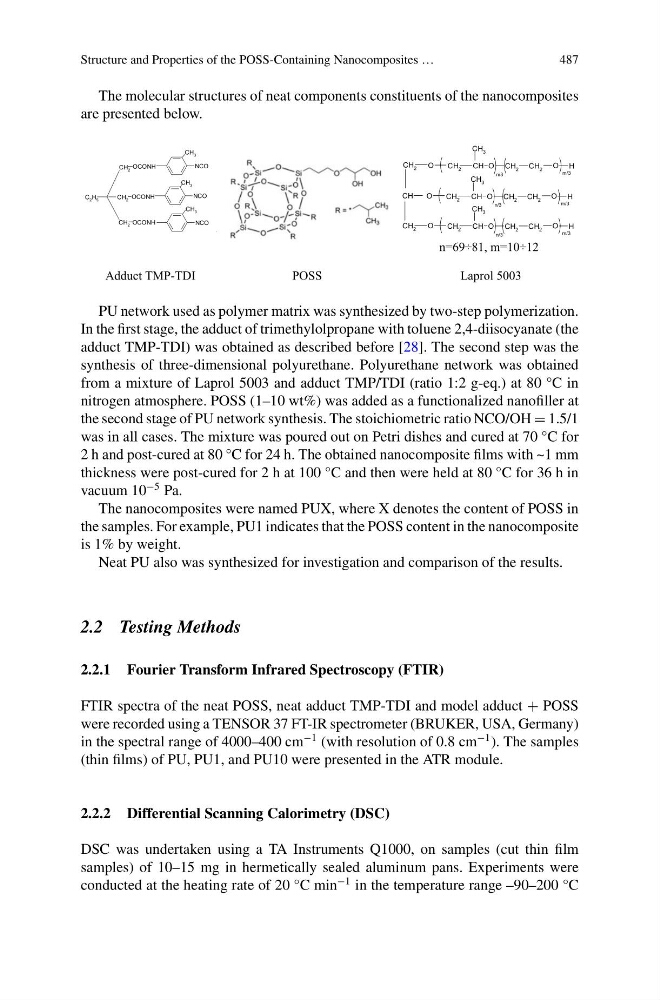
The molecular structures of neat components constituents of the nanocomposites
are presented below.
C 2 H 5
CH 2
CH 2
OCONH
CH 2 OCONH
NCO
NCO
CH 3
CH 3
OCONH
NCO
CH 3
CH 3
CH 2
CH O
O
CH 2
CH
CH 2
CH 2 CH 2 O H
CH 3
CH 2
CH O
O
CH 2 CH 2 O H
CH 3
CH 2
CH O
O
CH 2 CH 2 O H
m/3
n/3
m/3
n/3
m/3
n/3
n=69÷81, m=10÷12
Adduct TMP-TDI
POSS
Laprol 5003
PU network used as polymer matrix was synthesized by two-step polymerization.
In the first stage, the adduct of trimethylolpropane with toluene 2,4-diisocyanate (the
adduct TMP-TDI) was obtained as described before [28]. The second step was the
synthesis of three-dimensional polyurethane. Polyurethane network was obtained
from a mixture of Laprol 5003 and adduct TMP/TDI (ratio 1:2 g-eq.) at 80 °C in
nitrogen atmosphere. POSS (1–10 wt%) was added as a functionalized nanofiller at
the second stage of PU network synthesis. The stoichiometric ratio NCO/OH = 1.5/1
was in all cases. The mixture was poured out on Petri dishes and cured at 70 °C for
2 h and post-cured at 80 °C for 24 h. The obtained nanocomposite films with ~1 mm
thickness were post-cured for 2 h at 100 °C and then were held at 80 °C for 36 h in
vacuum 10
−5 Pa.
The nanocomposites were named PUX, where X denotes the content of POSS in
the samples. For example, PU1 indicates that the POSS content in the nanocomposite
is 1% by weight.
Neat PU also was synthesized for investigation and comparison of the results.
2.2 Testing Methods
2.2.1 Fourier Transform Infrared Spectroscopy (FTIR)
FTIR spectra of the neat POSS, neat adduct TMP-TDI and model adduct + POSS
were recorded using a TENSOR 37 FT-IR spectrometer (BRUKER, USA, Germany)
in the spectral range of 4000–400 cm
−1 (with resolution of 0.8 cm
−1 ). The samples
(thin films) of PU, PU1, and PU10 were presented in the ATR module.
2.2.2 Differential Scanning Calorimetry (DSC)
DSC was undertaken using a TA Instruments Q1000, on samples (cut thin film
samples) of 10–15 mg in hermetically sealed aluminum pans. Experiments were
conducted at the heating rate of 20 °C min
−1 in the temperature range –90–200 °C
487
The molecular structures of neat components constituents of the nanocomposites
are presented below.
C 2 H 5
CH 2
CH 2
OCONH
CH 2 OCONH
NCO
NCO
CH 3
CH 3
OCONH
NCO
CH 3
CH 3
CH 2
CH O
O
CH 2
CH
CH 2
CH 2 CH 2 O H
CH 3
CH 2
CH O
O
CH 2 CH 2 O H
CH 3
CH 2
CH O
O
CH 2 CH 2 O H
m/3
n/3
m/3
n/3
m/3
n/3
n=69÷81, m=10÷12
Adduct TMP-TDI
POSS
Laprol 5003
PU network used as polymer matrix was synthesized by two-step polymerization.
In the first stage, the adduct of trimethylolpropane with toluene 2,4-diisocyanate (the
adduct TMP-TDI) was obtained as described before [28]. The second step was the
synthesis of three-dimensional polyurethane. Polyurethane network was obtained
from a mixture of Laprol 5003 and adduct TMP/TDI (ratio 1:2 g-eq.) at 80 °C in
nitrogen atmosphere. POSS (1–10 wt%) was added as a functionalized nanofiller at
the second stage of PU network synthesis. The stoichiometric ratio NCO/OH = 1.5/1
was in all cases. The mixture was poured out on Petri dishes and cured at 70 °C for
2 h and post-cured at 80 °C for 24 h. The obtained nanocomposite films with ~1 mm
thickness were post-cured for 2 h at 100 °C and then were held at 80 °C for 36 h in
vacuum 10
−5 Pa.
The nanocomposites were named PUX, where X denotes the content of POSS in
the samples. For example, PU1 indicates that the POSS content in the nanocomposite
is 1% by weight.
Neat PU also was synthesized for investigation and comparison of the results.
2.2 Testing Methods
2.2.1 Fourier Transform Infrared Spectroscopy (FTIR)
FTIR spectra of the neat POSS, neat adduct TMP-TDI and model adduct + POSS
were recorded using a TENSOR 37 FT-IR spectrometer (BRUKER, USA, Germany)
in the spectral range of 4000–400 cm
−1 (with resolution of 0.8 cm
−1 ). The samples
(thin films) of PU, PU1, and PU10 were presented in the ATR module.
2.2.2 Differential Scanning Calorimetry (DSC)
DSC was undertaken using a TA Instruments Q1000, on samples (cut thin film
samples) of 10–15 mg in hermetically sealed aluminum pans. Experiments were
conducted at the heating rate of 20 °C min
−1 in the temperature range –90–200 °C