

478
B. M. Gorelov et al.
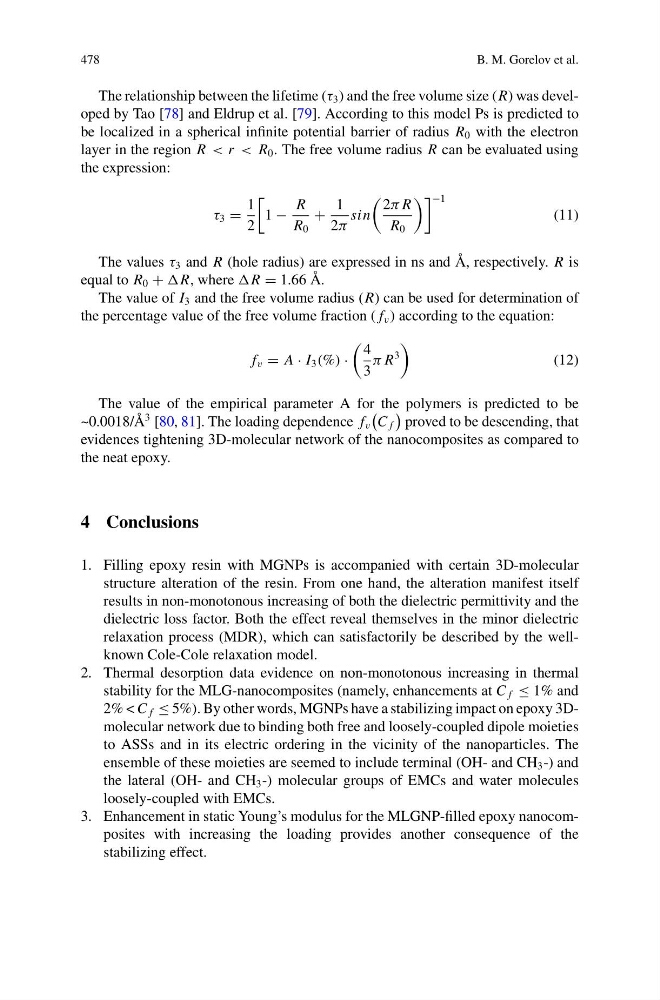
The relationship between the lifetime (τ 3 ) and the free volume size (R) was developed by Tao [78] and Eldrup et al. [79]. According to this model Ps is predicted to
be localized in a spherical infinite potential barrier of radius R 0 with the electron
layer in the region R < r < R 0 . The free volume radius R can be evaluated using
the expression:
τ 3 =
1
2
1 −
R
R 0
+
1
2π
sin
2π R
R 0
−1
(11)
The values τ 3 and R (hole radius) are expressed in ns and Å, respectively. R is
equal to R 0 + R, where R = 1.66 Å.
The value of I 3 and the free volume radius (R) can be used for determination of
the percentage value of the free volume fraction ( f v ) according to the equation:
f v = A · I 3 (%) ·
4
3
π R
3
(12)
The value of the empirical parameter A for the polymers is predicted to be
~0.0018/Å
3 [80, 81]. The loading dependence f v
C f
proved to be descending, that
evidences tightening 3D-molecular network of the nanocomposites as compared to
the neat epoxy.
4 Conclusions
1. Filling epoxy resin with MGNPs is accompanied with certain 3D-molecular
structure alteration of the resin. From one hand, the alteration manifest itself
results in non-monotonous increasing of both the dielectric permittivity and the
dielectric loss factor. Both the effect reveal themselves in the minor dielectric
relaxation process (MDR), which can satisfactorily be described by the wellknown Cole-Cole relaxation model.
2. Thermal desorption data evidence on non-monotonous increasing in thermal
stability for the MLG-nanocomposites (namely, enhancements at C f ≤ 1% and
2% < C f ≤ 5%). By other words, MGNPs have a stabilizing impact on epoxy 3Dmolecular network due to binding both free and loosely-coupled dipole moieties
to ASSs and in its electric ordering in the vicinity of the nanoparticles. The
ensemble of these moieties are seemed to include terminal (OH- and CH 3 -) and
the lateral (OH- and CH 3 -) molecular groups of EMCs and water molecules
loosely-coupled with EMCs.
3. Enhancement in static Young’s modulus for the MLGNP-filled epoxy nanocomposites with increasing the loading provides another consequence of the
stabilizing effect.
B. M. Gorelov et al.
The relationship between the lifetime (τ 3 ) and the free volume size (R) was developed by Tao [78] and Eldrup et al. [79]. According to this model Ps is predicted to
be localized in a spherical infinite potential barrier of radius R 0 with the electron
layer in the region R < r < R 0 . The free volume radius R can be evaluated using
the expression:
τ 3 =
1
2
1 −
R
R 0
+
1
2π
sin
2π R
R 0
−1
(11)
The values τ 3 and R (hole radius) are expressed in ns and Å, respectively. R is
equal to R 0 + R, where R = 1.66 Å.
The value of I 3 and the free volume radius (R) can be used for determination of
the percentage value of the free volume fraction ( f v ) according to the equation:
f v = A · I 3 (%) ·
4
3
π R
3
(12)
The value of the empirical parameter A for the polymers is predicted to be
~0.0018/Å
3 [80, 81]. The loading dependence f v
C f
proved to be descending, that
evidences tightening 3D-molecular network of the nanocomposites as compared to
the neat epoxy.
4 Conclusions
1. Filling epoxy resin with MGNPs is accompanied with certain 3D-molecular
structure alteration of the resin. From one hand, the alteration manifest itself
results in non-monotonous increasing of both the dielectric permittivity and the
dielectric loss factor. Both the effect reveal themselves in the minor dielectric
relaxation process (MDR), which can satisfactorily be described by the wellknown Cole-Cole relaxation model.
2. Thermal desorption data evidence on non-monotonous increasing in thermal
stability for the MLG-nanocomposites (namely, enhancements at C f ≤ 1% and
2% < C f ≤ 5%). By other words, MGNPs have a stabilizing impact on epoxy 3Dmolecular network due to binding both free and loosely-coupled dipole moieties
to ASSs and in its electric ordering in the vicinity of the nanoparticles. The
ensemble of these moieties are seemed to include terminal (OH- and CH 3 -) and
the lateral (OH- and CH 3 -) molecular groups of EMCs and water molecules
loosely-coupled with EMCs.
3. Enhancement in static Young’s modulus for the MLGNP-filled epoxy nanocomposites with increasing the loading provides another consequence of the
stabilizing effect.