

464
B. M. Gorelov et al.
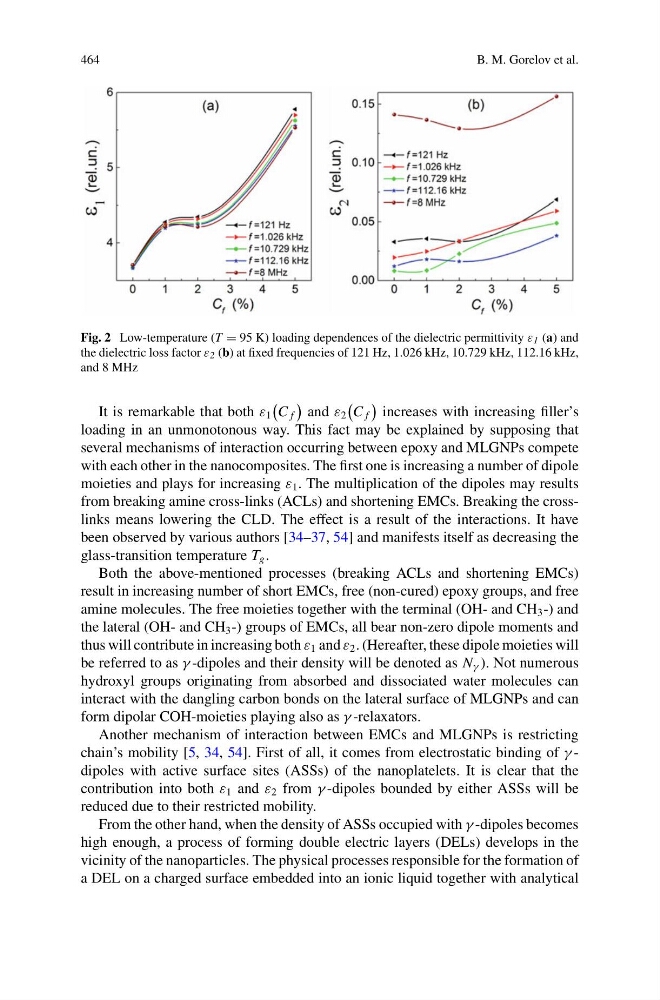
Fig. 2 Low-temperature (T = 95 K) loading dependences of the dielectric permittivity ε 1 (a) and
the dielectric loss factor ε 2 (b) at fixed frequencies of 121 Hz, 1.026 kHz, 10.729 kHz, 112.16 kHz,
and 8 MHz
It is remarkable that both ε 1
C f
and ε 2
C f
increases with increasing filler’s
loading in an unmonotonous way. This fact may be explained by supposing that
several mechanisms of interaction occurring between epoxy and MLGNPs compete
with each other in the nanocomposites. The first one is increasing a number of dipole
moieties and plays for increasing ε 1 . The multiplication of the dipoles may results
from breaking amine cross-links (ACLs) and shortening EMCs. Breaking the crosslinks means lowering the CLD. The effect is a result of the interactions. It have
been observed by various authors [34–37, 54] and manifests itself as decreasing the
glass-transition temperature T g .
Both the above-mentioned processes (breaking ACLs and shortening EMCs)
result in increasing number of short EMCs, free (non-cured) epoxy groups, and free
amine molecules. The free moieties together with the terminal (OH- and CH 3 -) and
the lateral (OH- and CH 3 -) groups of EMCs, all bear non-zero dipole moments and
thus will contribute in increasing both ε 1 and ε 2 . (Hereafter, these dipole moieties will
be referred to as γ -dipoles and their density will be denoted as N γ ). Not numerous
hydroxyl groups originating from absorbed and dissociated water molecules can
interact with the dangling carbon bonds on the lateral surface of MLGNPs and can
form dipolar COH-moieties playing also as γ -relaxators.
Another mechanism of interaction between EMCs and MLGNPs is restricting
chain’s mobility [5, 34, 54]. First of all, it comes from electrostatic binding of γ -
dipoles with active surface sites (ASSs) of the nanoplatelets. It is clear that the
contribution into both ε 1 and ε 2 from γ -dipoles bounded by either ASSs will be
reduced due to their restricted mobility.
From the other hand, when the density of ASSs occupied with γ -dipoles becomes
high enough, a process of forming double electric layers (DELs) develops in the
vicinity of the nanoparticles. The physical processes responsible for the formation of
a DEL on a charged surface embedded into an ionic liquid together with analytical
B. M. Gorelov et al.
Fig. 2 Low-temperature (T = 95 K) loading dependences of the dielectric permittivity ε 1 (a) and
the dielectric loss factor ε 2 (b) at fixed frequencies of 121 Hz, 1.026 kHz, 10.729 kHz, 112.16 kHz,
and 8 MHz
It is remarkable that both ε 1
C f
and ε 2
C f
increases with increasing filler’s
loading in an unmonotonous way. This fact may be explained by supposing that
several mechanisms of interaction occurring between epoxy and MLGNPs compete
with each other in the nanocomposites. The first one is increasing a number of dipole
moieties and plays for increasing ε 1 . The multiplication of the dipoles may results
from breaking amine cross-links (ACLs) and shortening EMCs. Breaking the crosslinks means lowering the CLD. The effect is a result of the interactions. It have
been observed by various authors [34–37, 54] and manifests itself as decreasing the
glass-transition temperature T g .
Both the above-mentioned processes (breaking ACLs and shortening EMCs)
result in increasing number of short EMCs, free (non-cured) epoxy groups, and free
amine molecules. The free moieties together with the terminal (OH- and CH 3 -) and
the lateral (OH- and CH 3 -) groups of EMCs, all bear non-zero dipole moments and
thus will contribute in increasing both ε 1 and ε 2 . (Hereafter, these dipole moieties will
be referred to as γ -dipoles and their density will be denoted as N γ ). Not numerous
hydroxyl groups originating from absorbed and dissociated water molecules can
interact with the dangling carbon bonds on the lateral surface of MLGNPs and can
form dipolar COH-moieties playing also as γ -relaxators.
Another mechanism of interaction between EMCs and MLGNPs is restricting
chain’s mobility [5, 34, 54]. First of all, it comes from electrostatic binding of γ -
dipoles with active surface sites (ASSs) of the nanoplatelets. It is clear that the
contribution into both ε 1 and ε 2 from γ -dipoles bounded by either ASSs will be
reduced due to their restricted mobility.
From the other hand, when the density of ASSs occupied with γ -dipoles becomes
high enough, a process of forming double electric layers (DELs) develops in the
vicinity of the nanoparticles. The physical processes responsible for the formation of
a DEL on a charged surface embedded into an ionic liquid together with analytical