

Modeling Multilayer Pyramidal-Like Adsorbate Structures …
443
a)
0.5
1.0
1.5
2.0
2.5
3.0
0.0
0.4
0.8
1.2
1.6
t = 40
t = 60
t = 100
Log-Normal
f
R/
b)
0.5
1.0
1.5
2.0
2.5
3.0
0.0
0.4
0.8
1.2
1.6
F = 4, = 2, = 0.1
F = 4, = 4, = 0.1
F = 5, = 4, = 0.1
F = 4, = 4, = 1.0
f
R/
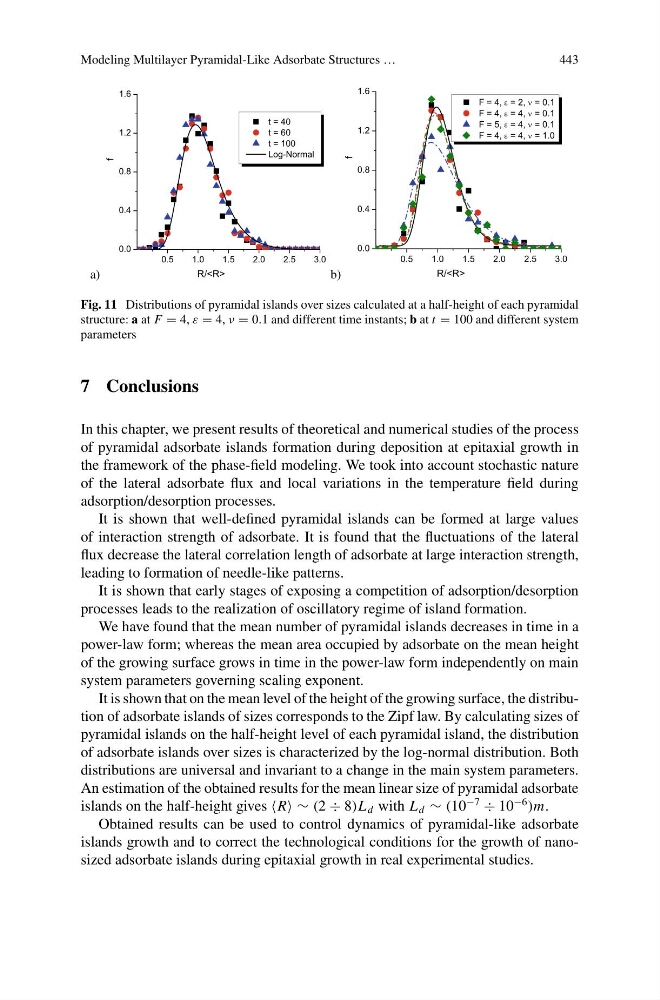
Fig. 11 Distributions of pyramidal islands over sizes calculated at a half-height of each pyramidal
structure: a at F = 4, ε = 4, ν = 0.1 and different time instants; b at t = 100 and different system
parameters
7 Conclusions
In this chapter, we present results of theoretical and numerical studies of the process
of pyramidal adsorbate islands formation during deposition at epitaxial growth in
the framework of the phase-field modeling. We took into account stochastic nature
of the lateral adsorbate flux and local variations in the temperature field during
adsorption/desorption processes.
It is shown that well-defined pyramidal islands can be formed at large values
of interaction strength of adsorbate. It is found that the fluctuations of the lateral
flux decrease the lateral correlation length of adsorbate at large interaction strength,
leading to formation of needle-like patterns.
It is shown that early stages of exposing a competition of adsorption/desorption
processes leads to the realization of oscillatory regime of island formation.
We have found that the mean number of pyramidal islands decreases in time in a
power-law form; whereas the mean area occupied by adsorbate on the mean height
of the growing surface grows in time in the power-law form independently on main
system parameters governing scaling exponent.
It is shown that on the mean level of the height of the growing surface, the distribution of adsorbate islands of sizes corresponds to the Zipf law. By calculating sizes of
pyramidal islands on the half-height level of each pyramidal island, the distribution
of adsorbate islands over sizes is characterized by the log-normal distribution. Both
distributions are universal and invariant to a change in the main system parameters.
An estimation of the obtained results for the mean linear size of pyramidal adsorbate
islands on the half-height gives ∼ (2 ÷ 8)L d with L d ∼ (10
−7
÷ 10
−6
)m.
Obtained results can be used to control dynamics of pyramidal-like adsorbate
islands growth and to correct the technological conditions for the growth of nanosized adsorbate islands during epitaxial growth in real experimental studies.
443
a)
0.5
1.0
1.5
2.0
2.5
3.0
0.0
0.4
0.8
1.2
1.6
t = 40
t = 60
t = 100
Log-Normal
f
R/
b)
0.5
1.0
1.5
2.0
2.5
3.0
0.0
0.4
0.8
1.2
1.6
F = 4, = 2, = 0.1
F = 4, = 4, = 0.1
F = 5, = 4, = 0.1
F = 4, = 4, = 1.0
f
R/
Fig. 11 Distributions of pyramidal islands over sizes calculated at a half-height of each pyramidal
structure: a at F = 4, ε = 4, ν = 0.1 and different time instants; b at t = 100 and different system
parameters
7 Conclusions
In this chapter, we present results of theoretical and numerical studies of the process
of pyramidal adsorbate islands formation during deposition at epitaxial growth in
the framework of the phase-field modeling. We took into account stochastic nature
of the lateral adsorbate flux and local variations in the temperature field during
adsorption/desorption processes.
It is shown that well-defined pyramidal islands can be formed at large values
of interaction strength of adsorbate. It is found that the fluctuations of the lateral
flux decrease the lateral correlation length of adsorbate at large interaction strength,
leading to formation of needle-like patterns.
It is shown that early stages of exposing a competition of adsorption/desorption
processes leads to the realization of oscillatory regime of island formation.
We have found that the mean number of pyramidal islands decreases in time in a
power-law form; whereas the mean area occupied by adsorbate on the mean height
of the growing surface grows in time in the power-law form independently on main
system parameters governing scaling exponent.
It is shown that on the mean level of the height of the growing surface, the distribution of adsorbate islands of sizes corresponds to the Zipf law. By calculating sizes of
pyramidal islands on the half-height level of each pyramidal island, the distribution
of adsorbate islands over sizes is characterized by the log-normal distribution. Both
distributions are universal and invariant to a change in the main system parameters.
An estimation of the obtained results for the mean linear size of pyramidal adsorbate
islands on the half-height gives ∼ (2 ÷ 8)L d with L d ∼ (10
−7
÷ 10
−6
)m.
Obtained results can be used to control dynamics of pyramidal-like adsorbate
islands growth and to correct the technological conditions for the growth of nanosized adsorbate islands during epitaxial growth in real experimental studies.