

Modeling Multilayer Pyramidal-Like Adsorbate Structures …
441
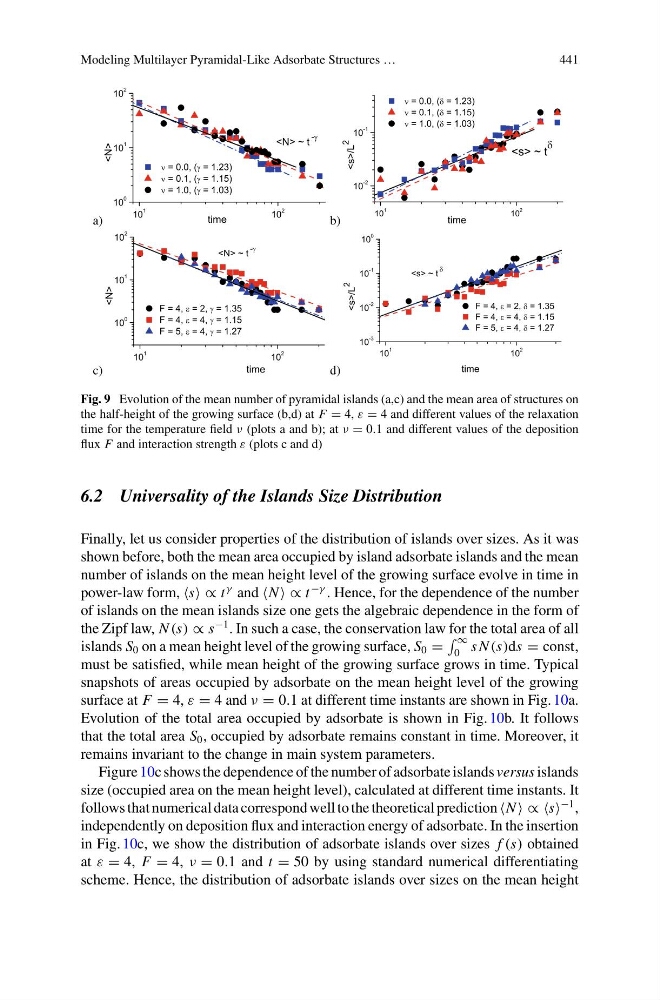
Fig. 9 Evolution of the mean number of pyramidal islands (a,c) and the mean area of structures on
the half-height of the growing surface (b,d) at F = 4, ε = 4 and different values of the relaxation
time for the temperature field ν (plots a and b); at ν = 0.1 and different values of the deposition
flux F and interaction strength ε (plots c and d)
6.2 Universality of the Islands Size Distribution
Finally, let us consider properties of the distribution of islands over sizes. As it was
shown before, both the mean area occupied by island adsorbate islands and the mean
number of islands on the mean height level of the growing surface evolve in time in
power-law form, ∝ t
γ and ∝ t
−γ . Hence, for the dependence of the number
of islands on the mean islands size one gets the algebraic dependence in the form of
the Zipf law, N (s) ∝ s
−1 . In such a case, the conservation law for the total area of all
islands S 0 on a mean height level of the growing surface, S 0 =
∞
0 s N (s)ds = const,
must be satisfied, while mean height of the growing surface grows in time. Typical
snapshots of areas occupied by adsorbate on the mean height level of the growing
surface at F = 4, ε = 4 and ν = 0.1 at different time instants are shown in Fig. 10a.
Evolution of the total area occupied by adsorbate is shown in Fig. 10b. It follows
that the total area S 0 , occupied by adsorbate remains constant in time. Moreover, it
remains invariant to the change in main system parameters.
Figure 10c shows the dependence of the number of adsorbate islands versus islands
size (occupied area on the mean height level), calculated at different time instants. It
follows that numerical data correspond well to the theoretical prediction ∝ ∝s
−1 ,
independently on deposition flux and interaction energy of adsorbate. In the insertion
in Fig. 10c, we show the distribution of adsorbate islands over sizes f (s) obtained
at ε = 4, F = 4, ν = 0.1 and t = 50 by using standard numerical differentiating
scheme. Hence, the distribution of adsorbate islands over sizes on the mean height
441
Fig. 9 Evolution of the mean number of pyramidal islands (a,c) and the mean area of structures on
the half-height of the growing surface (b,d) at F = 4, ε = 4 and different values of the relaxation
time for the temperature field ν (plots a and b); at ν = 0.1 and different values of the deposition
flux F and interaction strength ε (plots c and d)
6.2 Universality of the Islands Size Distribution
Finally, let us consider properties of the distribution of islands over sizes. As it was
shown before, both the mean area occupied by island adsorbate islands and the mean
number of islands on the mean height level of the growing surface evolve in time in
power-law form, ∝ t
γ and ∝ t
−γ . Hence, for the dependence of the number
of islands on the mean islands size one gets the algebraic dependence in the form of
the Zipf law, N (s) ∝ s
−1 . In such a case, the conservation law for the total area of all
islands S 0 on a mean height level of the growing surface, S 0 =
∞
0 s N (s)ds = const,
must be satisfied, while mean height of the growing surface grows in time. Typical
snapshots of areas occupied by adsorbate on the mean height level of the growing
surface at F = 4, ε = 4 and ν = 0.1 at different time instants are shown in Fig. 10a.
Evolution of the total area occupied by adsorbate is shown in Fig. 10b. It follows
that the total area S 0 , occupied by adsorbate remains constant in time. Moreover, it
remains invariant to the change in main system parameters.
Figure 10c shows the dependence of the number of adsorbate islands versus islands
size (occupied area on the mean height level), calculated at different time instants. It
follows that numerical data correspond well to the theoretical prediction ∝ ∝s
−1 ,
independently on deposition flux and interaction energy of adsorbate. In the insertion
in Fig. 10c, we show the distribution of adsorbate islands over sizes f (s) obtained
at ε = 4, F = 4, ν = 0.1 and t = 50 by using standard numerical differentiating
scheme. Hence, the distribution of adsorbate islands over sizes on the mean height