

436
A. V. Dvornichenko and O. M. Shchokotova
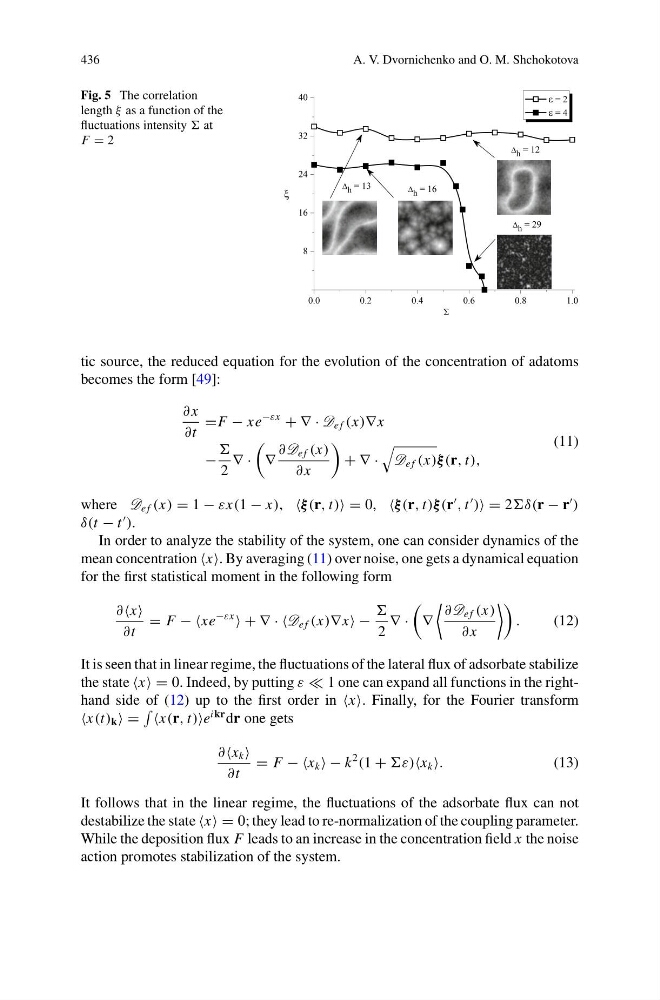
Fig. 5 The correlation
length ξ as a function of the
fluctuations intensity at
F = 2
tic source, the reduced equation for the evolution of the concentration of adatoms
becomes the form [49]:
∂ x
∂t
=F − xe
−εx
+ ∇ · D e f (x)∇x
−
2
∇ ·
∇
∂D e f (x)
∂ x
+ ∇ ·
D e f (x)ξ (r, t),
(11)
where D e f (x) = 1 − εx(1 − x), (r, t) = 0, (r, t)ξ (r
, t
) = 2 − r
)
δ(t − t
).
In order to analyze the stability of the system, one can consider dynamics of the
mean concentration By averaging (11) over noise, one gets a dynamical equation
for the first statistical moment in the following form
∂
∂t
= F − −xe
−εx
+ ∇ · ·D e f (x)∇x −
2
∇ ·
∇
∂D e f (x)
∂ x
.
(12)
It is seen that in linear regime, the fluctuations of the lateral flux of adsorbate stabilize
the state = 0. Indeed, by putting ε 1 one can expand all functions in the righthand side of (12) up to the first order in Finally, for the Fourier transform
k =
t)
ikr dr one gets
∂ k
∂t
= F − −x k − k
2
(1 + ε) k
(13)
It follows that in the linear regime, the fluctuations of the adsorbate flux can not
destabilize the state = 0; they lead to re-normalization of the coupling parameter.
While the deposition flux F leads to an increase in the concentration field x the noise
action promotes stabilization of the system.
A. V. Dvornichenko and O. M. Shchokotova
Fig. 5 The correlation
length ξ as a function of the
fluctuations intensity at
F = 2
tic source, the reduced equation for the evolution of the concentration of adatoms
becomes the form [49]:
∂ x
∂t
=F − xe
−εx
+ ∇ · D e f (x)∇x
−
2
∇ ·
∇
∂D e f (x)
∂ x
+ ∇ ·
D e f (x)ξ (r, t),
(11)
where D e f (x) = 1 − εx(1 − x), (r, t) = 0, (r, t)ξ (r
, t
) = 2 − r
)
δ(t − t
).
In order to analyze the stability of the system, one can consider dynamics of the
mean concentration By averaging (11) over noise, one gets a dynamical equation
for the first statistical moment in the following form
∂
∂t
= F − −xe
−εx
+ ∇ · ·D e f (x)∇x −
2
∇ ·
∇
∂D e f (x)
∂ x
.
(12)
It is seen that in linear regime, the fluctuations of the lateral flux of adsorbate stabilize
the state = 0. Indeed, by putting ε 1 one can expand all functions in the righthand side of (12) up to the first order in Finally, for the Fourier transform
k =
t)
ikr dr one gets
∂ k
∂t
= F − −x k − k
2
(1 + ε) k
(13)
It follows that in the linear regime, the fluctuations of the adsorbate flux can not
destabilize the state = 0; they lead to re-normalization of the coupling parameter.
While the deposition flux F leads to an increase in the concentration field x the noise
action promotes stabilization of the system.