

430
A. V. Dvornichenko and O. M. Shchokotova
coefficient M and chemical potential μ with ∇μ = (∂μ/∂ x) T ∇x + (∂μ/∂ T ) x ∇T .
This allows us to rewrite the total flux in the form
J tot = −
L
T
∂μ
∂ x
T
∇x +
∂μ
∂ T
x
∇T −
μ
T
∇T
,
and write the free energy functional F according to the chemical potential μ =
δF /δx in the form:
F =
dr
T [x ln x + (1 − x) ln(1 − x)] −
2
x
2
.
(6)
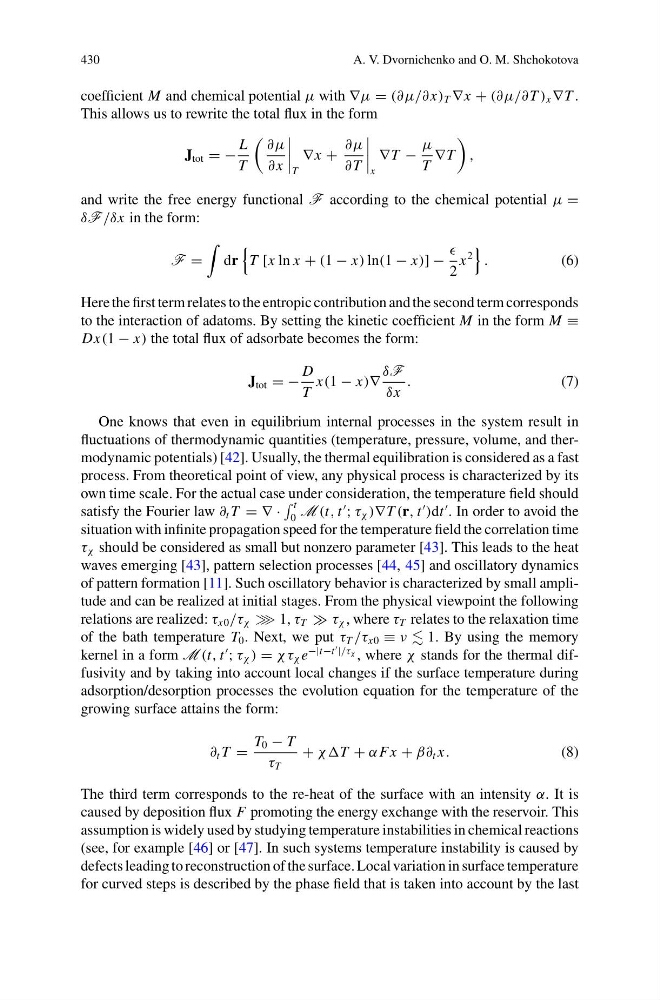
Here the first term relates to the entropic contribution and the second term corresponds
to the interaction of adatoms. By setting the kinetic coefficient M in the form M ≡
Dx(1 − x) the total flux of adsorbate becomes the form:
J tot = −
D
T
x(1 − x)∇
δF
δx
.
(7)
One knows that even in equilibrium internal processes in the system result in
fluctuations of thermodynamic quantities (temperature, pressure, volume, and thermodynamic potentials) [42]. Usually, the thermal equilibration is considered as a fast
process. From theoretical point of view, any physical process is characterized by its
own time scale. For the actual case under consideration, the temperature field should
satisfy the Fourier law ∂ t T = ∇ ·
t
0 M (t, t
; τ χ )∇T (r, t
)dt
. In order to avoid the
situation with infinite propagation speed for the temperature field the correlation time
τ χ should be considered as small but nonzero parameter [43]. This leads to the heat
waves emerging [43], pattern selection processes [44, 45] and oscillatory dynamics
of pattern formation [11]. Such oscillatory behavior is characterized by small amplitude and can be realized at initial stages. From the physical viewpoint the following
relations are realized: τ x0 /τ χ ≫ 1, τ T τ χ , where τ T relates to the relaxation time
of the bath temperature T 0 . Next, we put τ T /τ x0 ≡ ν 1. By using the memory
kernel in a form M (t, t
; τ χ ) = χτ χ e
−|t−t
|/τ χ , where χ stands for the thermal diffusivity and by taking into account local changes if the surface temperature during
adsorption/desorption processes the evolution equation for the temperature of the
growing surface attains the form:
∂ t T =
T 0 − T
τ T
+ χχT + α F x + β∂ t x.
(8)
The third term corresponds to the re-heat of the surface with an intensity α. It is
caused by deposition flux F promoting the energy exchange with the reservoir. This
assumption is widely used by studying temperature instabilities in chemical reactions
(see, for example [46] or [47]. In such systems temperature instability is caused by
defects leading to reconstruction of the surface. Local variation in surface temperature
for curved steps is described by the phase field that is taken into account by the last
A. V. Dvornichenko and O. M. Shchokotova
coefficient M and chemical potential μ with ∇μ = (∂μ/∂ x) T ∇x + (∂μ/∂ T ) x ∇T .
This allows us to rewrite the total flux in the form
J tot = −
L
T
∂μ
∂ x
T
∇x +
∂μ
∂ T
x
∇T −
μ
T
∇T
,
and write the free energy functional F according to the chemical potential μ =
δF /δx in the form:
F =
dr
T [x ln x + (1 − x) ln(1 − x)] −
2
x
2
.
(6)
Here the first term relates to the entropic contribution and the second term corresponds
to the interaction of adatoms. By setting the kinetic coefficient M in the form M ≡
Dx(1 − x) the total flux of adsorbate becomes the form:
J tot = −
D
T
x(1 − x)∇
δF
δx
.
(7)
One knows that even in equilibrium internal processes in the system result in
fluctuations of thermodynamic quantities (temperature, pressure, volume, and thermodynamic potentials) [42]. Usually, the thermal equilibration is considered as a fast
process. From theoretical point of view, any physical process is characterized by its
own time scale. For the actual case under consideration, the temperature field should
satisfy the Fourier law ∂ t T = ∇ ·
t
0 M (t, t
; τ χ )∇T (r, t
)dt
. In order to avoid the
situation with infinite propagation speed for the temperature field the correlation time
τ χ should be considered as small but nonzero parameter [43]. This leads to the heat
waves emerging [43], pattern selection processes [44, 45] and oscillatory dynamics
of pattern formation [11]. Such oscillatory behavior is characterized by small amplitude and can be realized at initial stages. From the physical viewpoint the following
relations are realized: τ x0 /τ χ ≫ 1, τ T τ χ , where τ T relates to the relaxation time
of the bath temperature T 0 . Next, we put τ T /τ x0 ≡ ν 1. By using the memory
kernel in a form M (t, t
; τ χ ) = χτ χ e
−|t−t
|/τ χ , where χ stands for the thermal diffusivity and by taking into account local changes if the surface temperature during
adsorption/desorption processes the evolution equation for the temperature of the
growing surface attains the form:
∂ t T =
T 0 − T
τ T
+ χχT + α F x + β∂ t x.
(8)
The third term corresponds to the re-heat of the surface with an intensity α. It is
caused by deposition flux F promoting the energy exchange with the reservoir. This
assumption is widely used by studying temperature instabilities in chemical reactions
(see, for example [46] or [47]. In such systems temperature instability is caused by
defects leading to reconstruction of the surface. Local variation in surface temperature
for curved steps is described by the phase field that is taken into account by the last