

Electric Field-Controlled Magnetic Anisotropy …
19
U
0
2 =
1
4
(t
)
2
J
−
15
64
(t
)
4
J 3 , U
0
4 = −
15
64
(t
)
4
J 3 , U
2
4 =
1
4
U
0
4 ,
(39)
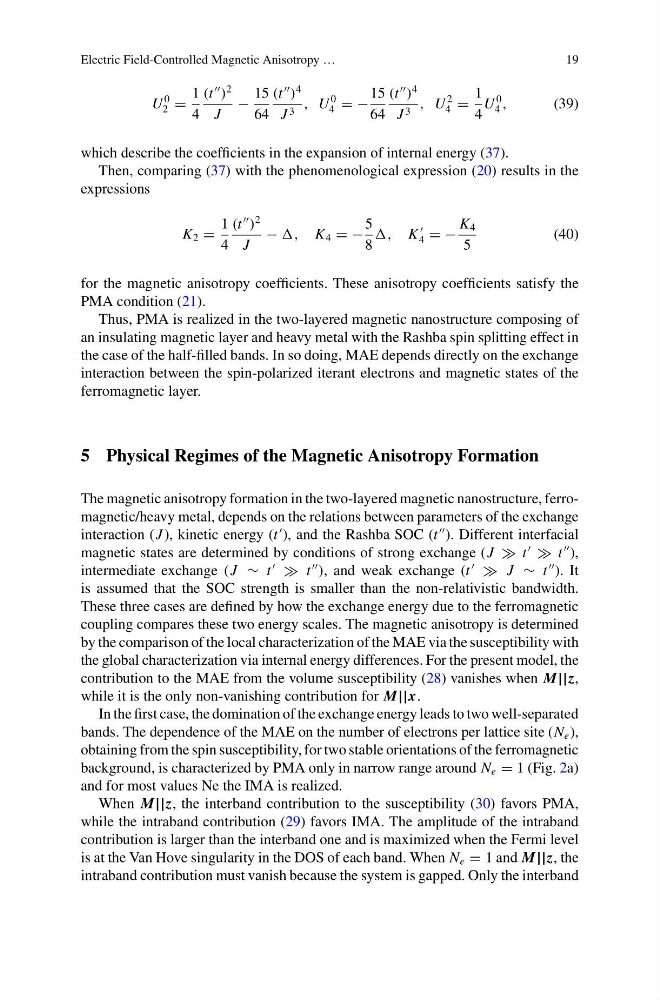
which describe the coefficients in the expansion of internal energy (37).
Then, comparing (37) with the phenomenological expression (20) results in the
expressions
K 2 =
1
4
(t
)
2
J
− , K 4 = −
5
8
, K
4 = −
K 4
5
(40)
for the magnetic anisotropy coefficients. These anisotropy coefficients satisfy the
PMA condition (21).
Thus, PMA is realized in the two-layered magnetic nanostructure composing of
an insulating magnetic layer and heavy metal with the Rashba spin splitting effect in
the case of the half-filled bands. In so doing, MAE depends directly on the exchange
interaction between the spin-polarized iterant electrons and magnetic states of the
ferromagnetic layer.
5 Physical Regimes of the Magnetic Anisotropy Formation
The magnetic anisotropy formation in the two-layered magnetic nanostructure, ferromagnetic/heavy metal, depends on the relations between parameters of the exchange
interaction (J ), kinetic energy (t
), and the Rashba SOC (t
). Different interfacial
magnetic states are determined by conditions of strong exchange (J t
t
),
intermediate exchange (J ∼ t
t
), and weak exchange (t
J ∼ t
). It
is assumed that the SOC strength is smaller than the non-relativistic bandwidth.
These three cases are defined by how the exchange energy due to the ferromagnetic
coupling compares these two energy scales. The magnetic anisotropy is determined
by the comparison of the local characterization of the MAE via the susceptibility with
the global characterization via internal energy differences. For the present model, the
contribution to the MAE from the volume susceptibility (28) vanishes when M||z,
while it is the only non-vanishing contribution for M||x.
In the first case, the domination of the exchange energy leads to two well-separated
bands. The dependence of the MAE on the number of electrons per lattice site (N e ),
obtaining from the spin susceptibility, for two stable orientations of the ferromagnetic
background, is characterized by PMA only in narrow range around N e = 1 (Fig. 2a)
and for most values Ne the IMA is realized.
When M||z, the interband contribution to the susceptibility (30) favors PMA,
while the intraband contribution (29) favors IMA. The amplitude of the intraband
contribution is larger than the interband one and is maximized when the Fermi level
is at the Van Hove singularity in the DOS of each band. When N e = 1 and M||z, the
intraband contribution must vanish because the system is gapped. Only the interband
19
U
0
2 =
1
4
(t
)
2
J
−
15
64
(t
)
4
J 3 , U
0
4 = −
15
64
(t
)
4
J 3 , U
2
4 =
1
4
U
0
4 ,
(39)
which describe the coefficients in the expansion of internal energy (37).
Then, comparing (37) with the phenomenological expression (20) results in the
expressions
K 2 =
1
4
(t
)
2
J
− , K 4 = −
5
8
, K
4 = −
K 4
5
(40)
for the magnetic anisotropy coefficients. These anisotropy coefficients satisfy the
PMA condition (21).
Thus, PMA is realized in the two-layered magnetic nanostructure composing of
an insulating magnetic layer and heavy metal with the Rashba spin splitting effect in
the case of the half-filled bands. In so doing, MAE depends directly on the exchange
interaction between the spin-polarized iterant electrons and magnetic states of the
ferromagnetic layer.
5 Physical Regimes of the Magnetic Anisotropy Formation
The magnetic anisotropy formation in the two-layered magnetic nanostructure, ferromagnetic/heavy metal, depends on the relations between parameters of the exchange
interaction (J ), kinetic energy (t
), and the Rashba SOC (t
). Different interfacial
magnetic states are determined by conditions of strong exchange (J t
t
),
intermediate exchange (J ∼ t
t
), and weak exchange (t
J ∼ t
). It
is assumed that the SOC strength is smaller than the non-relativistic bandwidth.
These three cases are defined by how the exchange energy due to the ferromagnetic
coupling compares these two energy scales. The magnetic anisotropy is determined
by the comparison of the local characterization of the MAE via the susceptibility with
the global characterization via internal energy differences. For the present model, the
contribution to the MAE from the volume susceptibility (28) vanishes when M||z,
while it is the only non-vanishing contribution for M||x.
In the first case, the domination of the exchange energy leads to two well-separated
bands. The dependence of the MAE on the number of electrons per lattice site (N e ),
obtaining from the spin susceptibility, for two stable orientations of the ferromagnetic
background, is characterized by PMA only in narrow range around N e = 1 (Fig. 2a)
and for most values Ne the IMA is realized.
When M||z, the interband contribution to the susceptibility (30) favors PMA,
while the intraband contribution (29) favors IMA. The amplitude of the intraband
contribution is larger than the interband one and is maximized when the Fermi level
is at the Van Hove singularity in the DOS of each band. When N e = 1 and M||z, the
intraband contribution must vanish because the system is gapped. Only the interband