

410
T. L. Tsaregradskaya et al.
at the boundary of the phase separation, which is accompanied by the self-heating
of the crystallization front.
The phenomenon of explosive crystallization is intensively studied both theoretically and experimentally. In addition to the apparent physical interest in this
phenomenon, the study of the nature of explosive crystallization is also important in
connection with the increasing use of amorphous materials in modern technology.
Indeed, explosive crystallization, initiated by a rather strong local energy momentum,
can extend to the entire volume of amorphous material at high velocity [5]. It is very
important that the appearance of explosive crystallization can occur at temperatures substantially lower than the temperature of crystallization during isothermal
annealing. This fact must be taken into account when choosing amorphous materials
for practical application. The problem of research is related to the theoretical analysis
of the possibilities of the process of explosive crystallization during laser treatment
of binary amorphous alloys of the Fe–Zr system.
2 Equation of the Description of the Kinetics
of the Crystallization Process in the Fe–Zr System
A series of theoretical calculations were carried out to analyze the possibility of
the process of explosive crystallization during laser treatment of binary amorphous
alloys of the Fe–Zr system. The calculations were carried out within the framework
of the modified theory of homogeneous crystallization for binary alloys, which takes
into account the work associated with the concentration fluctuation. An important
characteristic of the crystallization process of amorphous alloys is the volume part of
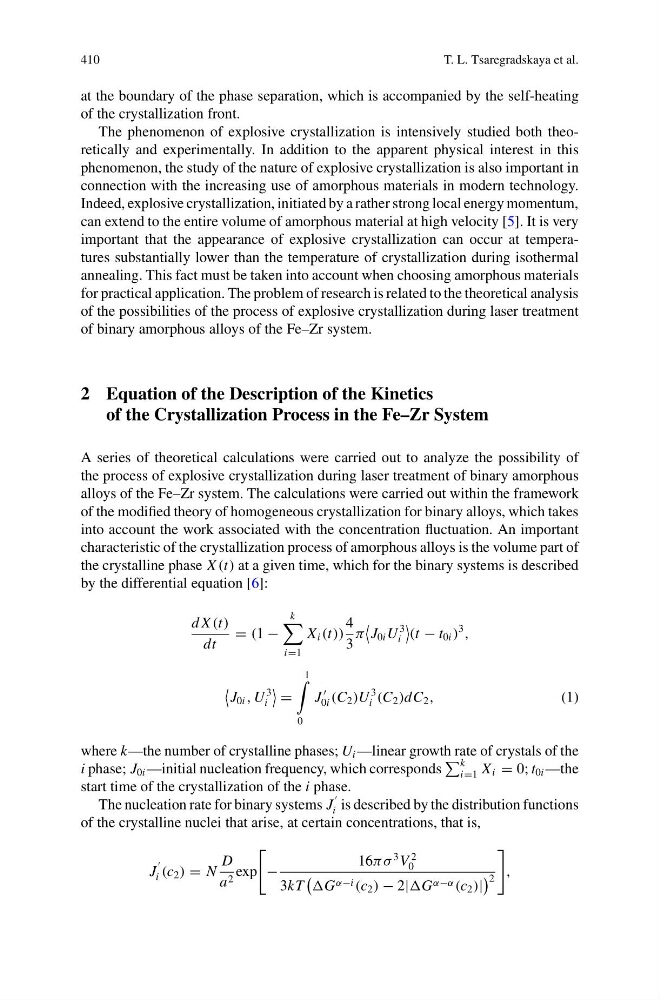
the crystalline phase X (t) at a given time, which for the binary systems is described
by the differential equation [6]:
d X (t)
dt
= (1 −
k
i=1
X i (t))
4
3
π
J 0i U
3
i
(t − t 0i )
3
,
J 0i , U
3
i
=
1
0
J
0i (C 2 )U
3
i (C 2 )dC 2 ,
(1)
where k—the number of crystalline phases; U i —linear growth rate of crystals of the
i phase; J 0i —initial nucleation frequency, which corresponds
k
i=1 X i = 0; t 0i —the
start time of the crystallization of the i phase.
The nucleation rate for binary systems J
i is described by the distribution functions
of the crystalline nuclei that arise, at certain concentrations, that is,
J
i (c 2 ) = N
D
a 2 exp
−
16πσ
3 V
2
0
3kT
G α−i (c 2 ) − 2|G α−α (c 2 )|
2
,
T. L. Tsaregradskaya et al.
at the boundary of the phase separation, which is accompanied by the self-heating
of the crystallization front.
The phenomenon of explosive crystallization is intensively studied both theoretically and experimentally. In addition to the apparent physical interest in this
phenomenon, the study of the nature of explosive crystallization is also important in
connection with the increasing use of amorphous materials in modern technology.
Indeed, explosive crystallization, initiated by a rather strong local energy momentum,
can extend to the entire volume of amorphous material at high velocity [5]. It is very
important that the appearance of explosive crystallization can occur at temperatures substantially lower than the temperature of crystallization during isothermal
annealing. This fact must be taken into account when choosing amorphous materials
for practical application. The problem of research is related to the theoretical analysis
of the possibilities of the process of explosive crystallization during laser treatment
of binary amorphous alloys of the Fe–Zr system.
2 Equation of the Description of the Kinetics
of the Crystallization Process in the Fe–Zr System
A series of theoretical calculations were carried out to analyze the possibility of
the process of explosive crystallization during laser treatment of binary amorphous
alloys of the Fe–Zr system. The calculations were carried out within the framework
of the modified theory of homogeneous crystallization for binary alloys, which takes
into account the work associated with the concentration fluctuation. An important
characteristic of the crystallization process of amorphous alloys is the volume part of
the crystalline phase X (t) at a given time, which for the binary systems is described
by the differential equation [6]:
d X (t)
dt
= (1 −
k
i=1
X i (t))
4
3
π
J 0i U
3
i
(t − t 0i )
3
,
J 0i , U
3
i
=
1
0
J
0i (C 2 )U
3
i (C 2 )dC 2 ,
(1)
where k—the number of crystalline phases; U i —linear growth rate of crystals of the
i phase; J 0i —initial nucleation frequency, which corresponds
k
i=1 X i = 0; t 0i —the
start time of the crystallization of the i phase.
The nucleation rate for binary systems J
i is described by the distribution functions
of the crystalline nuclei that arise, at certain concentrations, that is,
J
i (c 2 ) = N
D
a 2 exp
−
16πσ
3 V
2
0
3kT
G α−i (c 2 ) − 2|G α−α (c 2 )|
2
,