

The Effect of the Intensity of Ammonium Nitrate Granules …
399
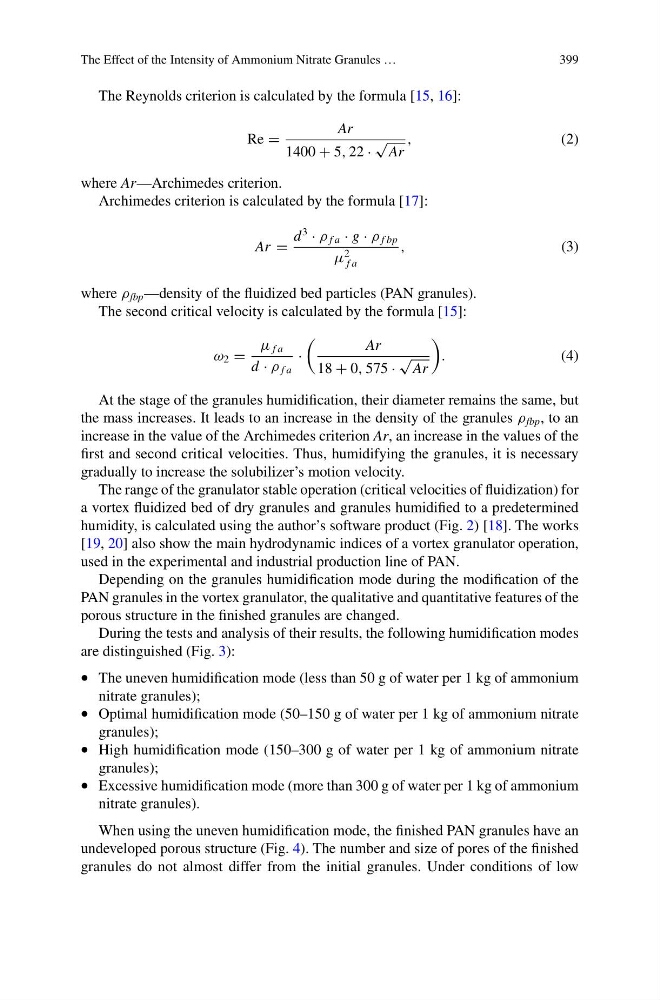
The Reynolds criterion is calculated by the formula [15, 16]:
Re =
Ar
1400 + 5, 22 ·
√
Ar
,
(2)
where Ar—Archimedes criterion.
Archimedes criterion is calculated by the formula [17]:
Ar =
d
3
· ρ f a · g · ρ f bp
μ
2
f a
,
(3)
where ρ fbp —density of the fluidized bed particles (PAN granules).
The second critical velocity is calculated by the formula [15]:
ω 2 =
μ f a
d · ρ f a
·
Ar
18 + 0, 575 ·
√
Ar
.
(4)
At the stage of the granules humidification, their diameter remains the same, but
the mass increases. It leads to an increase in the density of the granules ρ fbp , to an
increase in the value of the Archimedes criterion Ar, an increase in the values of the
first and second critical velocities. Thus, humidifying the granules, it is necessary
gradually to increase the solubilizer’s motion velocity.
The range of the granulator stable operation (critical velocities of fluidization) for
a vortex fluidized bed of dry granules and granules humidified to a predetermined
humidity, is calculated using the author’s software product (Fig. 2) [18]. The works
[19, 20] also show the main hydrodynamic indices of a vortex granulator operation,
used in the experimental and industrial production line of PAN.
Depending on the granules humidification mode during the modification of the
PAN granules in the vortex granulator, the qualitative and quantitative features of the
porous structure in the finished granules are changed.
During the tests and analysis of their results, the following humidification modes
are distinguished (Fig. 3):
• The uneven humidification mode (less than 50 g of water per 1 kg of ammonium
nitrate granules);
• Optimal humidification mode (50–150 g of water per 1 kg of ammonium nitrate
granules);
• High humidification mode (150–300 g of water per 1 kg of ammonium nitrate
granules);
• Excessive humidification mode (more than 300 g of water per 1 kg of ammonium
nitrate granules).
When using the uneven humidification mode, the finished PAN granules have an
undeveloped porous structure (Fig. 4). The number and size of pores of the finished
granules do not almost differ from the initial granules. Under conditions of low
399
The Reynolds criterion is calculated by the formula [15, 16]:
Re =
Ar
1400 + 5, 22 ·
√
Ar
,
(2)
where Ar—Archimedes criterion.
Archimedes criterion is calculated by the formula [17]:
Ar =
d
3
· ρ f a · g · ρ f bp
μ
2
f a
,
(3)
where ρ fbp —density of the fluidized bed particles (PAN granules).
The second critical velocity is calculated by the formula [15]:
ω 2 =
μ f a
d · ρ f a
·
Ar
18 + 0, 575 ·
√
Ar
.
(4)
At the stage of the granules humidification, their diameter remains the same, but
the mass increases. It leads to an increase in the density of the granules ρ fbp , to an
increase in the value of the Archimedes criterion Ar, an increase in the values of the
first and second critical velocities. Thus, humidifying the granules, it is necessary
gradually to increase the solubilizer’s motion velocity.
The range of the granulator stable operation (critical velocities of fluidization) for
a vortex fluidized bed of dry granules and granules humidified to a predetermined
humidity, is calculated using the author’s software product (Fig. 2) [18]. The works
[19, 20] also show the main hydrodynamic indices of a vortex granulator operation,
used in the experimental and industrial production line of PAN.
Depending on the granules humidification mode during the modification of the
PAN granules in the vortex granulator, the qualitative and quantitative features of the
porous structure in the finished granules are changed.
During the tests and analysis of their results, the following humidification modes
are distinguished (Fig. 3):
• The uneven humidification mode (less than 50 g of water per 1 kg of ammonium
nitrate granules);
• Optimal humidification mode (50–150 g of water per 1 kg of ammonium nitrate
granules);
• High humidification mode (150–300 g of water per 1 kg of ammonium nitrate
granules);
• Excessive humidification mode (more than 300 g of water per 1 kg of ammonium
nitrate granules).
When using the uneven humidification mode, the finished PAN granules have an
undeveloped porous structure (Fig. 4). The number and size of pores of the finished
granules do not almost differ from the initial granules. Under conditions of low