

16
A. M. Korostil and M. M. Krupa
1
2
∂
2 U
∂ϕ 2
M||x
=
J
2
2
M
J
− χ
yy
= −8K
4 ,
(25)
and for the polar magnetization orientation
1
2
∂
2 U
∂ϕ 2
M||z
=
J
2
2
M
J
− χ
zz
= K 2 .
(26)
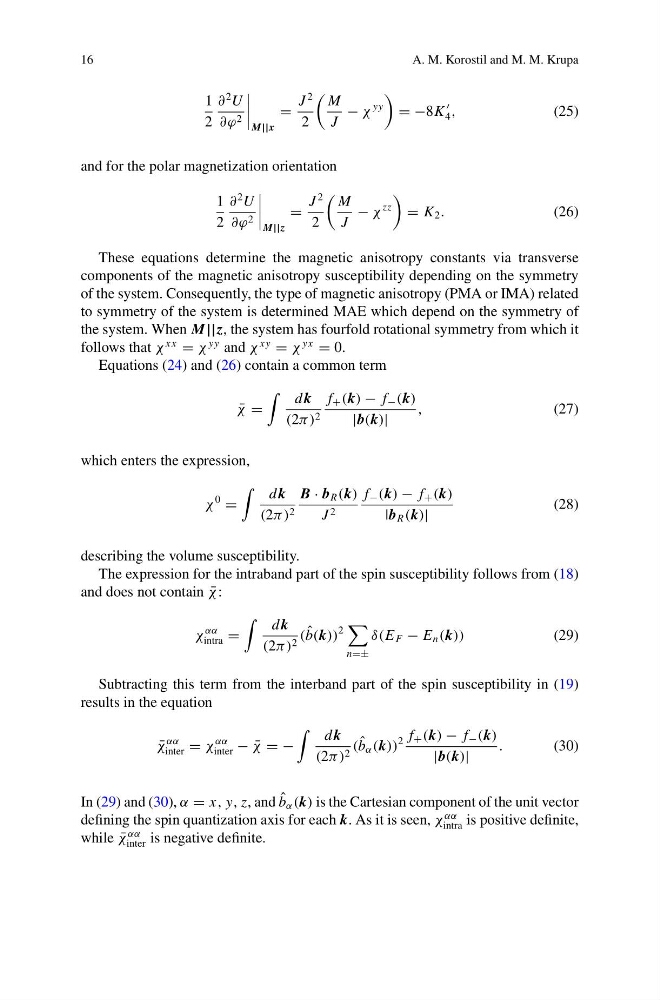
These equations determine the magnetic anisotropy constants via transverse
components of the magnetic anisotropy susceptibility depending on the symmetry
of the system. Consequently, the type of magnetic anisotropy (PMA or IMA) related
to symmetry of the system is determined MAE which depend on the symmetry of
the system. When M||z, the system has fourfold rotational symmetry from which it
follows that χ
xx
= χ
yy and χ
xy
= χ
yx
= 0.
Equations (24) and (26) contain a common term
¯
χ =
d k
(2π) 2
f + (k) − f − (k)
|b(k)|
,
(27)
which enters the expression,
χ
0
=
d k
(2π) 2
B · b R (k)
J 2
f − (k) − f + (k)
|b R (k)|
(28)
describing the volume susceptibility.
The expression for the intraband part of the spin susceptibility follows from (18)
and does not contain ¯
χ:
χ
αα
intra =
d k
(2π) 2 ( ˆ
b(k))
2
n=±
δ(E F − E n (k))
(29)
Subtracting this term from the interband part of the spin susceptibility in (19)
results in the equation
¯
χ
αα
inter = χ
αα
inter − ¯
χ = −
d k
(2π) 2 ( ˆ
b α (k))
2 f + (k) − f − (k)
|b(k)|
.
(30)
In (29) and (30), α = x, y, z, and ˆ
b α (k) is the Cartesian component of the unit vector
defining the spin quantization axis for each k. As it is seen, χ
αα
intra is positive definite,
while ¯
χ
αα
inter is negative definite.
A. M. Korostil and M. M. Krupa
1
2
∂
2 U
∂ϕ 2
M||x
=
J
2
2
M
J
− χ
yy
= −8K
4 ,
(25)
and for the polar magnetization orientation
1
2
∂
2 U
∂ϕ 2
M||z
=
J
2
2
M
J
− χ
zz
= K 2 .
(26)
These equations determine the magnetic anisotropy constants via transverse
components of the magnetic anisotropy susceptibility depending on the symmetry
of the system. Consequently, the type of magnetic anisotropy (PMA or IMA) related
to symmetry of the system is determined MAE which depend on the symmetry of
the system. When M||z, the system has fourfold rotational symmetry from which it
follows that χ
xx
= χ
yy and χ
xy
= χ
yx
= 0.
Equations (24) and (26) contain a common term
¯
χ =
d k
(2π) 2
f + (k) − f − (k)
|b(k)|
,
(27)
which enters the expression,
χ
0
=
d k
(2π) 2
B · b R (k)
J 2
f − (k) − f + (k)
|b R (k)|
(28)
describing the volume susceptibility.
The expression for the intraband part of the spin susceptibility follows from (18)
and does not contain ¯
χ:
χ
αα
intra =
d k
(2π) 2 ( ˆ
b(k))
2
n=±
δ(E F − E n (k))
(29)
Subtracting this term from the interband part of the spin susceptibility in (19)
results in the equation
¯
χ
αα
inter = χ
αα
inter − ¯
χ = −
d k
(2π) 2 ( ˆ
b α (k))
2 f + (k) − f − (k)
|b(k)|
.
(30)
In (29) and (30), α = x, y, z, and ˆ
b α (k) is the Cartesian component of the unit vector
defining the spin quantization axis for each k. As it is seen, χ
αα
intra is positive definite,
while ¯
χ
αα
inter is negative definite.