

Catastrophic Phenomena on Marine Slopes and in Artificial Dams …
383
with shared colloid–chemical properties typical for most of IASSs and NIASMs.
As an example of the iron-aluminosilicate materials, they were chosen earlier [4–6]:
different soils and clays; polymineral iron-aluminosilicate compositions extracted
from iron ores; pelagic shallow-water and deep-water sediments and peloids of the
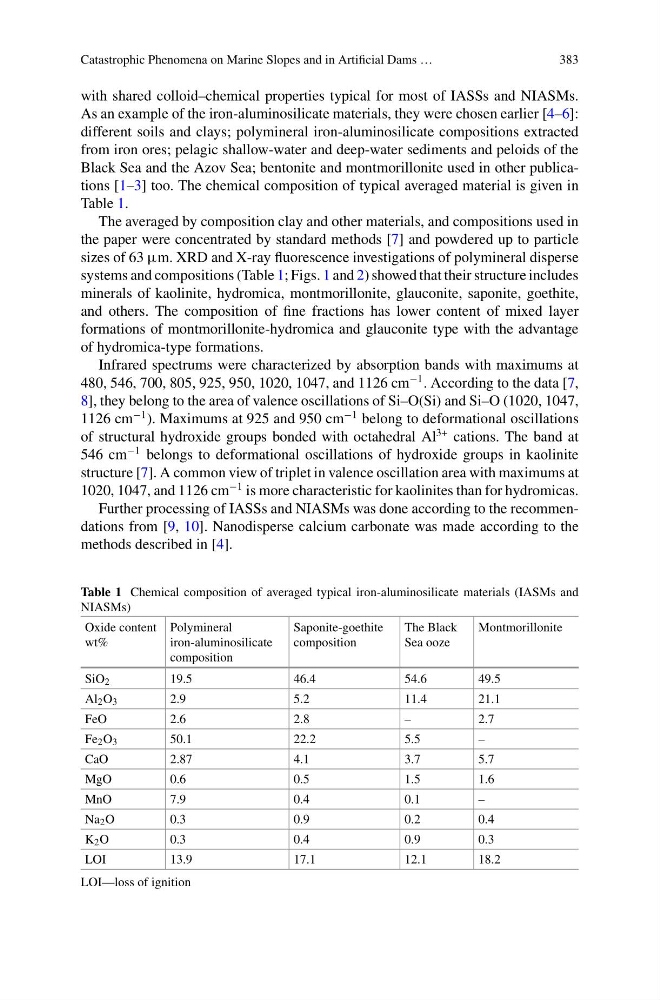
Black Sea and the Azov Sea; bentonite and montmorillonite used in other publications [1–3] too. The chemical composition of typical averaged material is given in
Table 1.
The averaged by composition clay and other materials, and compositions used in
the paper were concentrated by standard methods [7] and powdered up to particle
sizes of 63 μm. XRD and X-ray fluorescence investigations of polymineral disperse
systems and compositions (Table 1; Figs. 1 and 2) showed that their structure includes
minerals of kaolinite, hydromica, montmorillonite, glauconite, saponite, goethite,
and others. The composition of fine fractions has lower content of mixed layer
formations of montmorillonite-hydromica and glauconite type with the advantage
of hydromica-type formations.
Infrared spectrums were characterized by absorption bands with maximums at
480, 546, 700, 805, 925, 950, 1020, 1047, and 1126 cm
−1 . According to the data [7,
8], they belong to the area of valence oscillations of Si–O(Si) and Si–O (1020, 1047,
1126 cm
−1 ). Maximums at 925 and 950 cm
−1 belong to deformational oscillations
of structural hydroxide groups bonded with octahedral Al
3+ cations. The band at
546 cm
−1 belongs to deformational oscillations of hydroxide groups in kaolinite
structure [7]. A common view of triplet in valence oscillation area with maximums at
1020, 1047, and 1126 cm
−1 is more characteristic for kaolinites than for hydromicas.
Further processing of IASSs and NIASMs was done according to the recommendations from [9, 10]. Nanodisperse calcium carbonate was made according to the
methods described in [4].
Table 1 Chemical composition of averaged typical iron-aluminosilicate materials (IASMs and
NIASMs)
Oxide content
wt%
Polymineral
iron-aluminosilicate
composition
Saponite-goethite
composition
The Black
Sea ooze
Montmorillonite
SiO 2
19.5
46.4
54.6
49.5
Al 2 O 3
2.9
5.2
11.4
21.1
FeO
2.6
2.8
–
2.7
Fe 2 O 3
50.1
22.2
5.5
–
CaO
2.87
4.1
3.7
5.7
MgO
0.6
0.5
1.5
1.6
MnO
7.9
0.4
0.1
–
Na 2 O
0.3
0.9
0.2
0.4
K 2 O
0.3
0.4
0.9
0.3
LOI
13.9
17.1
12.1
18.2
LOI—loss of ignition
383
with shared colloid–chemical properties typical for most of IASSs and NIASMs.
As an example of the iron-aluminosilicate materials, they were chosen earlier [4–6]:
different soils and clays; polymineral iron-aluminosilicate compositions extracted
from iron ores; pelagic shallow-water and deep-water sediments and peloids of the
Black Sea and the Azov Sea; bentonite and montmorillonite used in other publications [1–3] too. The chemical composition of typical averaged material is given in
Table 1.
The averaged by composition clay and other materials, and compositions used in
the paper were concentrated by standard methods [7] and powdered up to particle
sizes of 63 μm. XRD and X-ray fluorescence investigations of polymineral disperse
systems and compositions (Table 1; Figs. 1 and 2) showed that their structure includes
minerals of kaolinite, hydromica, montmorillonite, glauconite, saponite, goethite,
and others. The composition of fine fractions has lower content of mixed layer
formations of montmorillonite-hydromica and glauconite type with the advantage
of hydromica-type formations.
Infrared spectrums were characterized by absorption bands with maximums at
480, 546, 700, 805, 925, 950, 1020, 1047, and 1126 cm
−1 . According to the data [7,
8], they belong to the area of valence oscillations of Si–O(Si) and Si–O (1020, 1047,
1126 cm
−1 ). Maximums at 925 and 950 cm
−1 belong to deformational oscillations
of structural hydroxide groups bonded with octahedral Al
3+ cations. The band at
546 cm
−1 belongs to deformational oscillations of hydroxide groups in kaolinite
structure [7]. A common view of triplet in valence oscillation area with maximums at
1020, 1047, and 1126 cm
−1 is more characteristic for kaolinites than for hydromicas.
Further processing of IASSs and NIASMs was done according to the recommendations from [9, 10]. Nanodisperse calcium carbonate was made according to the
methods described in [4].
Table 1 Chemical composition of averaged typical iron-aluminosilicate materials (IASMs and
NIASMs)
Oxide content
wt%
Polymineral
iron-aluminosilicate
composition
Saponite-goethite
composition
The Black
Sea ooze
Montmorillonite
SiO 2
19.5
46.4
54.6
49.5
Al 2 O 3
2.9
5.2
11.4
21.1
FeO
2.6
2.8
–
2.7
Fe 2 O 3
50.1
22.2
5.5
–
CaO
2.87
4.1
3.7
5.7
MgO
0.6
0.5
1.5
1.6
MnO
7.9
0.4
0.1
–
Na 2 O
0.3
0.9
0.2
0.4
K 2 O
0.3
0.4
0.9
0.3
LOI
13.9
17.1
12.1
18.2
LOI—loss of ignition