

376
T. A. Khalyavka et al.
Investigation of the structural and textural properties of the obtained samples
showed that with the introduction of La in TiO 2 , the specific surface area, pore
volume, and pore radius of the samples increase that leads to an increase in the
number of active sites of the catalyst surface and its adsorption and photocatalytic
capacity. That is, the number of reaction sites for the absorption and decomposition
of dye molecules increases.
The photocatalytic activity of TiO 2 depends on the competition between the rate
of transfer of surface charge carriers from volume to surface and the rate of recombination of photogenerated electrons and holes. It was shown in [46–49] that doping
with TiO 2 lanthanide ions suppresses the rate of electron–hole recombination during
the photocatalytic reaction.
With an increase in the amount of La in TiO 2 , changes in the crystal lattice
parameters are observed (an increase in the unit cell volume and the c/a ratio), as
well as an increase in the bandgap for direct and indirect electronic transitions. The
distorted titanium dioxide crystal lattice can take in more photoexcited holes and
form stronger surface free radicals to oxidize adsorbed molecules [25]. All these
factors explain the higher photocatalytic activity of La/TiO 2 composites compared
to pure titanium dioxide in the decomposition of safranin dye.
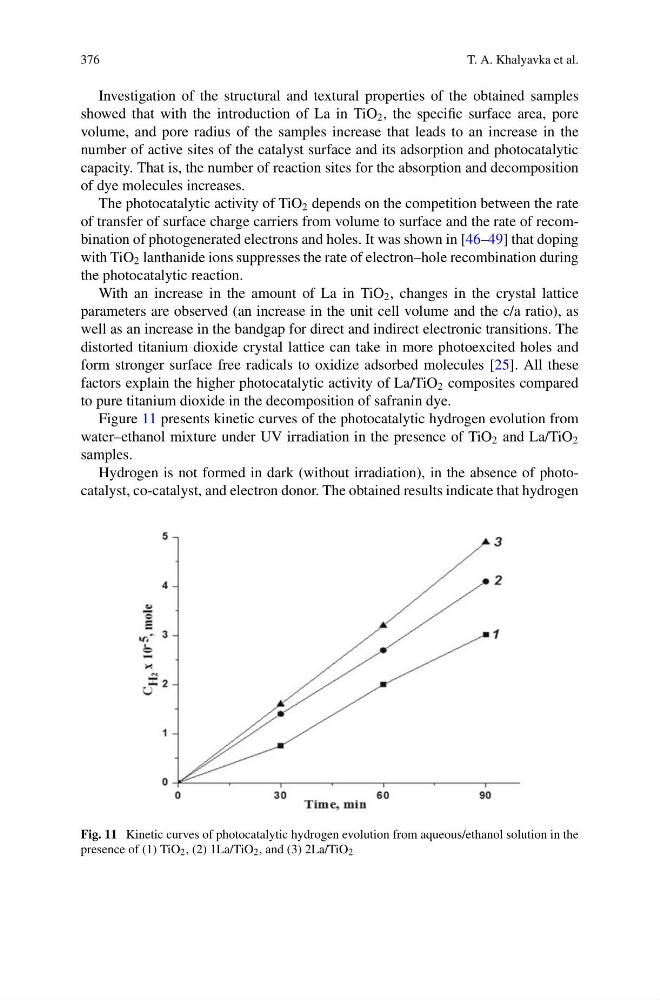
Figure 11 presents kinetic curves of the photocatalytic hydrogen evolution from
water–ethanol mixture under UV irradiation in the presence of TiO 2 and La/TiO 2
samples.
Hydrogen is not formed in dark (without irradiation), in the absence of photocatalyst, co-catalyst, and electron donor. The obtained results indicate that hydrogen
Fig. 11 Kinetic curves of photocatalytic hydrogen evolution from aqueous/ethanol solution in the
presence of (1) TiO 2 , (2) 1La/TiO 2 , and (3) 2La/TiO 2
T. A. Khalyavka et al.
Investigation of the structural and textural properties of the obtained samples
showed that with the introduction of La in TiO 2 , the specific surface area, pore
volume, and pore radius of the samples increase that leads to an increase in the
number of active sites of the catalyst surface and its adsorption and photocatalytic
capacity. That is, the number of reaction sites for the absorption and decomposition
of dye molecules increases.
The photocatalytic activity of TiO 2 depends on the competition between the rate
of transfer of surface charge carriers from volume to surface and the rate of recombination of photogenerated electrons and holes. It was shown in [46–49] that doping
with TiO 2 lanthanide ions suppresses the rate of electron–hole recombination during
the photocatalytic reaction.
With an increase in the amount of La in TiO 2 , changes in the crystal lattice
parameters are observed (an increase in the unit cell volume and the c/a ratio), as
well as an increase in the bandgap for direct and indirect electronic transitions. The
distorted titanium dioxide crystal lattice can take in more photoexcited holes and
form stronger surface free radicals to oxidize adsorbed molecules [25]. All these
factors explain the higher photocatalytic activity of La/TiO 2 composites compared
to pure titanium dioxide in the decomposition of safranin dye.
Figure 11 presents kinetic curves of the photocatalytic hydrogen evolution from
water–ethanol mixture under UV irradiation in the presence of TiO 2 and La/TiO 2
samples.
Hydrogen is not formed in dark (without irradiation), in the absence of photocatalyst, co-catalyst, and electron donor. The obtained results indicate that hydrogen
Fig. 11 Kinetic curves of photocatalytic hydrogen evolution from aqueous/ethanol solution in the
presence of (1) TiO 2 , (2) 1La/TiO 2 , and (3) 2La/TiO 2