

The Influence of La Doping on Structural, Optical …
363
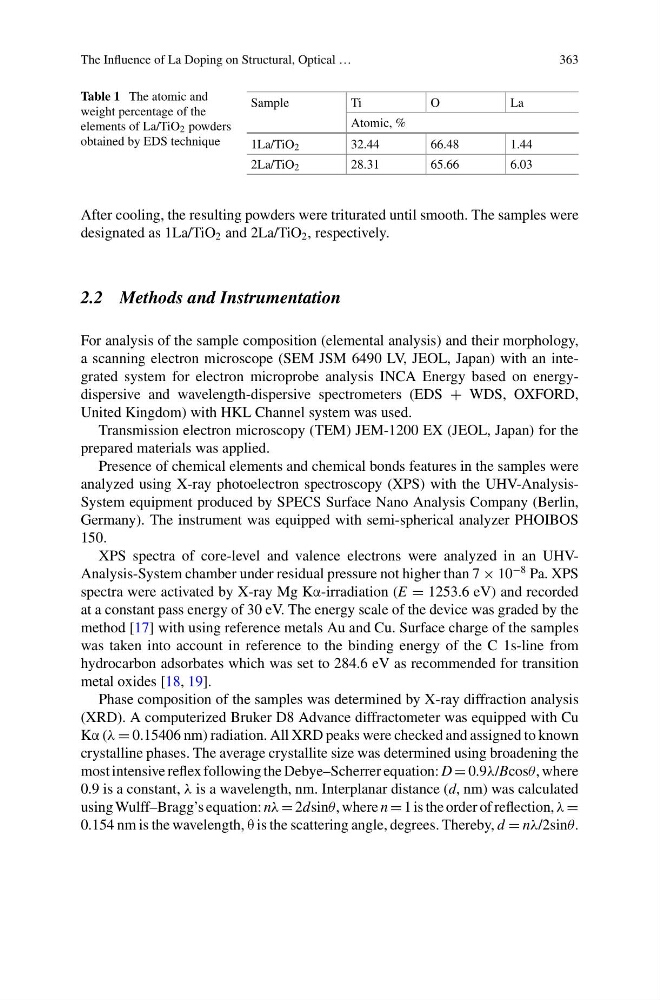
Table 1 The atomic and
weight percentage of the
elements of La/TiO 2 powders
obtained by EDS technique
Sample
Ti
O
La
Atomic, %
1La/TiO 2
32.44
66.48
1.44
2La/TiO 2
28.31
65.66
6.03
After cooling, the resulting powders were triturated until smooth. The samples were
designated as 1La/TiO 2 and 2La/TiO 2 , respectively.
2.2 Methods and Instrumentation
For analysis of the sample composition (elemental analysis) and their morphology,
a scanning electron microscope (SEM JSM 6490 LV, JEOL, Japan) with an integrated system for electron microprobe analysis INCA Energy based on energydispersive and wavelength-dispersive spectrometers (EDS + WDS, OXFORD,
United Kingdom) with HKL Channel system was used.
Transmission electron microscopy (TEM) JEM-1200 EX (JEOL, Japan) for the
prepared materials was applied.
Presence of chemical elements and chemical bonds features in the samples were
analyzed using X-ray photoelectron spectroscopy (XPS) with the UHV-AnalysisSystem equipment produced by SPECS Surface Nano Analysis Company (Berlin,
Germany). The instrument was equipped with semi-spherical analyzer PHOIBOS
150.
XPS spectra of core-level and valence electrons were analyzed in an UHVAnalysis-System chamber under residual pressure not higher than 7 × 10
−8 Pa. XPS
spectra were activated by X-ray Mg Kα-irradiation (E = 1253.6 eV) and recorded
at a constant pass energy of 30 eV. The energy scale of the device was graded by the
method [17] with using reference metals Au and Cu. Surface charge of the samples
was taken into account in reference to the binding energy of the C 1s-line from
hydrocarbon adsorbates which was set to 284.6 eV as recommended for transition
metal oxides [18, 19].
Phase composition of the samples was determined by X-ray diffraction analysis
(XRD). A computerized Bruker D8 Advance diffractometer was equipped with Cu
Kα (λ = 0.15406 nm) radiation. All XRD peaks were checked and assigned to known
crystalline phases. The average crystallite size was determined using broadening the
most intensive reflex following the Debye–Scherrer equation: D = 0.9λ/Bcosθ, where
0.9 is a constant, λ is a wavelength, nm. Interplanar distance (d, nm) was calculated
using Wulff–Bragg’s equation: nλ = 2dsinθ, where n = 1 is the order of reflection, λ =
0.154 nm is the wavelength, θ is the scattering angle, degrees. Thereby, d = nλ/2sinθ.
363
Table 1 The atomic and
weight percentage of the
elements of La/TiO 2 powders
obtained by EDS technique
Sample
Ti
O
La
Atomic, %
1La/TiO 2
32.44
66.48
1.44
2La/TiO 2
28.31
65.66
6.03
After cooling, the resulting powders were triturated until smooth. The samples were
designated as 1La/TiO 2 and 2La/TiO 2 , respectively.
2.2 Methods and Instrumentation
For analysis of the sample composition (elemental analysis) and their morphology,
a scanning electron microscope (SEM JSM 6490 LV, JEOL, Japan) with an integrated system for electron microprobe analysis INCA Energy based on energydispersive and wavelength-dispersive spectrometers (EDS + WDS, OXFORD,
United Kingdom) with HKL Channel system was used.
Transmission electron microscopy (TEM) JEM-1200 EX (JEOL, Japan) for the
prepared materials was applied.
Presence of chemical elements and chemical bonds features in the samples were
analyzed using X-ray photoelectron spectroscopy (XPS) with the UHV-AnalysisSystem equipment produced by SPECS Surface Nano Analysis Company (Berlin,
Germany). The instrument was equipped with semi-spherical analyzer PHOIBOS
150.
XPS spectra of core-level and valence electrons were analyzed in an UHVAnalysis-System chamber under residual pressure not higher than 7 × 10
−8 Pa. XPS
spectra were activated by X-ray Mg Kα-irradiation (E = 1253.6 eV) and recorded
at a constant pass energy of 30 eV. The energy scale of the device was graded by the
method [17] with using reference metals Au and Cu. Surface charge of the samples
was taken into account in reference to the binding energy of the C 1s-line from
hydrocarbon adsorbates which was set to 284.6 eV as recommended for transition
metal oxides [18, 19].
Phase composition of the samples was determined by X-ray diffraction analysis
(XRD). A computerized Bruker D8 Advance diffractometer was equipped with Cu
Kα (λ = 0.15406 nm) radiation. All XRD peaks were checked and assigned to known
crystalline phases. The average crystallite size was determined using broadening the
most intensive reflex following the Debye–Scherrer equation: D = 0.9λ/Bcosθ, where
0.9 is a constant, λ is a wavelength, nm. Interplanar distance (d, nm) was calculated
using Wulff–Bragg’s equation: nλ = 2dsinθ, where n = 1 is the order of reflection, λ =
0.154 nm is the wavelength, θ is the scattering angle, degrees. Thereby, d = nλ/2sinθ.