

354
H. Karakurkchi et al.
valleys of the relief of the coating and the distribution of the components of the oxide
layer on them were established. As can be seen from Fig. 16, conical hills ranging
in size from 200 nm to 1 μm alternate on the surface with valleys, and the height
difference is in a wide range of 50–500 nm. In addition, it should be noted that the
hills are enriched in manganese, which is consistent with the proposed mechanism
for the incorporation of MnO x into an alumina matrix. Thus, it was established that
the manganese incorporation contributes to a significant increase in oxide coatings
roughness in comparison to the Al 2 O 3 .
The surface of oxides Al 2 O 3 ·MnO x on the AK12M2MgN alloy has a microglobular structure [26]. So, oxides MnO x are incorporated in the matrix of aluminum
oxide and form the external coating layer.
The obtained results allow us to assume that oxides MnO x are incorporated in the
matrix of aluminum oxide and form the external coating layer.
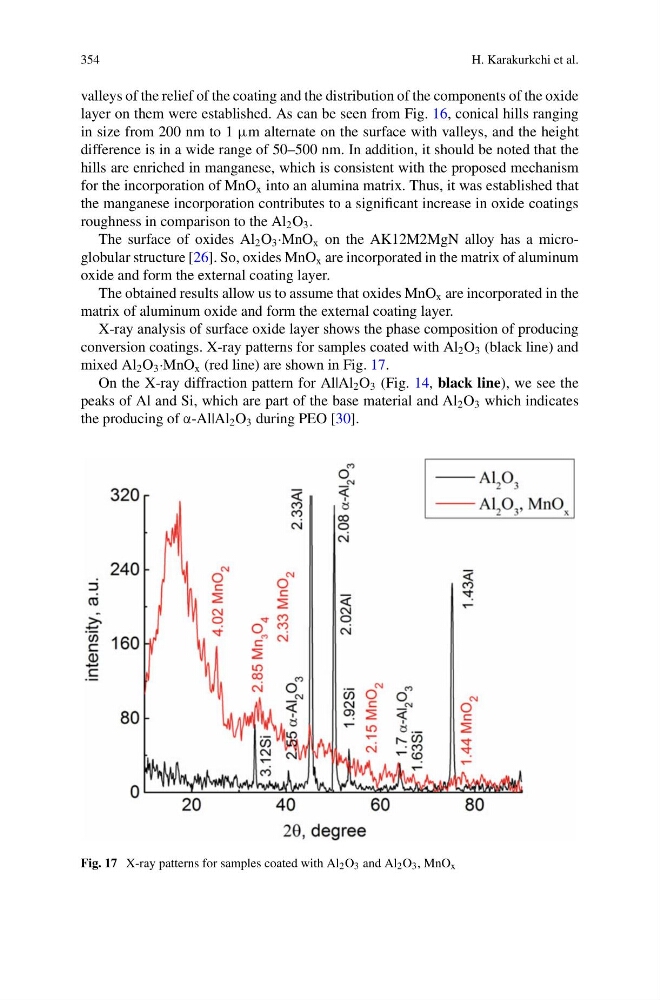
X-ray analysis of surface oxide layer shows the phase composition of producing
conversion coatings. X-ray patterns for samples coated with Al 2 O 3 (black line) and
mixed Al 2 O 3 ·MnO x (red line) are shown in Fig. 17.
On the X-ray diffraction pattern for Al|Al 2 O 3 (Fig. 14, black line), we see the
peaks of Al and Si, which are part of the base material and Al 2 O 3 which indicates
the producing of α-Al|Al 2 O 3 during PEO [30].
Fig. 17 X-ray patterns for samples coated with Al 2 O 3 and Al 2 O 3 , MnO x
H. Karakurkchi et al.
valleys of the relief of the coating and the distribution of the components of the oxide
layer on them were established. As can be seen from Fig. 16, conical hills ranging
in size from 200 nm to 1 μm alternate on the surface with valleys, and the height
difference is in a wide range of 50–500 nm. In addition, it should be noted that the
hills are enriched in manganese, which is consistent with the proposed mechanism
for the incorporation of MnO x into an alumina matrix. Thus, it was established that
the manganese incorporation contributes to a significant increase in oxide coatings
roughness in comparison to the Al 2 O 3 .
The surface of oxides Al 2 O 3 ·MnO x on the AK12M2MgN alloy has a microglobular structure [26]. So, oxides MnO x are incorporated in the matrix of aluminum
oxide and form the external coating layer.
The obtained results allow us to assume that oxides MnO x are incorporated in the
matrix of aluminum oxide and form the external coating layer.
X-ray analysis of surface oxide layer shows the phase composition of producing
conversion coatings. X-ray patterns for samples coated with Al 2 O 3 (black line) and
mixed Al 2 O 3 ·MnO x (red line) are shown in Fig. 17.
On the X-ray diffraction pattern for Al|Al 2 O 3 (Fig. 14, black line), we see the
peaks of Al and Si, which are part of the base material and Al 2 O 3 which indicates
the producing of α-Al|Al 2 O 3 during PEO [30].
Fig. 17 X-ray patterns for samples coated with Al 2 O 3 and Al 2 O 3 , MnO x