

352
H. Karakurkchi et al.
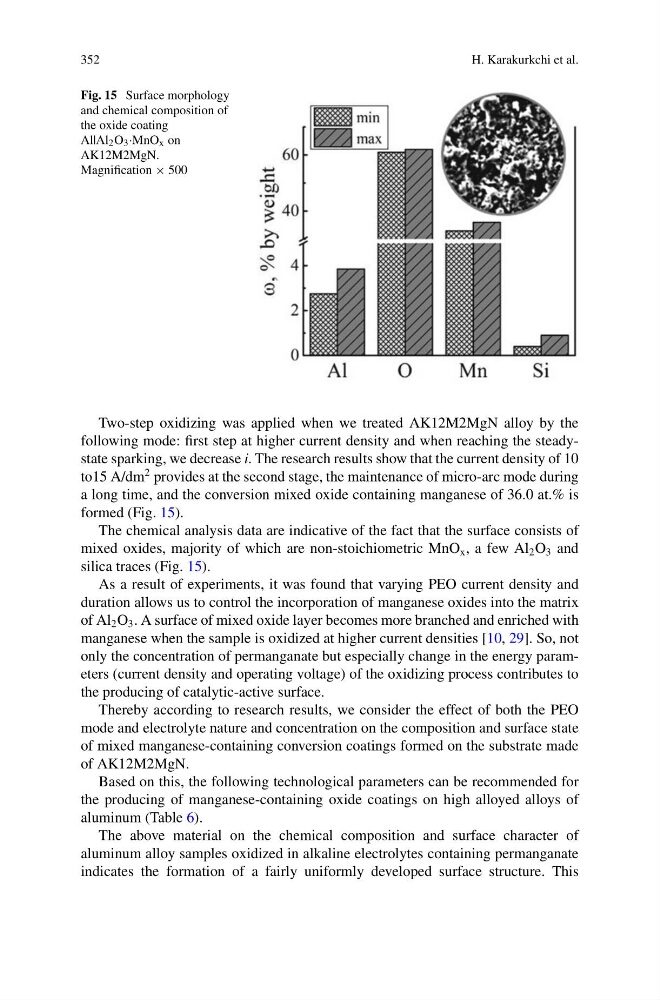
Fig. 15 Surface morphology
and chemical composition of
the oxide coating
Al|Al 2 O 3 ·MnO x on
AK12M2MgN.
Magnification × 500
Two-step oxidizing was applied when we treated AK12M2MgN alloy by the
following mode: first step at higher current density and when reaching the steadystate sparking, we decrease i. The research results show that the current density of 10
to15 A/dm
2 provides at the second stage, the maintenance of micro-arc mode during
a long time, and the conversion mixed oxide containing manganese of 36.0 at.% is
formed (Fig. 15).
The chemical analysis data are indicative of the fact that the surface consists of
mixed oxides, majority of which are non-stoichiometric MnO x , a few Al 2 O 3 and
silica traces (Fig. 15).
As a result of experiments, it was found that varying PEO current density and
duration allows us to control the incorporation of manganese oxides into the matrix
of Al 2 O 3 . A surface of mixed oxide layer becomes more branched and enriched with
manganese when the sample is oxidized at higher current densities [10, 29]. So, not
only the concentration of permanganate but especially change in the energy parameters (current density and operating voltage) of the oxidizing process contributes to
the producing of catalytic-active surface.
Thereby according to research results, we consider the effect of both the PEO
mode and electrolyte nature and concentration on the composition and surface state
of mixed manganese-containing conversion coatings formed on the substrate made
of AK12M2MgN.
Based on this, the following technological parameters can be recommended for
the producing of manganese-containing oxide coatings on high alloyed alloys of
aluminum (Table 6).
The above material on the chemical composition and surface character of
aluminum alloy samples oxidized in alkaline electrolytes containing permanganate
indicates the formation of a fairly uniformly developed surface structure. This
H. Karakurkchi et al.
Fig. 15 Surface morphology
and chemical composition of
the oxide coating
Al|Al 2 O 3 ·MnO x on
AK12M2MgN.
Magnification × 500
Two-step oxidizing was applied when we treated AK12M2MgN alloy by the
following mode: first step at higher current density and when reaching the steadystate sparking, we decrease i. The research results show that the current density of 10
to15 A/dm
2 provides at the second stage, the maintenance of micro-arc mode during
a long time, and the conversion mixed oxide containing manganese of 36.0 at.% is
formed (Fig. 15).
The chemical analysis data are indicative of the fact that the surface consists of
mixed oxides, majority of which are non-stoichiometric MnO x , a few Al 2 O 3 and
silica traces (Fig. 15).
As a result of experiments, it was found that varying PEO current density and
duration allows us to control the incorporation of manganese oxides into the matrix
of Al 2 O 3 . A surface of mixed oxide layer becomes more branched and enriched with
manganese when the sample is oxidized at higher current densities [10, 29]. So, not
only the concentration of permanganate but especially change in the energy parameters (current density and operating voltage) of the oxidizing process contributes to
the producing of catalytic-active surface.
Thereby according to research results, we consider the effect of both the PEO
mode and electrolyte nature and concentration on the composition and surface state
of mixed manganese-containing conversion coatings formed on the substrate made
of AK12M2MgN.
Based on this, the following technological parameters can be recommended for
the producing of manganese-containing oxide coatings on high alloyed alloys of
aluminum (Table 6).
The above material on the chemical composition and surface character of
aluminum alloy samples oxidized in alkaline electrolytes containing permanganate
indicates the formation of a fairly uniformly developed surface structure. This