

Formation of Manganese-Containing PEO Coatings on Aluminum Alloys
349
3 Mixed Oxide Coatings on Aluminum Alloys
As previously shown, it is possible to irreversibly oxidize aluminum alloys in an
alkaline environment. The products of oxidation are mainly aluminates and hydroxycomplexes of different compositions Al(OH)
3−x
x . Upon reaching the passivation
potential, a film of phase aluminum oxides is formed on the surface, the perfection
of which depends on the alloy composition. There is some contradiction associated
with the fact that micro-alloying additives of copper and silicon contribute to the
hardening of aluminum alloys. And at the same time, they complicate the surface
treatment and violate the homogeneity of the oxide phase film. The formation of a
thick protective oxide film on the surface of such alloys becomes possible only at
high voltages [13].
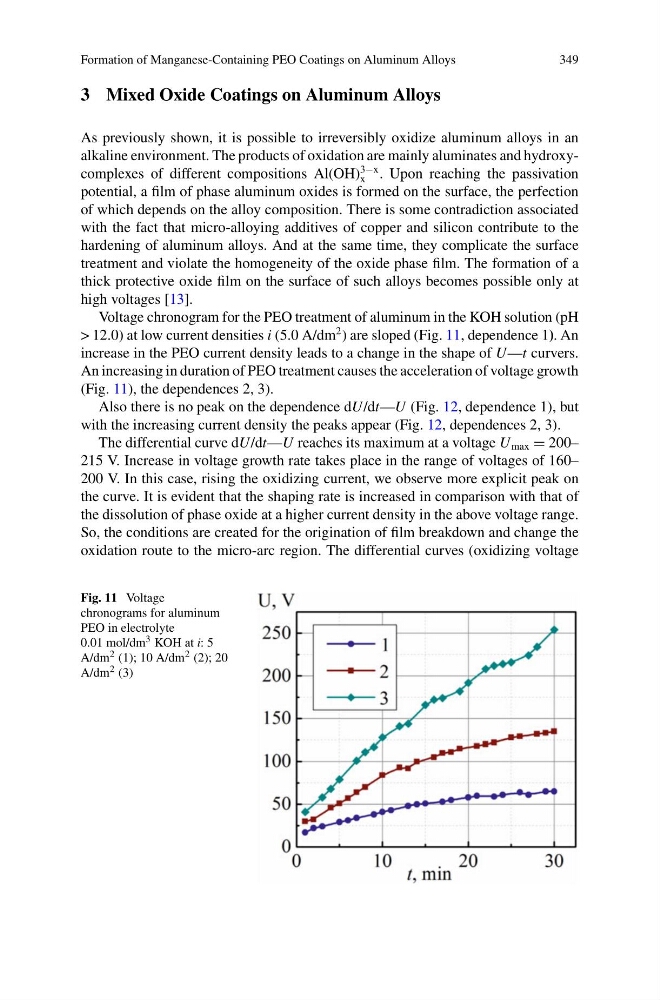
Voltage chronogram for the PEO treatment of aluminum in the KOH solution (pH
> 12.0) at low current densities i (5.0 A/dm
2 ) are sloped (Fig. 11, dependence 1). An
increase in the PEO current density leads to a change in the shape of U—t curvers.
An increasing in duration of PEO treatment causes the acceleration of voltage growth
(Fig. 11), the dependences 2, 3).
Also there is no peak on the dependence dU/dt—U (Fig. 12, dependence 1), but
with the increasing current density the peaks appear (Fig. 12, dependences 2, 3).
The differential curve dU/dt—U reaches its maximum at a voltage U max = 200–
215 V. Increase in voltage growth rate takes place in the range of voltages of 160–
200 V. In this case, rising the oxidizing current, we observe more explicit peak on
the curve. It is evident that the shaping rate is increased in comparison with that of
the dissolution of phase oxide at a higher current density in the above voltage range.
So, the conditions are created for the origination of film breakdown and change the
oxidation route to the micro-arc region. The differential curves (oxidizing voltage
Fig. 11 Voltage
chronograms for aluminum
PEO in electrolyte
0.01 mol/dm 3 KOH at i: 5
A/dm 2 (1); 10 A/dm 2 (2); 20
A/dm 2 (3)
349
3 Mixed Oxide Coatings on Aluminum Alloys
As previously shown, it is possible to irreversibly oxidize aluminum alloys in an
alkaline environment. The products of oxidation are mainly aluminates and hydroxycomplexes of different compositions Al(OH)
3−x
x . Upon reaching the passivation
potential, a film of phase aluminum oxides is formed on the surface, the perfection
of which depends on the alloy composition. There is some contradiction associated
with the fact that micro-alloying additives of copper and silicon contribute to the
hardening of aluminum alloys. And at the same time, they complicate the surface
treatment and violate the homogeneity of the oxide phase film. The formation of a
thick protective oxide film on the surface of such alloys becomes possible only at
high voltages [13].
Voltage chronogram for the PEO treatment of aluminum in the KOH solution (pH
> 12.0) at low current densities i (5.0 A/dm
2 ) are sloped (Fig. 11, dependence 1). An
increase in the PEO current density leads to a change in the shape of U—t curvers.
An increasing in duration of PEO treatment causes the acceleration of voltage growth
(Fig. 11), the dependences 2, 3).
Also there is no peak on the dependence dU/dt—U (Fig. 12, dependence 1), but
with the increasing current density the peaks appear (Fig. 12, dependences 2, 3).
The differential curve dU/dt—U reaches its maximum at a voltage U max = 200–
215 V. Increase in voltage growth rate takes place in the range of voltages of 160–
200 V. In this case, rising the oxidizing current, we observe more explicit peak on
the curve. It is evident that the shaping rate is increased in comparison with that of
the dissolution of phase oxide at a higher current density in the above voltage range.
So, the conditions are created for the origination of film breakdown and change the
oxidation route to the micro-arc region. The differential curves (oxidizing voltage
Fig. 11 Voltage
chronograms for aluminum
PEO in electrolyte
0.01 mol/dm 3 KOH at i: 5
A/dm 2 (1); 10 A/dm 2 (2); 20
A/dm 2 (3)