

298
L. V. Shmeleva et al.
ρ s (n · v s )
H s +
v
(ζ )
s
2
2
+ ϕ 0
+ L d
n · q s
− Lλ s (n · gradT ) s = 0.
(13)
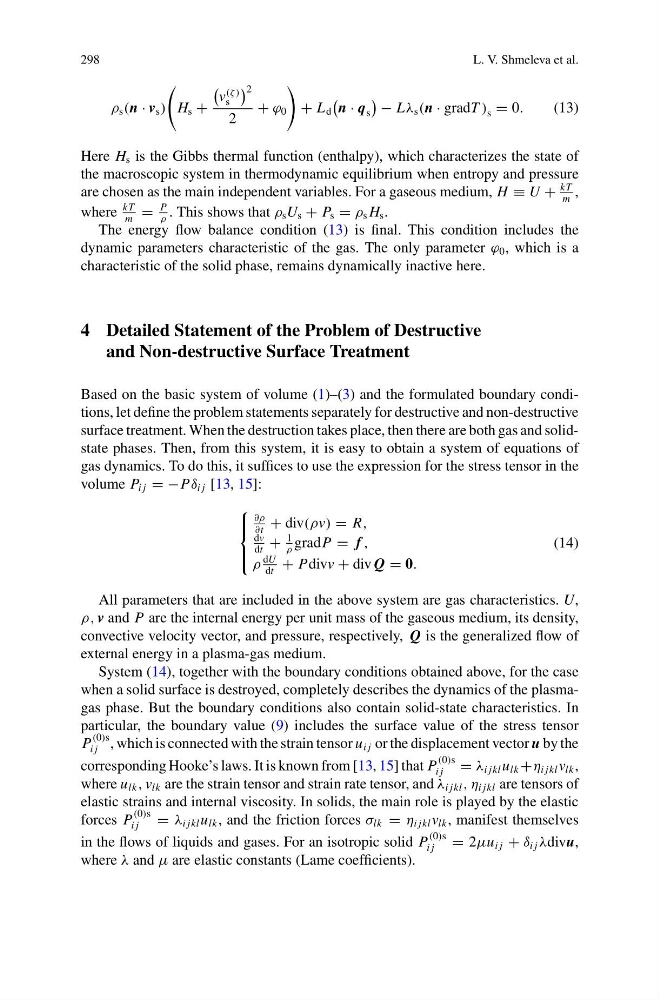
Here H s is the Gibbs thermal function (enthalpy), which characterizes the state of
the macroscopic system in thermodynamic equilibrium when entropy and pressure
are chosen as the main independent variables. For a gaseous medium, H ≡ U +
kT
m
,
where
kT
m
=
P
ρ
. This shows that ρ s U s + P s = ρ s H s .
The energy flow balance condition (13) is final. This condition includes the
dynamic parameters characteristic of the gas. The only parameter ϕ 0 , which is a
characteristic of the solid phase, remains dynamically inactive here.
4 Detailed Statement of the Problem of Destructive
and Non-destructive Surface Treatment
Based on the basic system of volume (1)–(3) and the formulated boundary conditions, let define the problem statements separately for destructive and non-destructive
surface treatment. When the destruction takes place, then there are both gas and solidstate phases. Then, from this system, it is easy to obtain a system of equations of
gas dynamics. To do this, it suffices to use the expression for the stress tensor in the
volume P i j = −Pδ i j [13, 15]:
⎧
⎪ ⎨
⎪ ⎩
∂ρ
∂t
+ div(ρv) = R,
dv
dt
+
1
ρ
gradP = f ,
ρ
dU
dt
+ Pdivv + div Q = 0.
(14)
All parameters that are included in the above system are gas characteristics. U,
ρ, v and P are the internal energy per unit mass of the gaseous medium, its density,
convective velocity vector, and pressure, respectively, Q is the generalized flow of
external energy in a plasma-gas medium.
System (14), together with the boundary conditions obtained above, for the case
when a solid surface is destroyed, completely describes the dynamics of the plasmagas phase. But the boundary conditions also contain solid-state characteristics. In
particular, the boundary value (9) includes the surface value of the stress tensor
P
(0)s
i j , which is connected with the strain tensor u i j or the displacement vector u by the
corresponding Hooke’s laws. It is known from [13, 15] that P
(0)s
i j
= λ i jkl u lk +η i jkl v lk ,
where u lk , v lk are the strain tensor and strain rate tensor, and λ i jkl , η i jkl are tensors of
elastic strains and internal viscosity. In solids, the main role is played by the elastic
forces P
(0)s
i j
= λ i jkl u lk , and the friction forces σ lk = η i jkl v lk , manifest themselves
in the flows of liquids and gases. For an isotropic solid P
(0)s
i j
= 2μu i j + δ i j λdivu,
where λ and μ are elastic constants (Lame coefficients).
L. V. Shmeleva et al.
ρ s (n · v s )
H s +
v
(ζ )
s
2
2
+ ϕ 0
+ L d
n · q s
− Lλ s (n · gradT ) s = 0.
(13)
Here H s is the Gibbs thermal function (enthalpy), which characterizes the state of
the macroscopic system in thermodynamic equilibrium when entropy and pressure
are chosen as the main independent variables. For a gaseous medium, H ≡ U +
kT
m
,
where
kT
m
=
P
ρ
. This shows that ρ s U s + P s = ρ s H s .
The energy flow balance condition (13) is final. This condition includes the
dynamic parameters characteristic of the gas. The only parameter ϕ 0 , which is a
characteristic of the solid phase, remains dynamically inactive here.
4 Detailed Statement of the Problem of Destructive
and Non-destructive Surface Treatment
Based on the basic system of volume (1)–(3) and the formulated boundary conditions, let define the problem statements separately for destructive and non-destructive
surface treatment. When the destruction takes place, then there are both gas and solidstate phases. Then, from this system, it is easy to obtain a system of equations of
gas dynamics. To do this, it suffices to use the expression for the stress tensor in the
volume P i j = −Pδ i j [13, 15]:
⎧
⎪ ⎨
⎪ ⎩
∂ρ
∂t
+ div(ρv) = R,
dv
dt
+
1
ρ
gradP = f ,
ρ
dU
dt
+ Pdivv + div Q = 0.
(14)
All parameters that are included in the above system are gas characteristics. U,
ρ, v and P are the internal energy per unit mass of the gaseous medium, its density,
convective velocity vector, and pressure, respectively, Q is the generalized flow of
external energy in a plasma-gas medium.
System (14), together with the boundary conditions obtained above, for the case
when a solid surface is destroyed, completely describes the dynamics of the plasmagas phase. But the boundary conditions also contain solid-state characteristics. In
particular, the boundary value (9) includes the surface value of the stress tensor
P
(0)s
i j , which is connected with the strain tensor u i j or the displacement vector u by the
corresponding Hooke’s laws. It is known from [13, 15] that P
(0)s
i j
= λ i jkl u lk +η i jkl v lk ,
where u lk , v lk are the strain tensor and strain rate tensor, and λ i jkl , η i jkl are tensors of
elastic strains and internal viscosity. In solids, the main role is played by the elastic
forces P
(0)s
i j
= λ i jkl u lk , and the friction forces σ lk = η i jkl v lk , manifest themselves
in the flows of liquids and gases. For an isotropic solid P
(0)s
i j
= 2μu i j + δ i j λdivu,
where λ and μ are elastic constants (Lame coefficients).