

290
L. V. Shmeleva et al.
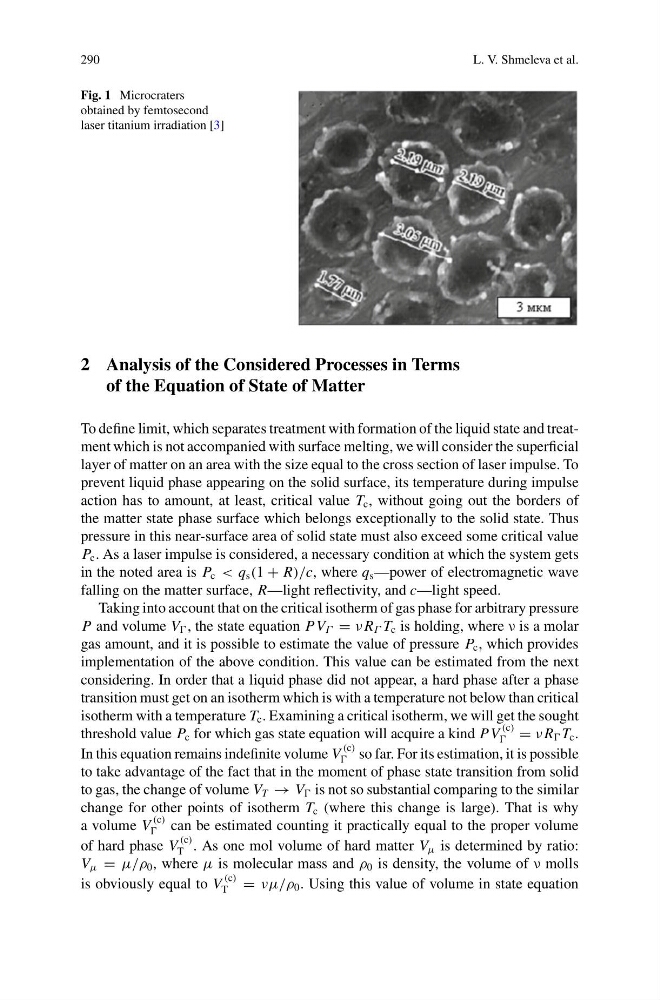
Fig. 1 Microcraters
obtained by femtosecond
laser titanium irradiation [3]
2 Analysis of the Considered Processes in Terms
of the Equation of State of Matter
To define limit, which separates treatment with formation of the liquid state and treatment which is not accompanied with surface melting, we will consider the superficial
layer of matter on an area with the size equal to the cross section of laser impulse. To
prevent liquid phase appearing on the solid surface, its temperature during impulse
action has to amount, at least, critical value T c , without going out the borders of
the matter state phase surface which belongs exceptionally to the solid state. Thus
pressure in this near-surface area of solid state must also exceed some critical value
P c . As a laser impulse is considered, a necessary condition at which the system gets
in the noted area is P c < q s (1 + R)/c, where q s —power of electromagnetic wave
falling on the matter surface, R—light reflectivity, and c—light speed.
Taking into account that on the critical isotherm of gas phase for arbitrary pressure
P and volume V , the state equation PV Γ = ν R Γ T c is holding, where ν is a molar
gas amount, and it is possible to estimate the value of pressure P c , which provides
implementation of the above condition. This value can be estimated from the next
considering. In order that a liquid phase did not appear, a hard phase after a phase
transition must get on an isotherm which is with a temperature not below than critical
isotherm with a temperature T c . Examining a critical isotherm, we will get the sought
threshold value P c for which gas state equation will acquire a kind PV
(c)
= ν R T c .
In this equation remains indefinite volume V
(c)
so far. For its estimation, it is possible
to take advantage of the fact that in the moment of phase state transition from solid
to gas, the change of volume V T → V is not so substantial comparing to the similar
change for other points of isotherm T c (where this change is large). That is why
a volume V
(c)
can be estimated counting it practically equal to the proper volume
of hard phase V
(c)
T . As one mol volume of hard matter V μ is determined by ratio:
V μ = μ/ρ 0 , where μ is molecular mass and ρ 0 is density, the volume of ν molls
is obviously equal to V
(c)
T = νμ/ρ 0 . Using this value of volume in state equation
L. V. Shmeleva et al.
Fig. 1 Microcraters
obtained by femtosecond
laser titanium irradiation [3]
2 Analysis of the Considered Processes in Terms
of the Equation of State of Matter
To define limit, which separates treatment with formation of the liquid state and treatment which is not accompanied with surface melting, we will consider the superficial
layer of matter on an area with the size equal to the cross section of laser impulse. To
prevent liquid phase appearing on the solid surface, its temperature during impulse
action has to amount, at least, critical value T c , without going out the borders of
the matter state phase surface which belongs exceptionally to the solid state. Thus
pressure in this near-surface area of solid state must also exceed some critical value
P c . As a laser impulse is considered, a necessary condition at which the system gets
in the noted area is P c < q s (1 + R)/c, where q s —power of electromagnetic wave
falling on the matter surface, R—light reflectivity, and c—light speed.
Taking into account that on the critical isotherm of gas phase for arbitrary pressure
P and volume V , the state equation PV Γ = ν R Γ T c is holding, where ν is a molar
gas amount, and it is possible to estimate the value of pressure P c , which provides
implementation of the above condition. This value can be estimated from the next
considering. In order that a liquid phase did not appear, a hard phase after a phase
transition must get on an isotherm which is with a temperature not below than critical
isotherm with a temperature T c . Examining a critical isotherm, we will get the sought
threshold value P c for which gas state equation will acquire a kind PV
(c)
= ν R T c .
In this equation remains indefinite volume V
(c)
so far. For its estimation, it is possible
to take advantage of the fact that in the moment of phase state transition from solid
to gas, the change of volume V T → V is not so substantial comparing to the similar
change for other points of isotherm T c (where this change is large). That is why
a volume V
(c)
can be estimated counting it practically equal to the proper volume
of hard phase V
(c)
T . As one mol volume of hard matter V μ is determined by ratio:
V μ = μ/ρ 0 , where μ is molecular mass and ρ 0 is density, the volume of ν molls
is obviously equal to V
(c)
T = νμ/ρ 0 . Using this value of volume in state equation