

266
L. Yu. Matzui et al.
source graphite components, synthesis conditions, structure and phase composition
of obtained materials is one of the tasks of our investigations.
2 Creation of the Physical Model of Metal Oxide
Formation on the Surface of Graphite Materials
The reaction of thermolysis of the metal salt (which is preliminarily deposited from
solution on the graphite surface) is the basis of metal oxide formation on the graphite
surface. Iron, nickel, and cobalt nitrates and acetates were used in our investigation
in order to impregnate graphite material. The solid-phase reactions of thermolysis in
a generalized form for these salts may be presented as
A SOLID
T
−→B SOLID + C GASEOUS ,
(1)
where A is the metal salt (crystalline hydrate), B is the crystalline metal oxide, and
C is the gaseous-like products of the reaction of thermolysis.
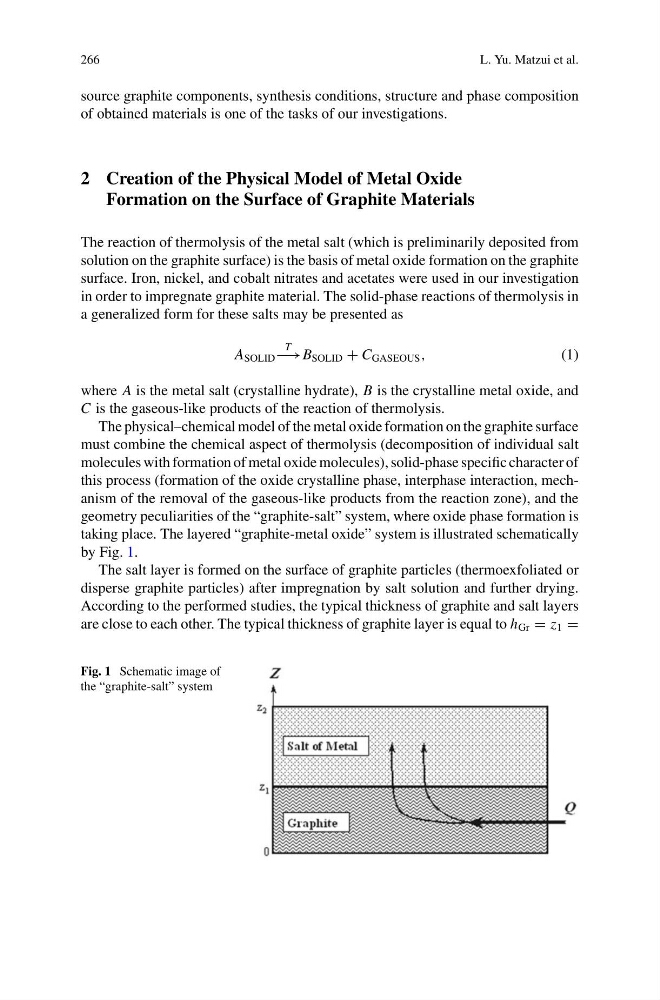
The physical–chemical model of the metal oxide formation on the graphite surface
must combine the chemical aspect of thermolysis (decomposition of individual salt
molecules with formation of metal oxide molecules), solid-phase specific character of
this process (formation of the oxide crystalline phase, interphase interaction, mechanism of the removal of the gaseous-like products from the reaction zone), and the
geometry peculiarities of the “graphite-salt” system, where oxide phase formation is
taking place. The layered “graphite-metal oxide” system is illustrated schematically
by Fig. 1.
The salt layer is formed on the surface of graphite particles (thermoexfoliated or
disperse graphite particles) after impregnation by salt solution and further drying.
According to the performed studies, the typical thickness of graphite and salt layers
are close to each other. The typical thickness of graphite layer is equal to h Gr = z 1 =
Fig. 1 Schematic image of
the “graphite-salt” system
L. Yu. Matzui et al.
source graphite components, synthesis conditions, structure and phase composition
of obtained materials is one of the tasks of our investigations.
2 Creation of the Physical Model of Metal Oxide
Formation on the Surface of Graphite Materials
The reaction of thermolysis of the metal salt (which is preliminarily deposited from
solution on the graphite surface) is the basis of metal oxide formation on the graphite
surface. Iron, nickel, and cobalt nitrates and acetates were used in our investigation
in order to impregnate graphite material. The solid-phase reactions of thermolysis in
a generalized form for these salts may be presented as
A SOLID
T
−→B SOLID + C GASEOUS ,
(1)
where A is the metal salt (crystalline hydrate), B is the crystalline metal oxide, and
C is the gaseous-like products of the reaction of thermolysis.
The physical–chemical model of the metal oxide formation on the graphite surface
must combine the chemical aspect of thermolysis (decomposition of individual salt
molecules with formation of metal oxide molecules), solid-phase specific character of
this process (formation of the oxide crystalline phase, interphase interaction, mechanism of the removal of the gaseous-like products from the reaction zone), and the
geometry peculiarities of the “graphite-salt” system, where oxide phase formation is
taking place. The layered “graphite-metal oxide” system is illustrated schematically
by Fig. 1.
The salt layer is formed on the surface of graphite particles (thermoexfoliated or
disperse graphite particles) after impregnation by salt solution and further drying.
According to the performed studies, the typical thickness of graphite and salt layers
are close to each other. The typical thickness of graphite layer is equal to h Gr = z 1 =
Fig. 1 Schematic image of
the “graphite-salt” system