

248
I. M. Dmitruk et al.
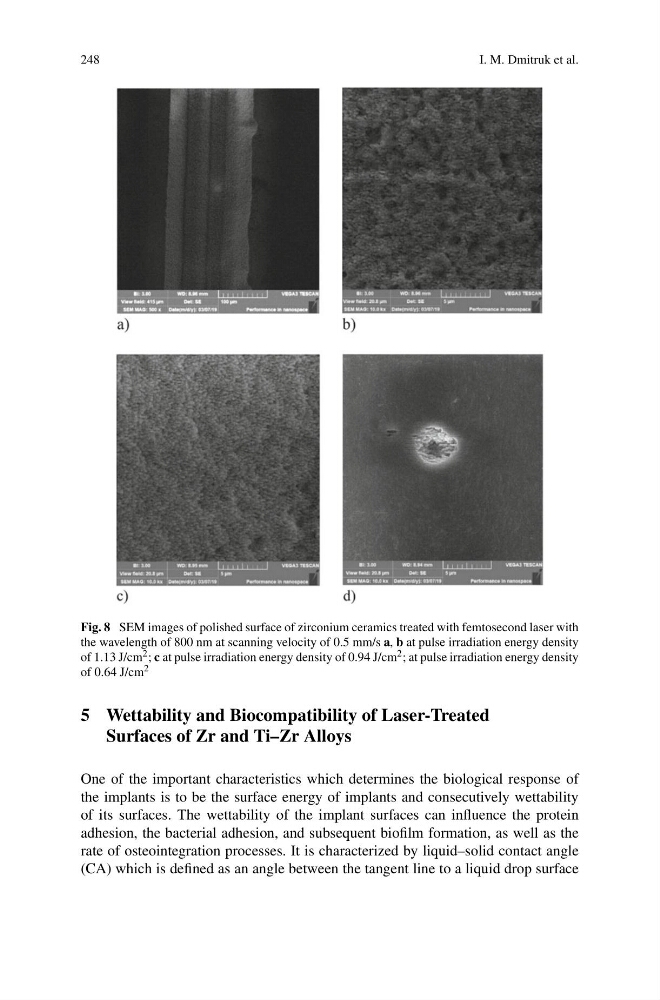
Fig. 8 SEM images of polished surface of zirconium ceramics treated with femtosecond laser with
the wavelength of 800 nm at scanning velocity of 0.5 mm/s a, b at pulse irradiation energy density
of 1.13 J/cm 2 ; c at pulse irradiation energy density of 0.94 J/cm 2 ; at pulse irradiation energy density
of 0.64 J/cm 2
5 Wettability and Biocompatibility of Laser-Treated
Surfaces of Zr and Ti–Zr Alloys
One of the important characteristics which determines the biological response of
the implants is to be the surface energy of implants and consecutively wettability
of its surfaces. The wettability of the implant surfaces can influence the protein
adhesion, the bacterial adhesion, and subsequent biofilm formation, as well as the
rate of osteointegration processes. It is characterized by liquid–solid contact angle
(CA) which is defined as an angle between the tangent line to a liquid drop surface
I. M. Dmitruk et al.
Fig. 8 SEM images of polished surface of zirconium ceramics treated with femtosecond laser with
the wavelength of 800 nm at scanning velocity of 0.5 mm/s a, b at pulse irradiation energy density
of 1.13 J/cm 2 ; c at pulse irradiation energy density of 0.94 J/cm 2 ; at pulse irradiation energy density
of 0.64 J/cm 2
5 Wettability and Biocompatibility of Laser-Treated
Surfaces of Zr and Ti–Zr Alloys
One of the important characteristics which determines the biological response of
the implants is to be the surface energy of implants and consecutively wettability
of its surfaces. The wettability of the implant surfaces can influence the protein
adhesion, the bacterial adhesion, and subsequent biofilm formation, as well as the
rate of osteointegration processes. It is characterized by liquid–solid contact angle
(CA) which is defined as an angle between the tangent line to a liquid drop surface