

224
Y. Kharchenko et al.
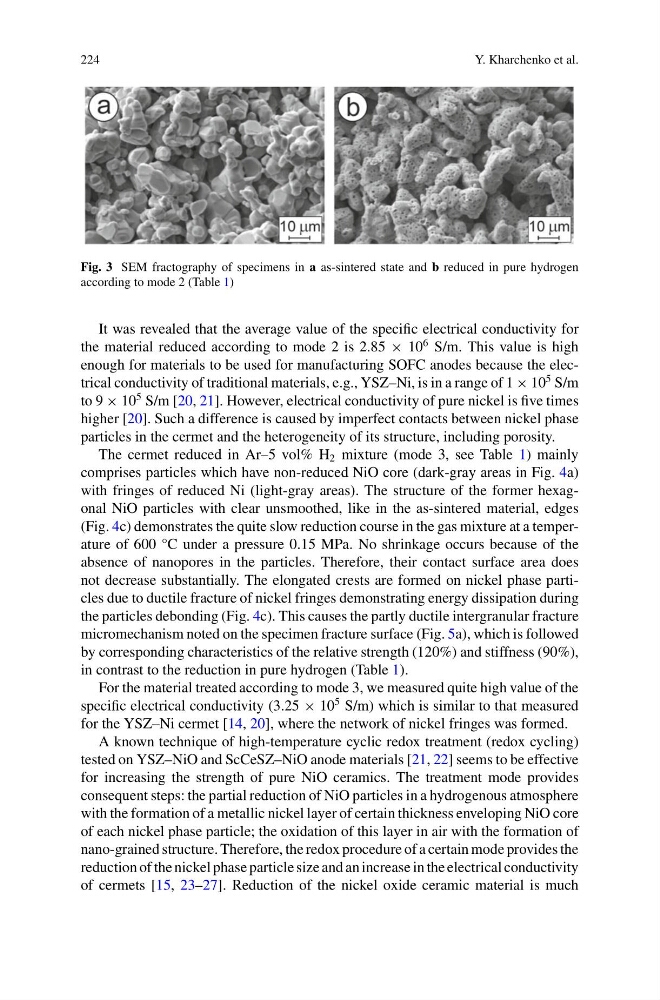
Fig. 3 SEM fractography of specimens in a as-sintered state and b reduced in pure hydrogen
according to mode 2 (Table 1)
It was revealed that the average value of the specific electrical conductivity for
the material reduced according to mode 2 is 2.85 × 10
6 S/m. This value is high
enough for materials to be used for manufacturing SOFC anodes because the electrical conductivity of traditional materials, e.g., YSZ–Ni, is in a range of 1 × 10
5 S/m
to 9 × 10
5 S/m [20, 21]. However, electrical conductivity of pure nickel is five times
higher [20]. Such a difference is caused by imperfect contacts between nickel phase
particles in the cermet and the heterogeneity of its structure, including porosity.
The cermet reduced in Ar–5 vol% H 2 mixture (mode 3, see Table 1) mainly
comprises particles which have non-reduced NiO core (dark-gray areas in Fig. 4a)
with fringes of reduced Ni (light-gray areas). The structure of the former hexagonal NiO particles with clear unsmoothed, like in the as-sintered material, edges
(Fig. 4c) demonstrates the quite slow reduction course in the gas mixture at a temperature of 600 °C under a pressure 0.15 MPa. No shrinkage occurs because of the
absence of nanopores in the particles. Therefore, their contact surface area does
not decrease substantially. The elongated crests are formed on nickel phase particles due to ductile fracture of nickel fringes demonstrating energy dissipation during
the particles debonding (Fig. 4c). This causes the partly ductile intergranular fracture
micromechanism noted on the specimen fracture surface (Fig. 5a), which is followed
by corresponding characteristics of the relative strength (120%) and stiffness (90%),
in contrast to the reduction in pure hydrogen (Table 1).
For the material treated according to mode 3, we measured quite high value of the
specific electrical conductivity (3.25 × 10
5 S/m) which is similar to that measured
for the YSZ–Ni cermet [14, 20], where the network of nickel fringes was formed.
A known technique of high-temperature cyclic redox treatment (redox cycling)
tested on YSZ–NiO and ScCeSZ–NiO anode materials [21, 22] seems to be effective
for increasing the strength of pure NiO ceramics. The treatment mode provides
consequent steps: the partial reduction of NiO particles in a hydrogenous atmosphere
with the formation of a metallic nickel layer of certain thickness enveloping NiO core
of each nickel phase particle; the oxidation of this layer in air with the formation of
nano-grained structure. Therefore, the redox procedure of a certain mode provides the
reduction of the nickel phase particle size and an increase in the electrical conductivity
of cermets [15, 23–27]. Reduction of the nickel oxide ceramic material is much
Y. Kharchenko et al.
Fig. 3 SEM fractography of specimens in a as-sintered state and b reduced in pure hydrogen
according to mode 2 (Table 1)
It was revealed that the average value of the specific electrical conductivity for
the material reduced according to mode 2 is 2.85 × 10
6 S/m. This value is high
enough for materials to be used for manufacturing SOFC anodes because the electrical conductivity of traditional materials, e.g., YSZ–Ni, is in a range of 1 × 10
5 S/m
to 9 × 10
5 S/m [20, 21]. However, electrical conductivity of pure nickel is five times
higher [20]. Such a difference is caused by imperfect contacts between nickel phase
particles in the cermet and the heterogeneity of its structure, including porosity.
The cermet reduced in Ar–5 vol% H 2 mixture (mode 3, see Table 1) mainly
comprises particles which have non-reduced NiO core (dark-gray areas in Fig. 4a)
with fringes of reduced Ni (light-gray areas). The structure of the former hexagonal NiO particles with clear unsmoothed, like in the as-sintered material, edges
(Fig. 4c) demonstrates the quite slow reduction course in the gas mixture at a temperature of 600 °C under a pressure 0.15 MPa. No shrinkage occurs because of the
absence of nanopores in the particles. Therefore, their contact surface area does
not decrease substantially. The elongated crests are formed on nickel phase particles due to ductile fracture of nickel fringes demonstrating energy dissipation during
the particles debonding (Fig. 4c). This causes the partly ductile intergranular fracture
micromechanism noted on the specimen fracture surface (Fig. 5a), which is followed
by corresponding characteristics of the relative strength (120%) and stiffness (90%),
in contrast to the reduction in pure hydrogen (Table 1).
For the material treated according to mode 3, we measured quite high value of the
specific electrical conductivity (3.25 × 10
5 S/m) which is similar to that measured
for the YSZ–Ni cermet [14, 20], where the network of nickel fringes was formed.
A known technique of high-temperature cyclic redox treatment (redox cycling)
tested on YSZ–NiO and ScCeSZ–NiO anode materials [21, 22] seems to be effective
for increasing the strength of pure NiO ceramics. The treatment mode provides
consequent steps: the partial reduction of NiO particles in a hydrogenous atmosphere
with the formation of a metallic nickel layer of certain thickness enveloping NiO core
of each nickel phase particle; the oxidation of this layer in air with the formation of
nano-grained structure. Therefore, the redox procedure of a certain mode provides the
reduction of the nickel phase particle size and an increase in the electrical conductivity
of cermets [15, 23–27]. Reduction of the nickel oxide ceramic material is much