

Thermodynamic Calculation of Vortex Granulator Operation …
209
– study of the microstructure of granules—microscope KONUSPIX-450X
KONUS, scanning electron microscope VEGA3 XM and X-ray spectrometer
with an energy dispersion.
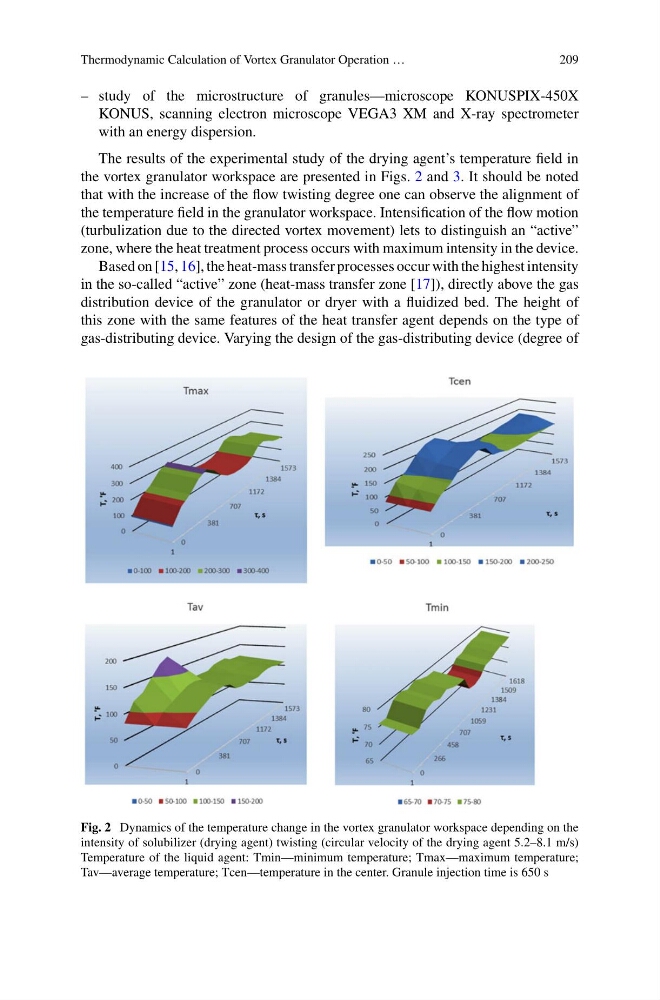
The results of the experimental study of the drying agent’s temperature field in
the vortex granulator workspace are presented in Figs. 2 and 3. It should be noted
that with the increase of the flow twisting degree one can observe the alignment of
the temperature field in the granulator workspace. Intensification of the flow motion
(turbulization due to the directed vortex movement) lets to distinguish an “active”
zone, where the heat treatment process occurs with maximum intensity in the device.
Based on [15, 16], the heat-mass transfer processes occur with the highest intensity
in the so-called “active” zone (heat-mass transfer zone [17]), directly above the gas
distribution device of the granulator or dryer with a fluidized bed. The height of
this zone with the same features of the heat transfer agent depends on the type of
gas-distributing device. Varying the design of the gas-distributing device (degree of
Fig. 2 Dynamics of the temperature change in the vortex granulator workspace depending on the
intensity of solubilizer (drying agent) twisting (circular velocity of the drying agent 5.2–8.1 m/s)
Temperature of the liquid agent: Tmin—minimum temperature; Tmax—maximum temperature;
Tav—average temperature; Tcen—temperature in the center. Granule injection time is 650 s
209
– study of the microstructure of granules—microscope KONUSPIX-450X
KONUS, scanning electron microscope VEGA3 XM and X-ray spectrometer
with an energy dispersion.
The results of the experimental study of the drying agent’s temperature field in
the vortex granulator workspace are presented in Figs. 2 and 3. It should be noted
that with the increase of the flow twisting degree one can observe the alignment of
the temperature field in the granulator workspace. Intensification of the flow motion
(turbulization due to the directed vortex movement) lets to distinguish an “active”
zone, where the heat treatment process occurs with maximum intensity in the device.
Based on [15, 16], the heat-mass transfer processes occur with the highest intensity
in the so-called “active” zone (heat-mass transfer zone [17]), directly above the gas
distribution device of the granulator or dryer with a fluidized bed. The height of
this zone with the same features of the heat transfer agent depends on the type of
gas-distributing device. Varying the design of the gas-distributing device (degree of
Fig. 2 Dynamics of the temperature change in the vortex granulator workspace depending on the
intensity of solubilizer (drying agent) twisting (circular velocity of the drying agent 5.2–8.1 m/s)
Temperature of the liquid agent: Tmin—minimum temperature; Tmax—maximum temperature;
Tav—average temperature; Tcen—temperature in the center. Granule injection time is 650 s