

198
S. V. Vasylyuk et al.
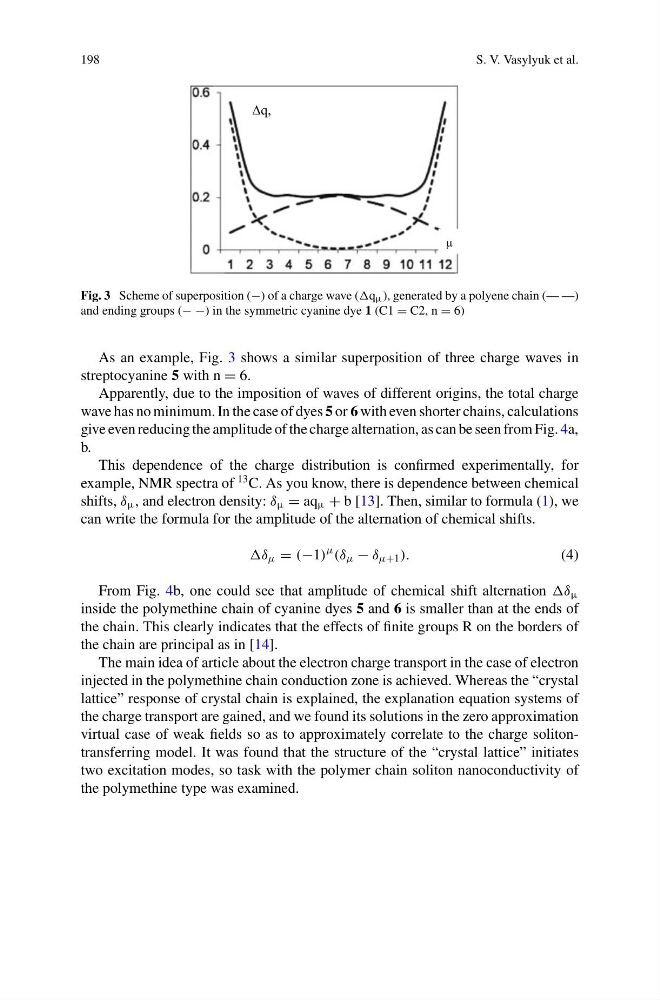
Fig. 3 Scheme of superposition (−) of a charge wave ( μ ), generated by a polyene chain (— —)
and ending groups (− −) in the symmetric cyanine dye 1 (C1 = C2, n = 6)
As an example, Fig. 3 shows a similar superposition of three charge waves in
streptocyanine 5 with n = 6.
Apparently, due to the imposition of waves of different origins, the total charge
wave has no minimum. In the case of dyes 5 or 6 with even shorter chains, calculations
give even reducing the amplitude of the charge alternation, as can be seen from Fig. 4a,
b.
This dependence of the charge distribution is confirmed experimentally, for
example, NMR spectra of
13 C. As you know, there is dependence between chemical
shifts, δ μ , and electron density: δ μ = aq μ + b [13]. Then, similar to formula (1), we
can write the formula for the amplitude of the alternation of chemical shifts.
μ = (−1)
μ
(δ μ − δ μ+1 ).
(4)
From Fig. 4b, one could see that amplitude of chemical shift alternation μ
inside the polymethine chain of cyanine dyes 5 and 6 is smaller than at the ends of
the chain. This clearly indicates that the effects of finite groups R on the borders of
the chain are principal as in [14].
The main idea of article about the electron charge transport in the case of electron
injected in the polymethine chain conduction zone is achieved. Whereas the “crystal
lattice” response of crystal chain is explained, the explanation equation systems of
the charge transport are gained, and we found its solutions in the zero approximation
virtual case of weak fields so as to approximately correlate to the charge solitontransferring model. It was found that the structure of the “crystal lattice” initiates
two excitation modes, so task with the polymer chain soliton nanoconductivity of
the polymethine type was examined.
S. V. Vasylyuk et al.
Fig. 3 Scheme of superposition (−) of a charge wave ( μ ), generated by a polyene chain (— —)
and ending groups (− −) in the symmetric cyanine dye 1 (C1 = C2, n = 6)
As an example, Fig. 3 shows a similar superposition of three charge waves in
streptocyanine 5 with n = 6.
Apparently, due to the imposition of waves of different origins, the total charge
wave has no minimum. In the case of dyes 5 or 6 with even shorter chains, calculations
give even reducing the amplitude of the charge alternation, as can be seen from Fig. 4a,
b.
This dependence of the charge distribution is confirmed experimentally, for
example, NMR spectra of
13 C. As you know, there is dependence between chemical
shifts, δ μ , and electron density: δ μ = aq μ + b [13]. Then, similar to formula (1), we
can write the formula for the amplitude of the alternation of chemical shifts.
μ = (−1)
μ
(δ μ − δ μ+1 ).
(4)
From Fig. 4b, one could see that amplitude of chemical shift alternation μ
inside the polymethine chain of cyanine dyes 5 and 6 is smaller than at the ends of
the chain. This clearly indicates that the effects of finite groups R on the borders of
the chain are principal as in [14].
The main idea of article about the electron charge transport in the case of electron
injected in the polymethine chain conduction zone is achieved. Whereas the “crystal
lattice” response of crystal chain is explained, the explanation equation systems of
the charge transport are gained, and we found its solutions in the zero approximation
virtual case of weak fields so as to approximately correlate to the charge solitontransferring model. It was found that the structure of the “crystal lattice” initiates
two excitation modes, so task with the polymer chain soliton nanoconductivity of
the polymethine type was examined.