

Configuration of Charge Waves in Polymethine Linear Dye Systems
195
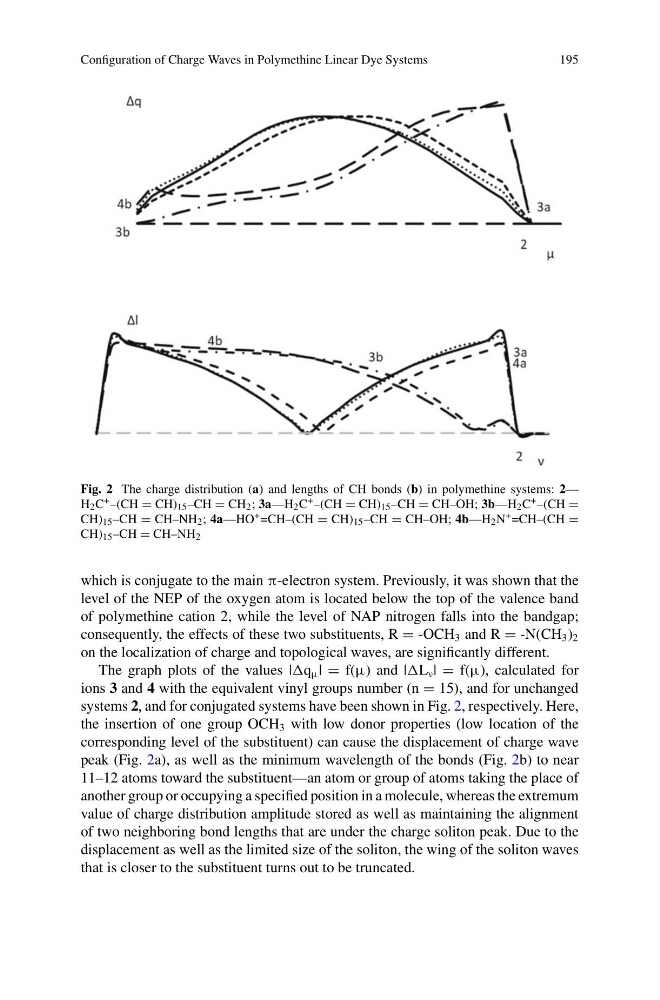
Fig. 2 The charge distribution (a) and lengths of CH bonds (b) in polymethine systems: 2—
H 2 C + –(CH = CH) 15 –CH = CH 2 ; 3a—H 2 C + –(CH = CH) 15 –CH = CH–OH; 3b—H 2 C + –(CH =
CH) 15 –CH = CH–NH 2 ; 4a—HO + =CH–(CH = CH) 15 –CH = CH–OH; 4b—H 2 N + =CH–(CH =
CH) 15 –CH = CH–NH 2
which is conjugate to the main π-electron system. Previously, it was shown that the
level of the NEP of the oxygen atom is located below the top of the valence band
of polymethine cation 2, while the level of NAP nitrogen falls into the bandgap;
consequently, the effects of these two substituents, R = -OCH 3 and R = -N(CH 3 ) 2
on the localization of charge and topological waves, are significantly different.
The graph plots of the values |q μ | = f(μ) and |L ν | = f(μ), calculated for
ions 3 and 4 with the equivalent vinyl groups number (n = 15), and for unchanged
systems 2, and for conjugated systems have been shown in Fig. 2, respectively. Here,
the insertion of one group OCH 3 with low donor properties (low location of the
corresponding level of the substituent) can cause the displacement of charge wave
peak (Fig. 2a), as well as the minimum wavelength of the bonds (Fig. 2b) to near
11–12 atoms toward the substituent—an atom or group of atoms taking the place of
another group or occupying a specified position in a molecule, whereas the extremum
value of charge distribution amplitude stored as well as maintaining the alignment
of two neighboring bond lengths that are under the charge soliton peak. Due to the
displacement as well as the limited size of the soliton, the wing of the soliton waves
that is closer to the substituent turns out to be truncated.
195
Fig. 2 The charge distribution (a) and lengths of CH bonds (b) in polymethine systems: 2—
H 2 C + –(CH = CH) 15 –CH = CH 2 ; 3a—H 2 C + –(CH = CH) 15 –CH = CH–OH; 3b—H 2 C + –(CH =
CH) 15 –CH = CH–NH 2 ; 4a—HO + =CH–(CH = CH) 15 –CH = CH–OH; 4b—H 2 N + =CH–(CH =
CH) 15 –CH = CH–NH 2
which is conjugate to the main π-electron system. Previously, it was shown that the
level of the NEP of the oxygen atom is located below the top of the valence band
of polymethine cation 2, while the level of NAP nitrogen falls into the bandgap;
consequently, the effects of these two substituents, R = -OCH 3 and R = -N(CH 3 ) 2
on the localization of charge and topological waves, are significantly different.
The graph plots of the values |q μ | = f(μ) and |L ν | = f(μ), calculated for
ions 3 and 4 with the equivalent vinyl groups number (n = 15), and for unchanged
systems 2, and for conjugated systems have been shown in Fig. 2, respectively. Here,
the insertion of one group OCH 3 with low donor properties (low location of the
corresponding level of the substituent) can cause the displacement of charge wave
peak (Fig. 2a), as well as the minimum wavelength of the bonds (Fig. 2b) to near
11–12 atoms toward the substituent—an atom or group of atoms taking the place of
another group or occupying a specified position in a molecule, whereas the extremum
value of charge distribution amplitude stored as well as maintaining the alignment
of two neighboring bond lengths that are under the charge soliton peak. Due to the
displacement as well as the limited size of the soliton, the wing of the soliton waves
that is closer to the substituent turns out to be truncated.